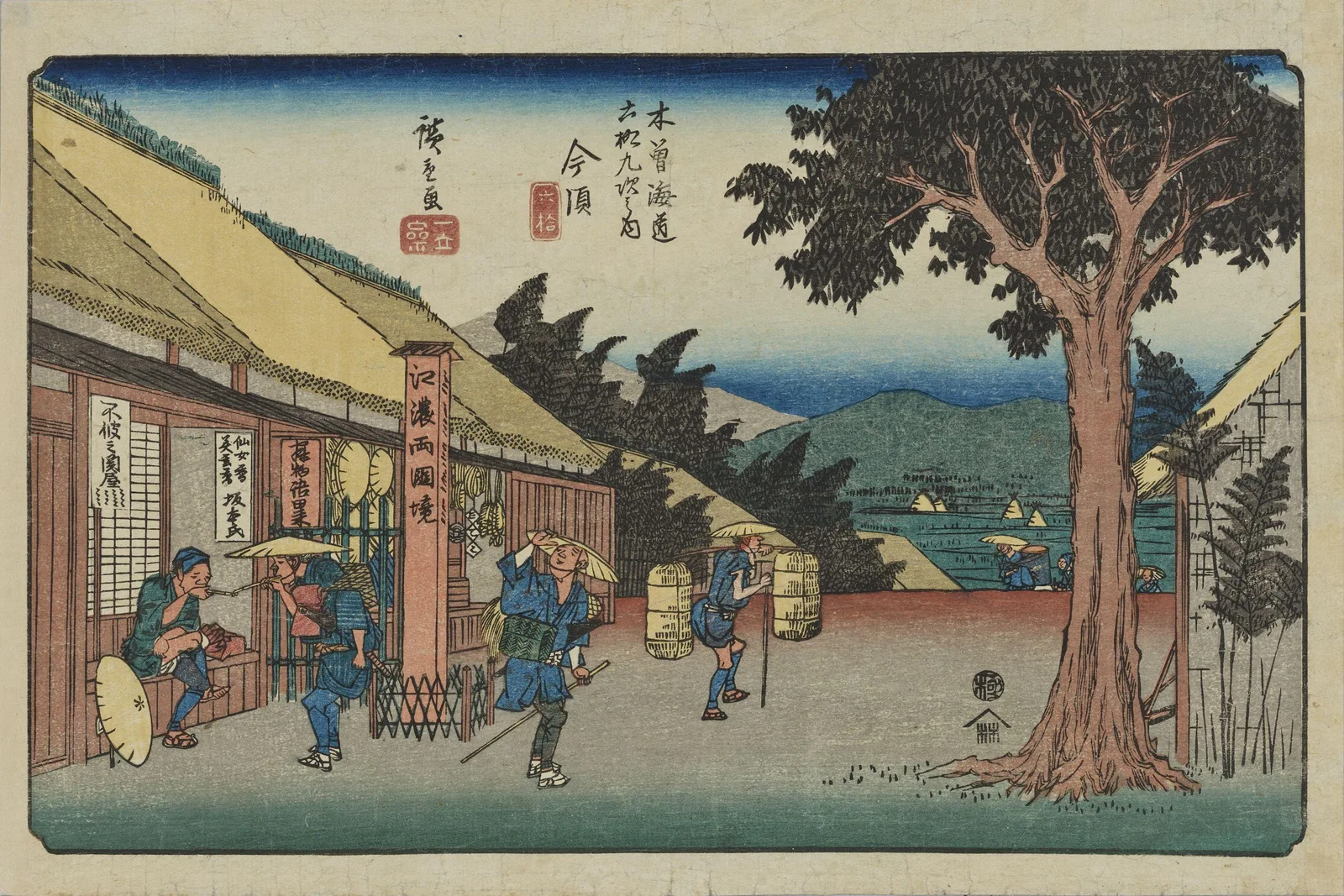
The Sixty-nine Stations of the Kisokaido ・ 60
Imasu
木曽海道六拾九次之内 今須
This shows the shops facing the highway at Imasu-juku, on the border of Mino and Omi. Travelers come and go beside a post inscribed "Border of the Two Provinces of Omi and Mino," with fields and mountains opening out beyond. The many signboards typical of a border post town are a highlight.
- Artist
- Utagawa Hiroshige
- Date
- c. 1835-38 (Tenpo 6-9)
- Medium / format
- Woodblock print (ukiyo-e)
- Series
- The Sixty-nine Stations of the Kisokaido 71 prints
- Place depicted
- Imasu-juku(Gifu)
About this work
On the left stand rows of thatched-roof shops, with signboards such as "Fuwa no Sekiya" hanging from their eaves. A vermilion post inscribed "Border of the Two Provinces of Omi and Mino" stands in front of the shops, and travelers carrying loads pass by. At right a large tree towers, and beyond it fields and distant mountains spread out.
The row of houses on the left stretches diagonally into the distance, and the large tree on the right tightens the composition. The lettering on the signboards is drawn in fine detail, and an advertisement for the cosmetic Senjoko can also be seen. Senjoko appears often in designs by Eisen and Hiroshige, and is thought to have served as advertising.
Imasu-juku was the westernmost post town in Mino Province, and just to the west lay the border with Omi Province. The border was only a narrow ditch, and it is said that guests at inns on either side could talk while lying in bed, which gave it the name "Village of Pillow Talk" (Nemonogatari no Sato).
This is a design by Hiroshige. By drawing the border post large, he shows that this is where travelers pass from Mino into Omi. The ten designs from the next station, Kashiwabara, to Otsu are all Omi post towns. It may also be that the change in a traveler's feelings on crossing the border was entrusted to a single post.
The place today
Imasu-juku corresponds to today's Imasu in Sekigahara-cho, Fuwa District, Gifu Prefecture, and the building of the Yamazaki family, who served as the post-station office, the milestone site, and Myoo-ji temple remain. At the prefectural border west of the town stands a monument to the "Village of Pillow Talk," which still marks the boundary between Mino and Omi. A row of maple trees also continues west of the town.
Where can I see it?
Exhibitions change over time. Check each museum's exhibition information before you visit.
Museums that hold this work
- Tokyo National MuseumMuseum's page for this work (opens in a new tab)
Taito City, Tokyo Accession no. A-12499-128
- National Diet LibraryMuseum's page for this work (opens in a new tab)
Chiyoda City, Tokyo Accession no. 寄別2-2-1-5
Included in Kisokaido Rokujukyu-tsugi
Museums abroad
Frequently asked questions
- Who painted The Sixty-nine Stations of the Kisokaido: Imasu, and when?
- The Sixty-nine Stations of the Kisokaido: Imasu is by Utagawa Hiroshige, made in c. 1835-38 (Tenpo 6-9). Medium: Woodblock print (ukiyo-e).
- What place does The Sixty-nine Stations of the Kisokaido: Imasu show?
- It shows Imasu-juku (Gifu).
- Where can I see The Sixty-nine Stations of the Kisokaido: Imasu?
- It is held by Tokyo National Museum, National Diet Library. Exhibitions change, so check each museum's information before you visit.
Sources and references
- ColBase(東京国立博物館): 木曽海道六拾九次之内 今須 (opens in a new tab) (checked 2026-10-19)
- 国立国会図書館デジタルコレクション: 六拾 木曽海道六拾九次之内今須 (opens in a new tab) (checked 2026-10-19)
- Wikipedia: 木曽海道六十九次 (opens in a new tab) (checked 2026-10-19)
You may also like
More from Gifu
Discover more of the same region on our sister sites.
Matsuri Biyori
Festivals in Gifu
- Takayama Festival Yatai Float Event
- Furukawa Festival Okoshi-daiko and Yatai Float Event
- Ogaki Festival Yama Float Event
- Gujo Odori