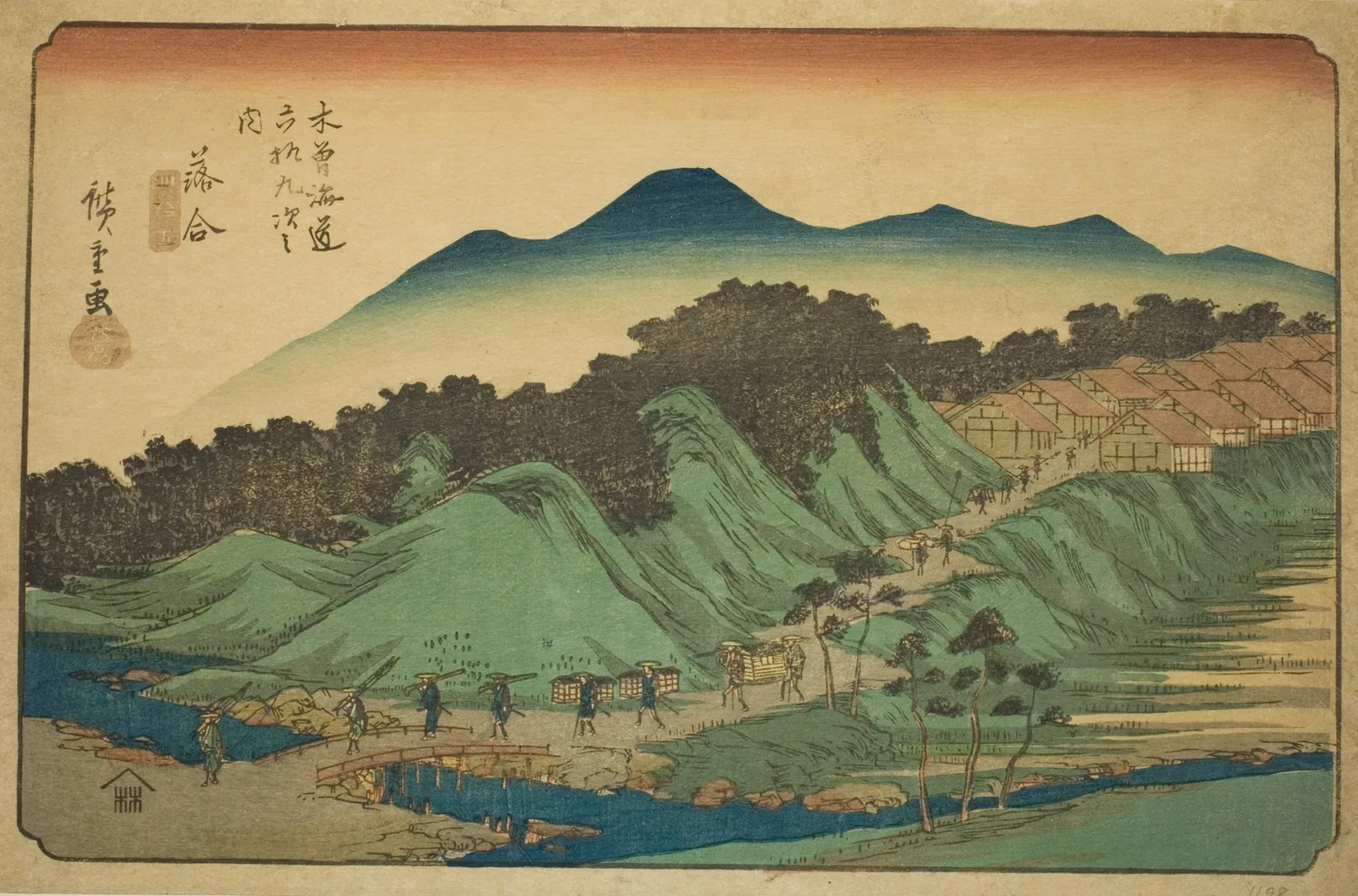
The Sixty-nine Stations of the Kisokaido ・ 45
Ochiai
木曽海道六拾九次之内 落合
A distant view of Ochiai, the first post town after entering Mino. A party that looks like a daimyo procession, having crossed a small bridge in the foreground, climbs the slope, and rows of the town's houses continue on the hill beyond. A great mountain rises behind.
- Artist
- Utagawa Hiroshige
- Date
- c. 1835-38 (Tenpo 6-9)
- Medium / format
- Woodblock print (ukiyo-e)
- Series
- The Sixty-nine Stations of the Kisokaido 71 prints
- Place depicted
- Ochiai-juku(Gifu)
About this work
Crossing an earthen bridge over the river in the foreground, a party carrying lacquered boxes and palanquins climbs the slope. On the high ground at right beyond the slope, tile-roofed houses stand in a row: this is the post town. Behind it spreads a blackish forest, and beyond that rises a large blue mountain.
The sky is red at the top and pale below, suggesting dusk. The indigo of the river in front, the green of the hill, and the blue of the distant mountain form layers, and the small figures of the procession give the picture rhythm. The houses at right are finely drawn, conveying the bustle of the post town even from afar.
Ochiai was the first post town of Mino after leaving the Kiso Road, where travelers who had descended the Magome Pass rested. Nearby flows the Ochiai River, a tributary of the Kiso River. One honjin and one waki-honjin were placed there, and it probably bustled with travelers preparing to cross the pass and with porters and horses carrying cargo.
This is by Hiroshige. The title does not name a mountain, and the picture, showing the post town with a large mountain behind it, is thought to indicate the entrance from the Kiso Road into Mino. The composition of drawing figures small to make the terrain of the post town look large seems to show the road ahead of the travelers.
The place today
A honjin building survives at Ochiai-juku, and in 2010 it was added to the national historic site "Nakasendo" as the only honjin building remaining in Gifu Prefecture. East of the post town lies the stone-paved road "Ochiai no Ishidatami," where one can walk the mountain section of the Nakasendo toward Magome-juku.
Where can I see it?
Exhibitions change over time. Check each museum's exhibition information before you visit.
Museums that hold this work
- Tokyo National MuseumMuseum's page for this work (opens in a new tab)
Taito City, Tokyo Accession no. A-12499-112
- National Diet LibraryMuseum's page for this work (opens in a new tab)
Chiyoda City, Tokyo Accession no. 寄別2-2-1-5
Included in Kisokaido Rokujukyu-tsugi
Museums abroad
- Art Institute of ChicagoMuseum's page for this work (opens in a new tab)
Chicago Accession no. 1925.3717
Frequently asked questions
- Who painted The Sixty-nine Stations of the Kisokaido: Ochiai, and when?
- The Sixty-nine Stations of the Kisokaido: Ochiai is by Utagawa Hiroshige, made in c. 1835-38 (Tenpo 6-9). Medium: Woodblock print (ukiyo-e).
- What place does The Sixty-nine Stations of the Kisokaido: Ochiai show?
- It shows Ochiai-juku (Gifu).
- Where can I see The Sixty-nine Stations of the Kisokaido: Ochiai?
- It is held by Tokyo National Museum, National Diet Library. Exhibitions change, so check each museum's information before you visit.
Sources and references
- Art Institute of Chicago: No. 45: Ochiai, from the series "Sixty-nine Stations of the Kisokaido (Kisokaido rokujukyu tsugi no uchi)" (opens in a new tab) (checked 2026-10-19)
- ColBase(東京国立博物館): 木曽海道六拾九次之内 落合 (opens in a new tab) (checked 2026-10-19)
- 国立国会図書館デジタルコレクション: 四拾五 木曽海道六拾九次之内落合 (opens in a new tab) (checked 2026-10-19)
- Wikipedia: 木曽海道六十九次 (opens in a new tab) (checked 2026-10-19)
You may also like
More from Gifu
Discover more of the same region on our sister sites.
Matsuri Biyori
Festivals in Gifu
- Takayama Festival Yatai Float Event
- Furukawa Festival Okoshi-daiko and Yatai Float Event
- Ogaki Festival Yama Float Event
- Gujo Odori