The Sixty-nine Stations of the Kisokaido ・ 56
Mieji
木曽海道六拾九次之内 みゑじ
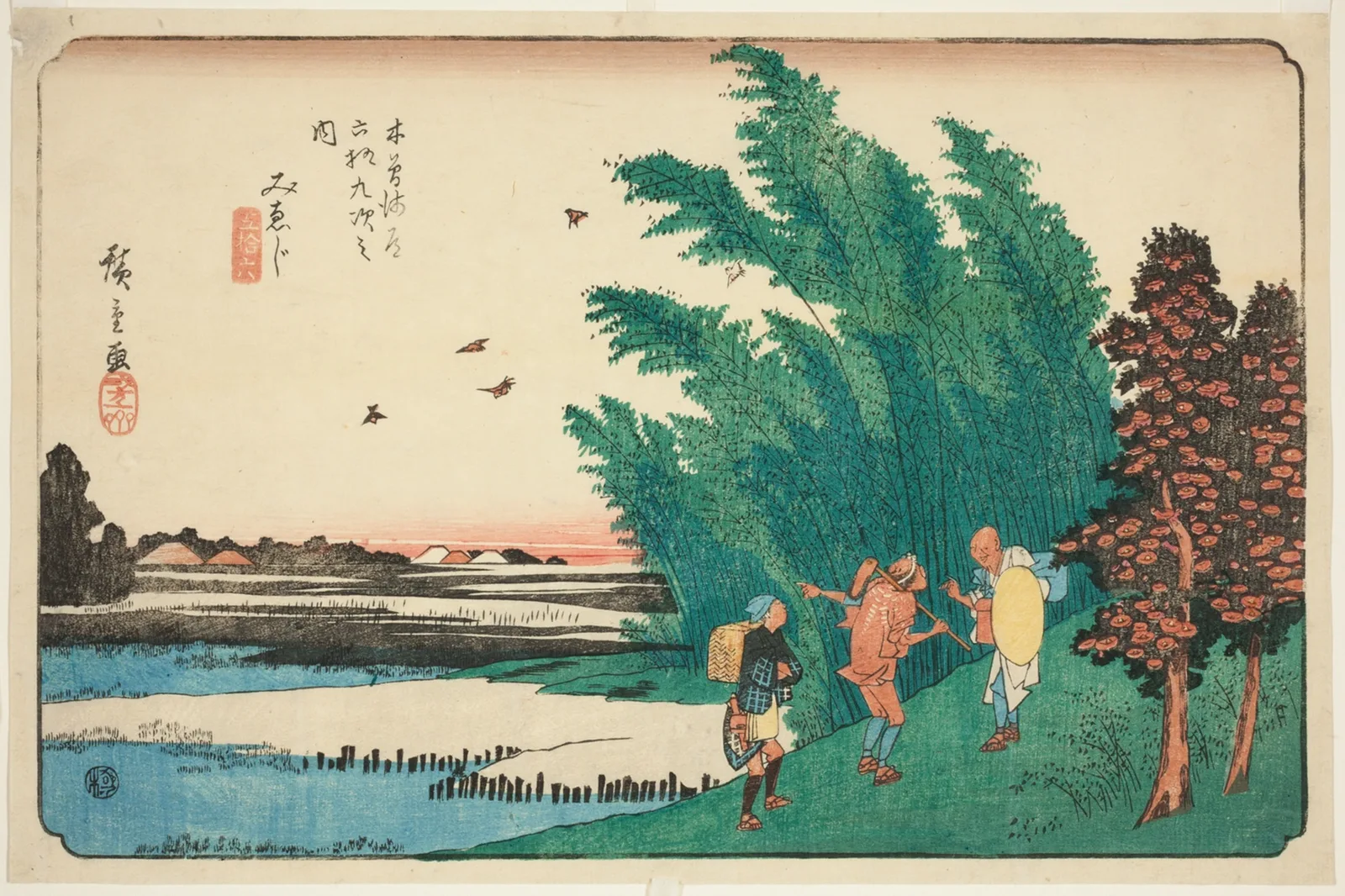
Under a sunset sky, a traveler passes a bamboo thicket bending in the wind on the outskirts of Mieji-juku. On the left, a river, its shallows, and distant houses spread out, conveying the calm of an evening in a peaceful waterside country.
- Artist
- Utagawa Hiroshige
- Date
- c. 1835-38 (Tenpo 6-9)
- Medium / format
- Woodblock print (ukiyo-e)
- Series
- The Sixty-nine Stations of the Kisokaido 71 prints
- Place depicted
- Mieji-juku(Gifu)
About this work
On the right, a large bamboo thicket leans in the wind, with a tree bearing red leaves beside it. On the sloping road, a man carrying a load and a traveler holding his hat seem to be talking. On the left, a river and shallows open out, and beyond a row of stakes you can see thatched-roof houses and the sunset sky.
The green bamboo takes up nearly half the picture, in strong contrast to the open waterside at left. The sky is printed vermilion at the bottom, fading lighter toward the top, and the silhouettes of birds in flight suggest the hour of dusk. The stakes lined up along the water are thought to have been for embankments or boat landings.
Mieji-juku was a post town in Ono District, Mino Province, and its name comes from Mieji temple, said to have been founded in the Nara period. The river shown is thought to be the Sai River, which flows south of the town. The area was low land troubled by flooding, and the settlement was built on the natural levee along the river.
This is a design by Hiroshige, and the station name in the title is written in kana as "Mieji." Hiroshige, who took over the series from Eisen, is thought to have drawn many scenes like this one, rich in mood of time and weather, once the road entered the Mino plain.
The place today
Mieji-juku corresponds to today's Mieji in Mizuho City, Gifu Prefecture, and a monument marking the site of the post town stands at Mie Shrine. The road is wide in front of the former honjin site, preserving a trace of the post town. Cherry trees line the nearby riverbank, and a cherry blossom festival is held every spring. A post town festival is also held in May.
Where can I see it?
Exhibitions change over time. Check each museum's exhibition information before you visit.
Museums that hold this work
- Tokyo National MuseumMuseum's page for this work (opens in a new tab)
Taito City, Tokyo Accession no. A-12499-124
- National Diet LibraryMuseum's page for this work (opens in a new tab)
Chiyoda City, Tokyo Accession no. 寄別2-2-1-5
Included in Kisokaido Rokujukyu-tsugi
Museums abroad
- Art Institute of ChicagoMuseum's page for this work (opens in a new tab)
Chicago Accession no. 1963.722
Frequently asked questions
- Who painted The Sixty-nine Stations of the Kisokaido: Mieji, and when?
- The Sixty-nine Stations of the Kisokaido: Mieji is by Utagawa Hiroshige, made in c. 1835-38 (Tenpo 6-9). Medium: Woodblock print (ukiyo-e).
- What place does The Sixty-nine Stations of the Kisokaido: Mieji show?
- It shows Mieji-juku (Gifu).
- Where can I see The Sixty-nine Stations of the Kisokaido: Mieji?
- It is held by Tokyo National Museum, National Diet Library. Exhibitions change, so check each museum's information before you visit.
Sources and references
- Art Institute of Chicago: No. 56: Mieji, from the series "Sixty-nine Stations of the Kisokaido (Kisokaido rokujukyu tsugi no uchi)" (opens in a new tab) (checked 2026-10-19)
- ColBase(東京国立博物館): 木曽海道六拾九次之内 みゑじ (opens in a new tab) (checked 2026-10-19)
- 国立国会図書館デジタルコレクション: 五拾六 木曽海道六拾九次之内みゑじ (opens in a new tab) (checked 2026-10-19)
You may also like
More from Gifu
Discover more of the same region on our sister sites.
Matsuri Biyori
Festivals in Gifu
- Takayama Festival Yatai Float Event
- Furukawa Festival Okoshi-daiko and Yatai Float Event
- Ogaki Festival Yama Float Event
- Gujo Odori