The Sixty-nine Stations of the Kisokaido ・ 55
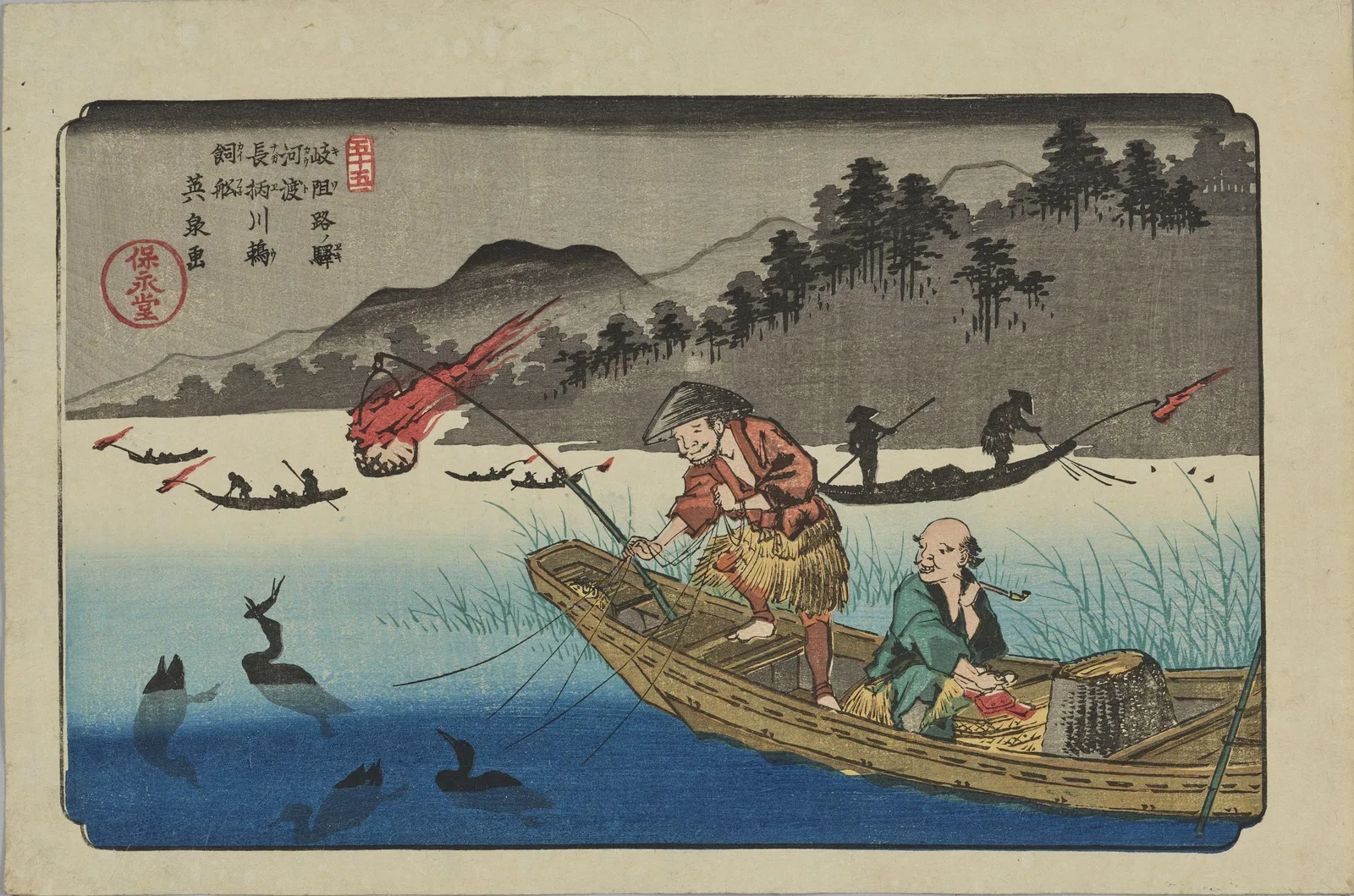
Cormorant Fishing Boats on the Nagara River at Godo Station
岐阻路ノ駅 河渡 長柄川鵜飼舩
Eisen shows cormorant fishing on the Nagara River against a riverside landscape sunk in gray. On boats lit by blazing cresset fires, the fishermen handle their cords while the cormorants chase fish in the water. The picture puts the river's specialty, not the post town itself, at center stage.
- Artist
- Keisai Eisen
- Date
- c. 1835-36 (Tenpo 6-7)
- Medium / format
- Woodblock print (ukiyo-e)
- Series
- The Sixty-nine Stations of the Kisokaido 71 prints
About this work
On the large boat in the foreground, a cormorant master in a straw waist cape leans out to work the cords, with a man holding a long pipe seated behind him. Diving cormorants show as dark shapes through the water. Several more boats carrying cresset fires float on the river beyond, and on the far bank a pine-covered hill and low mountains stretch along the horizon.
The sky and distant view are done in shades of gray, so that only the red of the fires, the brown of the boats, and the indigo of the river stand out. Painting even what lies beneath the surface to show the birds' movements is considered typical of Eisen's fine attention to detail. The boat is pushed to the lower right, drawing the eye across the river that opens out to the left.
Godo-juku was a small post town on the right bank of the Nagara River, and travelers coming from Kano-juku crossed the river at the Godo ferry. Nagara River cormorant fishing has long been famous, and in the Edo period it is said to have been under the protection of the Owari domain, which presented the sweetfish catch as tribute.
The title reads "Kiso Road Stations" (Kisoji no Eki), which is written differently from the "Kisokaido Sixty-nine Stations" used in Hiroshige's designs. This is the westernmost station among Eisen's designs; every station farther toward Kyoto was handled by Hiroshige. Beside the title is the signature "Eisen ga."
The place today
Godo-juku corresponds to today's Godo in Gifu City, and was a short post town about 330 meters long. The ferry ended when the Godo Bridge was built in 1881, and a monument marking the site of the milestone mound remains at Matsushita Shrine. Nagara River cormorant fishing is still held every year from May to October as a summer tradition of Gifu City.
Where can I see it?
Exhibitions change over time. Check each museum's exhibition information before you visit.
Museums that hold this work
- Tokyo National MuseumMuseum's page for this work (opens in a new tab)
Taito City, Tokyo Accession no. A-12499-123
- National Diet LibraryMuseum's page for this work (opens in a new tab)
Chiyoda City, Tokyo Accession no. 寄別2-2-1-5
Included in Kisokaido Rokujukyu-tsugi
Museums abroad
Frequently asked questions
- Who painted The Sixty-nine Stations of the Kisokaido: Cormorant Fishing Boats on the Nagara River at Godo Station, and when?
- The Sixty-nine Stations of the Kisokaido: Cormorant Fishing Boats on the Nagara River at Godo Station is by Keisai Eisen, made in c. 1835-36 (Tenpo 6-7). Medium: Woodblock print (ukiyo-e).
- What place does The Sixty-nine Stations of the Kisokaido: Cormorant Fishing Boats on the Nagara River at Godo Station show?
- It shows Godo-juku, Nagara River (Gifu).
- Where can I see The Sixty-nine Stations of the Kisokaido: Cormorant Fishing Boats on the Nagara River at Godo Station?
- It is held by Tokyo National Museum, National Diet Library. Exhibitions change, so check each museum's information before you visit.
Sources and references
- ColBase(東京国立博物館): 岐阻路ノ駅 河渡 長柄川鵜飼舩 (opens in a new tab) (checked 2026-10-19)
- 国立国会図書館デジタルコレクション: 五十五 岐阻路ノ駅河渡長柄川鵜飼船 (opens in a new tab) (checked 2026-10-19)
- Wikipedia: 木曽海道六十九次 (opens in a new tab) (checked 2026-10-19)
You may also like
More from Gifu
Discover more of the same region on our sister sites.
Matsuri Biyori
Festivals in Gifu
- Takayama Festival Yatai Float Event
- Furukawa Festival Okoshi-daiko and Yatai Float Event
- Ogaki Festival Yama Float Event
- Gujo Odori