The Sixty-nine Stations of the Kisokaido ・ 54
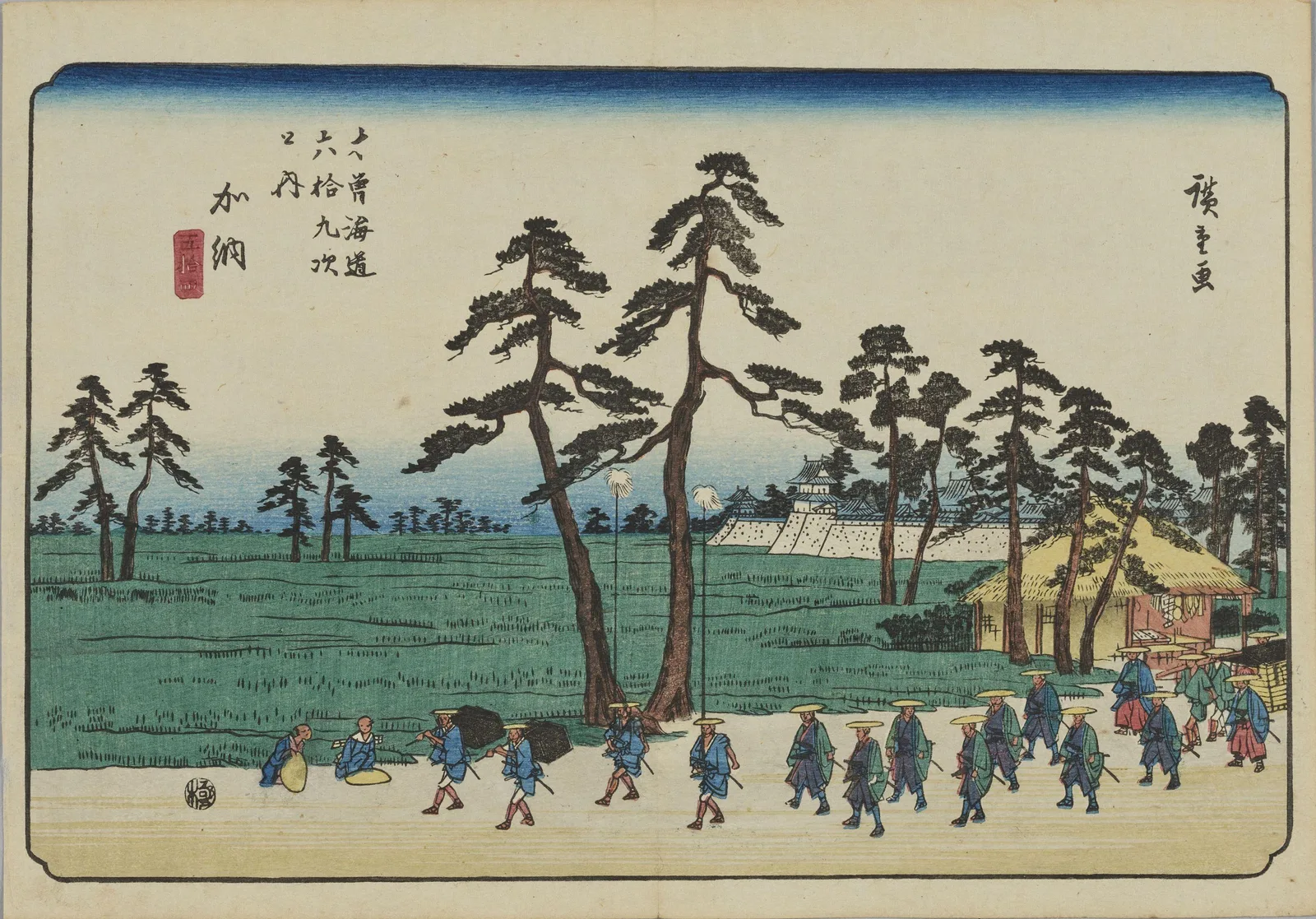
Kano
木曽海道六拾九次之内 加納
A daimyo procession moves through the castle town of Kano. A party holding feather-tassel spears walks along a pine-lined road, and people kneel at the roadside to see them off. Beyond the fields can be seen the castle's turrets and white walls.
- Artist
- Utagawa Hiroshige
- Date
- c. 1835-38 (Tenpo 6-9)
- Medium / format
- Woodblock print (ukiyo-e)
- Series
- The Sixty-nine Stations of the Kisokaido 71 prints
- Place depicted
- Kano-juku(Gifu)
About this work
Along the road in the foreground, a procession of samurai in broad hats moves from right to left. Near the head, a man walks holding a feather-tassel spear, and at the roadside at left two men kneel with heads bowed. A teahouse is visible at right rear, where people from the rear of the procession are also resting.
Two large pines stand in the middle of the picture, and beyond them one can see wide fields and the turrets of a castle surrounded by white walls. The blue gradation of the sky and the green of the fields are calm, and the movement of the orderly procession gives the picture a regular rhythm.
Kano was a post town in the center of today's Gifu that also served as the castle town of Kano Castle. With the abolition of Gifu Castle in 1601 (Keicho 6) and the construction of Kano Castle in its place, it developed as a post town. A honjin and a waki-honjin were placed there, and it played the roles of both castle town and post town.
This is by Hiroshige. With its composition combining castle and procession, it is thought to express the character of a post town that was also a castle town. Lining up the orderly procession across the whole horizontal picture conveys well the solemn air of the castle town.
The place today
The ruins of Kano Castle are designated a national historic site, with part of the stone walls and the site of the main enclosure remaining as a park. In the old post town spreading south of JR Gifu Station are the honjin site, with a monument inscribed with a poem by Princess Kazunomiya, and the waki-honjin site, and following the signboards one can walk around the townscape.
Where can I see it?
Exhibitions change over time. Check each museum's exhibition information before you visit.
Museums that hold this work
- Tokyo National MuseumMuseum's page for this work (opens in a new tab)
Taito City, Tokyo Accession no. A-12499-122
- National Diet LibraryMuseum's page for this work (opens in a new tab)
Chiyoda City, Tokyo Accession no. 寄別2-2-1-5
Included in Kisokaido Rokujukyu-tsugi
Museums abroad
Frequently asked questions
- Who painted The Sixty-nine Stations of the Kisokaido: Kano, and when?
- The Sixty-nine Stations of the Kisokaido: Kano is by Utagawa Hiroshige, made in c. 1835-38 (Tenpo 6-9). Medium: Woodblock print (ukiyo-e).
- What place does The Sixty-nine Stations of the Kisokaido: Kano show?
- It shows Kano-juku (Gifu).
- Where can I see The Sixty-nine Stations of the Kisokaido: Kano?
- It is held by Tokyo National Museum, National Diet Library. Exhibitions change, so check each museum's information before you visit.
Sources and references
- ColBase(東京国立博物館): 木曽海道六拾九次之内 加納 (opens in a new tab) (checked 2026-10-19)
- 国立国会図書館デジタルコレクション: 五拾四 木曽海道六拾九次之内加納 (opens in a new tab) (checked 2026-10-19)
- Wikipedia: 木曽海道六十九次 (opens in a new tab) (checked 2026-10-19)
You may also like
More from Gifu
Discover more of the same region on our sister sites.
Matsuri Biyori
Festivals in Gifu
- Takayama Festival Yatai Float Event
- Furukawa Festival Okoshi-daiko and Yatai Float Event
- Ogaki Festival Yama Float Event
- Gujo Odori