One Hundred Famous Views of Edo ・ 102
Minowa, Kanasugi, Mikawashima
名所江戸百景 蓑輪金杉三河しま
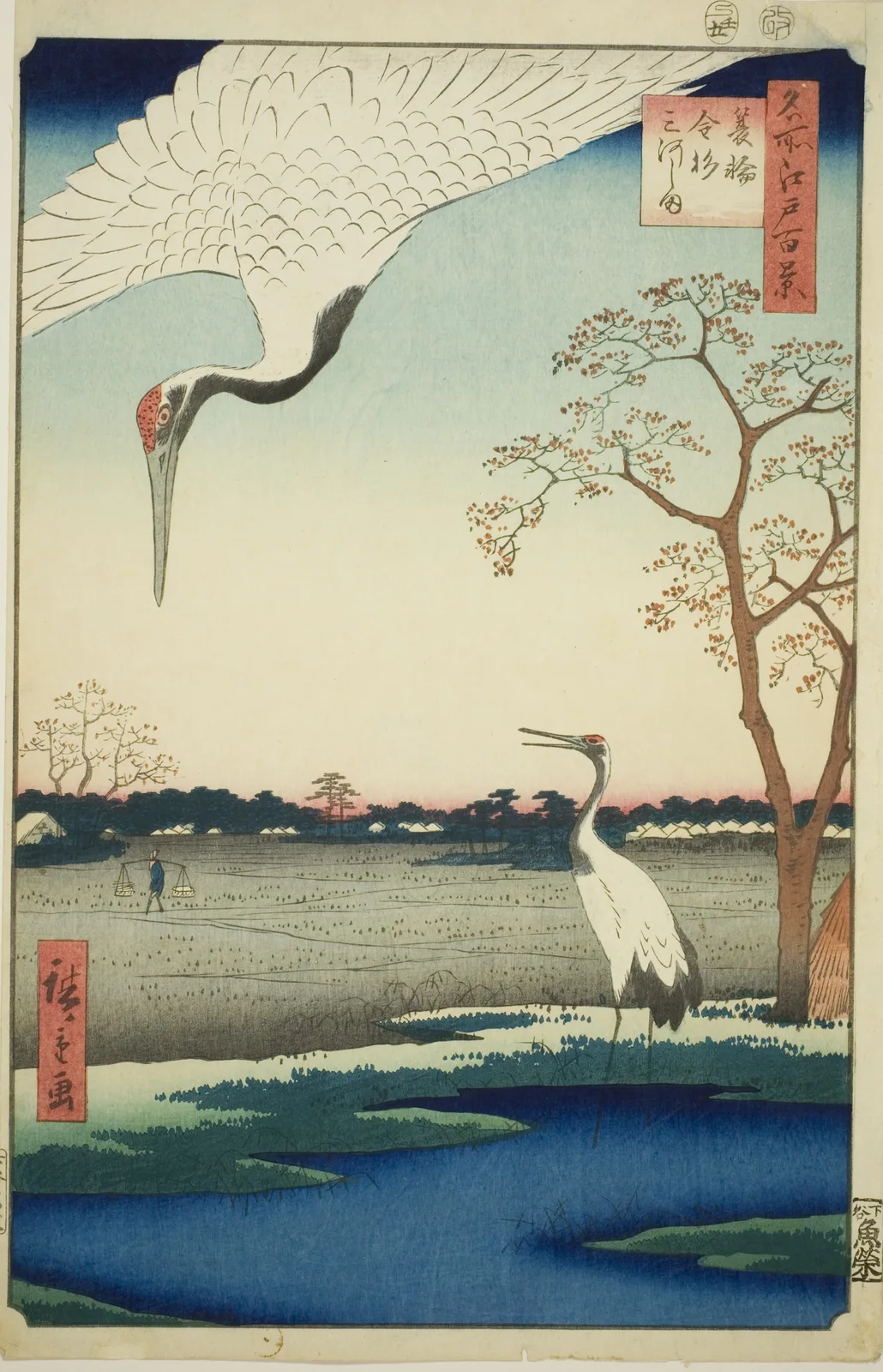
Red-crowned cranes alighting on the marshes of Mikawashima, in the northern suburbs of Edo. One crane spreading its wings broadly from the top of the picture is paired with another standing at the water's edge, giving a quiet winter rural scene.
- Artist
- Utagawa Hiroshige
- Date
- Intercalary 5th month, 1857 (Ansei 4)
- Medium / format
- Woodblock print (ukiyo-e)
- Series
- One Hundred Famous Views of Edo 119 prints
- Place depicted
- Mikawashima(Tokyo)
About this work
From the top of the picture a red-crowned crane descends with wings spread wide and neck stretched downward. Below it another stands at the water's edge looking up at the sky. In the middle ground rice fields and marsh spread out with a small farmer visible, and a branching tree stands at the right. Trees and houses line the distant horizon.
The wings of the white crane boldly cover the upper half of the picture, and the colors come together with the indigo water and green bank in front and the rose evening sky. Placing a large bird in the foreground against the distant view is also seen in the eagle of the winter print "Fukagawa Susaki and Jumantsubo."
The Mikawashima area was a hunting ground for the shogun's falconry, and a "crane feeding ground" was established there to feed the cranes that arrived in winter. The cranes were carefully protected, and cranes caught during the shogun's falconry are said to have been presented to the imperial court.
This print belongs to the winter section, and its title lists the names of three villages: Minowa, Kanasugi, and Mikawashima. It depicts a landscape in the suburbs, a little way from the city of Edo, with birds as its protagonists. The composition conveys, through the figures of two cranes alone, the character of Mikawashima as a place known for its winter crane visitors.
The place today
Mikawashima corresponds to the Arakawa and Higashi-Nippori area of Arakawa Ward, and the name survives in JR Joban Line's Mikawashima Station. After the Meiji era factories and houses filled the area, the fields and marshes where cranes once alighted vanished, and it became a downtown residential district. Traces of the old villages can be found in local monuments and temples and shrines.
Where can I see it?
Exhibitions change over time. Check each museum's exhibition information before you visit.
Museums that hold this work
- Tokyo National MuseumMuseum's page for this work (opens in a new tab)
Taito City, Tokyo Accession no. A-12499-421
- National Diet LibraryMuseum's page for this work (opens in a new tab)
Chiyoda City, Tokyo Accession no. 寄別1-8-2-1イ
Museums abroad
- Art Institute of ChicagoMuseum's page for this work (opens in a new tab)
Chicago Accession no. 1939.1440
- The Metropolitan Museum of ArtMuseum's page for this work (opens in a new tab)
New York Accession no. JP63
Frequently asked questions
- Who painted One Hundred Famous Views of Edo: Minowa, Kanasugi, Mikawashima, and when?
- One Hundred Famous Views of Edo: Minowa, Kanasugi, Mikawashima is by Utagawa Hiroshige, made in Intercalary 5th month, 1857 (Ansei 4). Medium: Woodblock print (ukiyo-e).
- What place does One Hundred Famous Views of Edo: Minowa, Kanasugi, Mikawashima show?
- It shows Mikawashima (Tokyo).
- Where can I see One Hundred Famous Views of Edo: Minowa, Kanasugi, Mikawashima?
- It is held by Tokyo National Museum, National Diet Library. Exhibitions change, so check each museum's information before you visit.
Sources and references
- Art Institute of Chicago: Minowa, Kanasugi, Mikawashima, from the series “One Hundred Famous Views of Edo (Meisho Edo hyakkei)” (opens in a new tab) (checked 2026-10-19)
- ColBase(東京国立博物館): 名所江戸百景 蓑輪金杉三河しま (opens in a new tab) (checked 2026-10-19)
- 国立国会図書館デジタルコレクション: 名所江戸百景 蓑輪金杉三河しま (opens in a new tab) (checked 2026-10-19)
- The Metropolitan Museum of Art: “Minowa, Kanasugi at Mikawashima,” from the series One Hundred Famous Views of Edo (JP63) (opens in a new tab) (checked 2026-10-19)
- Wikipedia: One Hundred Famous Views of Edo (opens in a new tab) (checked 2026-10-19)
You may also like
More from Tokyo
Discover more of the same region on our sister sites.