One Hundred Famous Views of Edo ・ 101
Asakusa Rice Fields and Torinomachi Festival
名所江戸百景 浅草田甫酉の町詣
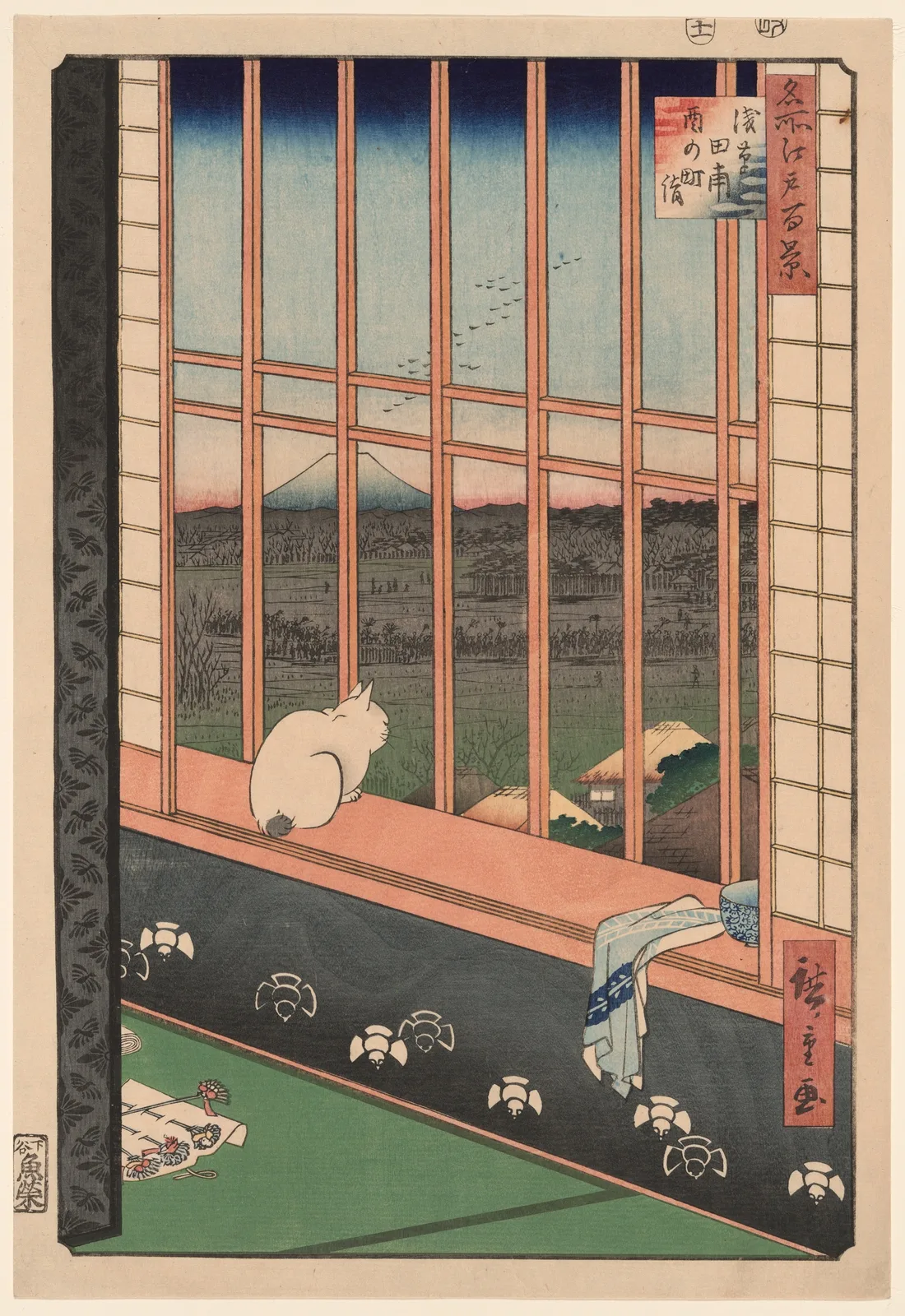
A white cat at the window of a Yoshiwara room, gazing out at the line of people heading to the Tori-no-Machi festival and at distant Mt. Fuji. It is famed for its device of suggesting the room's occupant through small props alone, without showing any person, and ranks among the most popular prints in the series.
- Artist
- Utagawa Hiroshige
- Date
- November 1857 (Ansei 4)
- Medium / format
- Woodblock print (ukiyo-e)
- Series
- One Hundred Famous Views of Edo 119 prints
- Place depicted
- Shin-Yoshiwara(Tokyo)
- Seen in the distance
- Mount Fuji
About this work
In the foreground is a room in a Yoshiwara brothel, where a white cat sits on the windowsill beneath a lattice window and looks outside. Beyond the window the Asakusa rice fields spread out, and in the distance a line of people heads for the Tori-no-Machi festival. A white Mt. Fuji can be seen beyond the horizon, and a line of geese crosses the sky.
A black frame and lattice divide the picture, and beyond them extends a sky of evening rose and indigo. From the rake-shaped hairpin and the paper tissues lying on the floor, the room is said to be read as that of a courtesan who has just seen off a customer.
The Tori-no-Machi was a festival held on the Day of the Rooster in November at the Otori Daimyojin shrine (today's Otori Shrine), and it drew great crowds seeking lucky rakes. The shrine stood very close to the Yoshiwara, and on that day the quarter too is said to have overflowed with customers returning from the shrine.
This print belongs to the winter section and is among the most popular in the series. There is almost no human figure in the picture, and the composition that makes a cat the protagonist is often cited as a demonstration of Hiroshige's wit. Because the outside scenery is shown through the window lattice, viewers feel as if they were gazing out the window beside the cat.
The place today
Otori Shrine still stands in Senzoku, Taito Ward, and on the Days of the Rooster in November the Tori-no-Machi fair is held, with stalls selling lucky rakes filling the precinct and the surrounding streets. The Asakusa rice fields became townscape after the Meiji era, and the rural views with Mt. Fuji no longer survive. Many worshippers visit the fair each year.
Where can I see it?
Exhibitions change over time. Check each museum's exhibition information before you visit.
Museums that hold this work
- Tokyo National MuseumMuseum's page for this work (opens in a new tab)
Taito City, Tokyo Accession no. A-12499-420
- National Diet LibraryMuseum's page for this work (opens in a new tab)
Chiyoda City, Tokyo Accession no. 寄別1-8-2-1イ
Museums abroad
- Art Institute of ChicagoMuseum's page for this work (opens in a new tab)
Chicago Accession no. 1961.147
- The Metropolitan Museum of ArtMuseum's page for this work (opens in a new tab)
New York Accession no. JP60
Frequently asked questions
- Who painted One Hundred Famous Views of Edo: Asakusa Rice Fields and Torinomachi Festival, and when?
- One Hundred Famous Views of Edo: Asakusa Rice Fields and Torinomachi Festival is by Utagawa Hiroshige, made in November 1857 (Ansei 4). Medium: Woodblock print (ukiyo-e).
- What place does One Hundred Famous Views of Edo: Asakusa Rice Fields and Torinomachi Festival show?
- It shows Shin-Yoshiwara (Tokyo).
- Where can I see One Hundred Famous Views of Edo: Asakusa Rice Fields and Torinomachi Festival?
- It is held by Tokyo National Museum, National Diet Library. Exhibitions change, so check each museum's information before you visit.
Sources and references
- Art Institute of Chicago: Asakusa Rice Fields and Torinomachi Festival (Asakusa tanbo Torinomachi mode), from the series "One Hundred Famous Views of Edo (Meisho Edo hyakkei)" (opens in a new tab) (checked 2026-10-19)
- ColBase(東京国立博物館): 名所江戸百景 浅草田甫酉の町詣 (opens in a new tab) (checked 2026-10-19)
- 国立国会図書館デジタルコレクション: 名所江戸百景 浅草田甫酉の町詣 (opens in a new tab) (checked 2026-10-19)
- The Metropolitan Museum of Art: Pilgrimage to the Torinomachi Festival across the Ricefields of Asakusa (Asakusa tanbo Torinomachi mōde) (JP60) (opens in a new tab) (checked 2026-10-19)
- Wikipedia: One Hundred Famous Views of Edo (opens in a new tab) (checked 2026-10-19)
You may also like
More from Tokyo
Discover more of the same region on our sister sites.