One Hundred Famous Views of Edo ・ 62
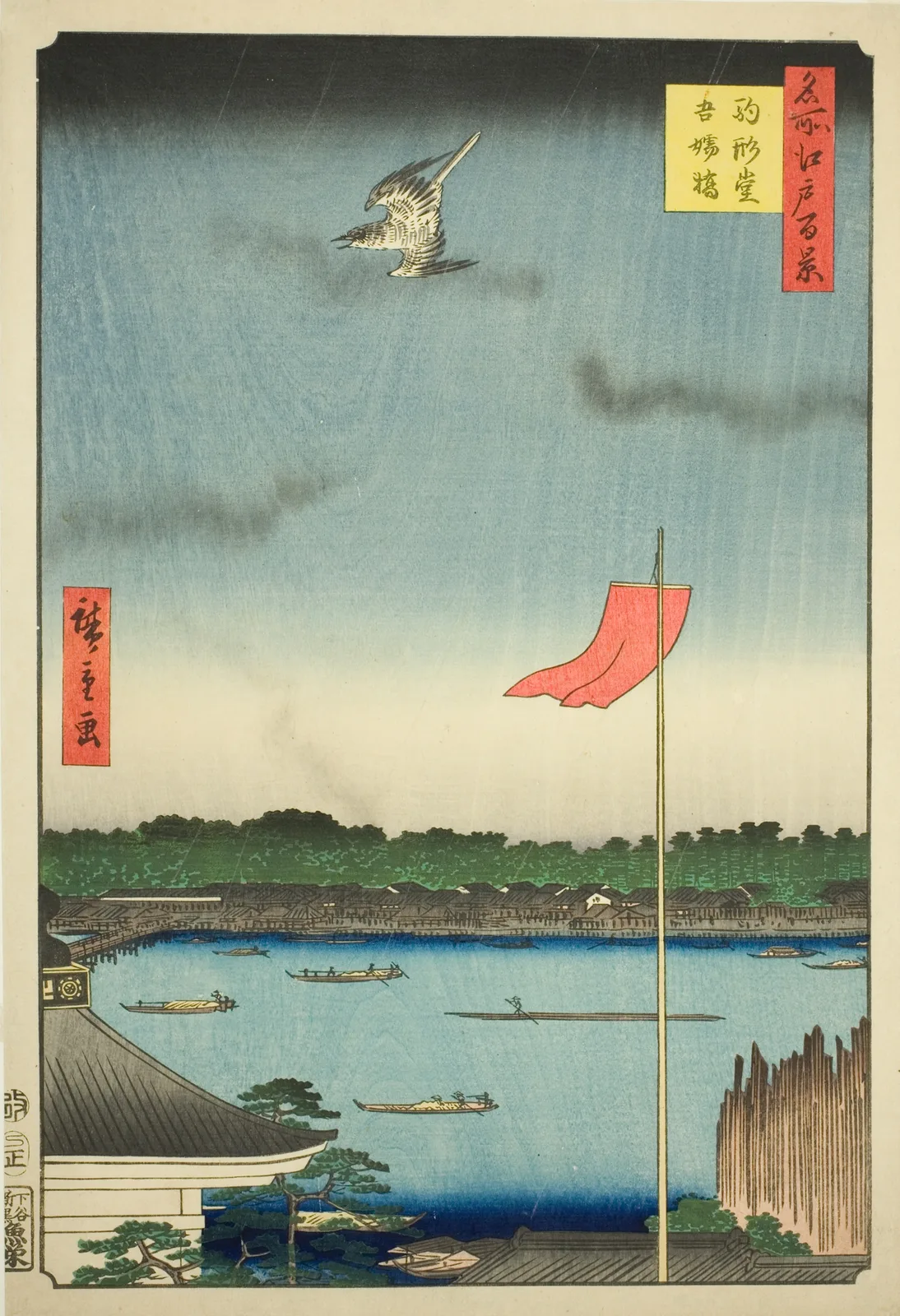
Komagata Hall and Azuma Bridge
名所江戸百景 駒形堂吾嬬橋
A cuckoo crosses a rainy sky, and below it can be seen the roof of Komagata Hall, the Sumida River, and Azuma Bridge in the distance. A red banner fluttering in the wind catches the eye amid the gray scenery. It conveys the damp air of an early-summer rainy day.
- Artist
- Utagawa Hiroshige
- Date
- January 1857 (Ansei 4)
- Medium / format
- Woodblock print (ukiyo-e)
- Series
- One Hundred Famous Views of Edo 119 prints
About this work
A single cuckoo crosses the top of the picture, calling as it goes. Below, a red banner flutters on a slender pole; the roof of Komagata Hall appears at lower left and a willow tree at lower right. On the Sumida River in the middle, boats go back and forth, Azuma Bridge spans small in the distance at left, and trees and houses continue on the far shore. A man working a raft can also be seen on the river.
The color of the red banner stands out vividly against a heavy sky of gray and blue. Leaving the upper half of the picture wide open and placing only the bird and banner there expresses the quiet and expanse of a rainy day.
Komagata Hall is said to stand where the Kannon image of Sensoji was pulled up from the Sumida River, and was the first hall that people arriving in Asakusa by boat visited. The red banner is thought to have been the signboard of a nearby shop that sold rouge. The cuckoo was a bird that announced the arrival of Edo's summer. A cuckoo calling in the rain was also a favored subject in waka and haiku.
This print belongs to the summer section, and its censor's seal dates it to the first month of Ansei 4 (1857). An impression is also held by the Metropolitan Museum of Art. Its composition, with a bird and banner large in front and the famous sight small below, is regarded as one of the most lyrical in the series.
The place today
Komagata Hall still stands at the west foot of Komagata Bridge, and the present hall was rebuilt in 2003. Azuma Bridge is a red steel arch bridge completed in 1931, and on the far bank the Asahi Beer headquarters building and Tokyo Skytree stand side by side, forming a view that represents the Asakusa riverside.
Where can I see it?
Exhibitions change over time. Check each museum's exhibition information before you visit.
Museums that hold this work
- Tokyo National MuseumMuseum's page for this work (opens in a new tab)
Taito City, Tokyo Accession no. A-12499-374
- National Diet LibraryMuseum's page for this work (opens in a new tab)
Chiyoda City, Tokyo Accession no. 寄別1-8-2-1イ
- National Diet LibraryMuseum's page for this work (opens in a new tab)
Chiyoda City, Tokyo Accession no. 寄別1-8-2-1
Museums abroad
- Art Institute of ChicagoMuseum's page for this work (opens in a new tab)
Chicago Accession no. 1939.2253
- The Metropolitan Museum of ArtMuseum's page for this work (opens in a new tab)
New York Accession no. JP1023
Frequently asked questions
- Who painted One Hundred Famous Views of Edo: Komagata Hall and Azuma Bridge, and when?
- One Hundred Famous Views of Edo: Komagata Hall and Azuma Bridge is by Utagawa Hiroshige, made in January 1857 (Ansei 4). Medium: Woodblock print (ukiyo-e).
- What place does One Hundred Famous Views of Edo: Komagata Hall and Azuma Bridge show?
- It shows Komagata-do Hall, Azuma Bridge, Sumida River (Tokyo).
- Where can I see One Hundred Famous Views of Edo: Komagata Hall and Azuma Bridge?
- It is held by Tokyo National Museum, National Diet Library. Exhibitions change, so check each museum's information before you visit.
Sources and references
- Art Institute of Chicago: Komagata Hall and Azuma Bridge (Komagatado Azumabashi), from the series "One Hundred Famous Views of Edo (Meisho Edo hyakkei)" (opens in a new tab) (checked 2026-10-19)
- ColBase(東京国立博物館): 名所江戸百景 駒形堂吾嬬橋 (opens in a new tab) (checked 2026-10-19)
- The Metropolitan Museum of Art: “Azuma Bridge from Komagatadō Temple”, from the series One Hundred Famous Views of Edo (opens in a new tab) (checked 2026-10-19)
- Wikipedia: One Hundred Famous Views of Edo (opens in a new tab) (checked 2026-10-19)
You may also like
More from Tokyo
Discover more of the same region on our sister sites.