One Hundred Famous Views of Edo ・ 63
Ayase River and Kanegafuchi
名所江戸百景 綾瀬川鐘か渕
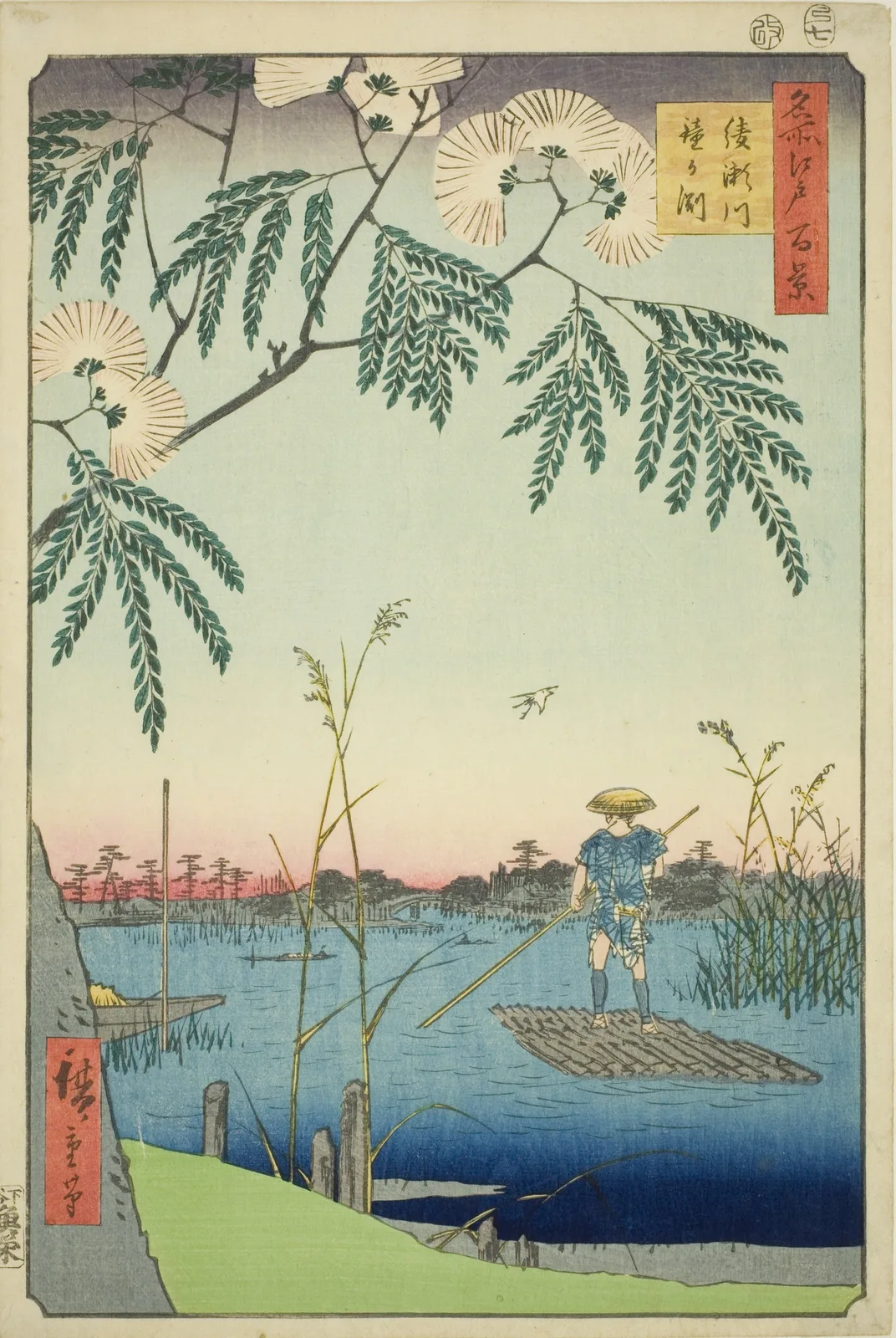
A man working a raft at Kanegafuchi, where the Ayase River joins the Sumida River. Above him bloom the flowers of a silk tree, conveying the quiet of a summer evening on the riverbank. A seasonal flower and river life are brought together in a single picture.
- Artist
- Utagawa Hiroshige
- Date
- January 1857 (Ansei 4)
- Medium / format
- Woodblock print (ukiyo-e)
- Series
- One Hundred Famous Views of Edo 119 prints
- Place depicted
- Kanegafuchi(Tokyo)
About this work
Branches of a silk tree cover the top of the picture, with pale pink flowers and fine leaves hanging down. In the river at the center, a man in a hat works a raft with a pole. Reeds and stakes stand in the foreground, trees and houses line the far shore, and a small bridge can be seen in the distance. A single bird flies in the sky. Small boats are tied to the stakes on the bank.
The gradation from the pale color of the sky to the red band of sunset and its contrast with the blue of the river is gentle. The top of the picture is framed with a flowering branch in the foreground and the raftsman is placed at the center, expressing the unhurried flow of time. The flowers are drawn in a soft shape by layering fine lines radiating outward.
Kanegafuchi is said to have been named after a legend that a temple bell sank into the river. The Ayase River was also a waterway linking the villages of Musashi with Edo, and the sight of rafts being floated downstream conveys the water transport that supported life in Edo. This area lay in the northeastern suburbs of Edo, where waterside scenery stretched out.
This print belongs to the summer section, and its censor's seal dates it to the first month of Ansei 4 (1857). The silk tree is a tree whose flowers open on summer evenings, and the device of placing a seasonal flower in the foreground appears throughout the series.
The place today
Around Kanegafuchi, the river's course changed greatly with the excavation of the Arakawa Diversion Channel and other works, and the scenery in the picture does not survive. It now lies at the northern edge of Sumida Ward, and the name remains in Tobu Line's Kanegafuchi Station and Kanegafuchi-dori. The northern part of Sumida Ward is a quiet residential area.
Where can I see it?
Exhibitions change over time. Check each museum's exhibition information before you visit.
Museums that hold this work
- Tokyo National MuseumMuseum's page for this work (opens in a new tab)
Taito City, Tokyo Accession no. A-12499-388
- National Diet LibraryMuseum's page for this work (opens in a new tab)
Chiyoda City, Tokyo Accession no. 寄別1-8-2-1イ
- National Diet LibraryMuseum's page for this work (opens in a new tab)
Chiyoda City, Tokyo Accession no. 寄別1-8-2-1
Museums abroad
- Art Institute of ChicagoMuseum's page for this work (opens in a new tab)
Chicago Accession no. 1925.3740
Frequently asked questions
- Who painted One Hundred Famous Views of Edo: Ayase River and Kanegafuchi, and when?
- One Hundred Famous Views of Edo: Ayase River and Kanegafuchi is by Utagawa Hiroshige, made in January 1857 (Ansei 4). Medium: Woodblock print (ukiyo-e).
- What place does One Hundred Famous Views of Edo: Ayase River and Kanegafuchi show?
- It shows Kanegafuchi (Tokyo).
- Where can I see One Hundred Famous Views of Edo: Ayase River and Kanegafuchi?
- It is held by Tokyo National Museum, National Diet Library. Exhibitions change, so check each museum's information before you visit.
Sources and references
- Art Institute of Chicago: Ayase River and Kanegafuchi (Ayasegawa Kanegafuchi), from the series "One Hundred Famous Views of Edo (Meisho Edo hyakkei)" (opens in a new tab) (checked 2026-10-19)
- ColBase(東京国立博物館): 名所江戸百景 綾瀬川鐘か渕 (opens in a new tab) (checked 2026-10-19)
- Wikipedia: One Hundred Famous Views of Edo (opens in a new tab) (checked 2026-10-19)
You may also like
More from Tokyo
Discover more of the same region on our sister sites.