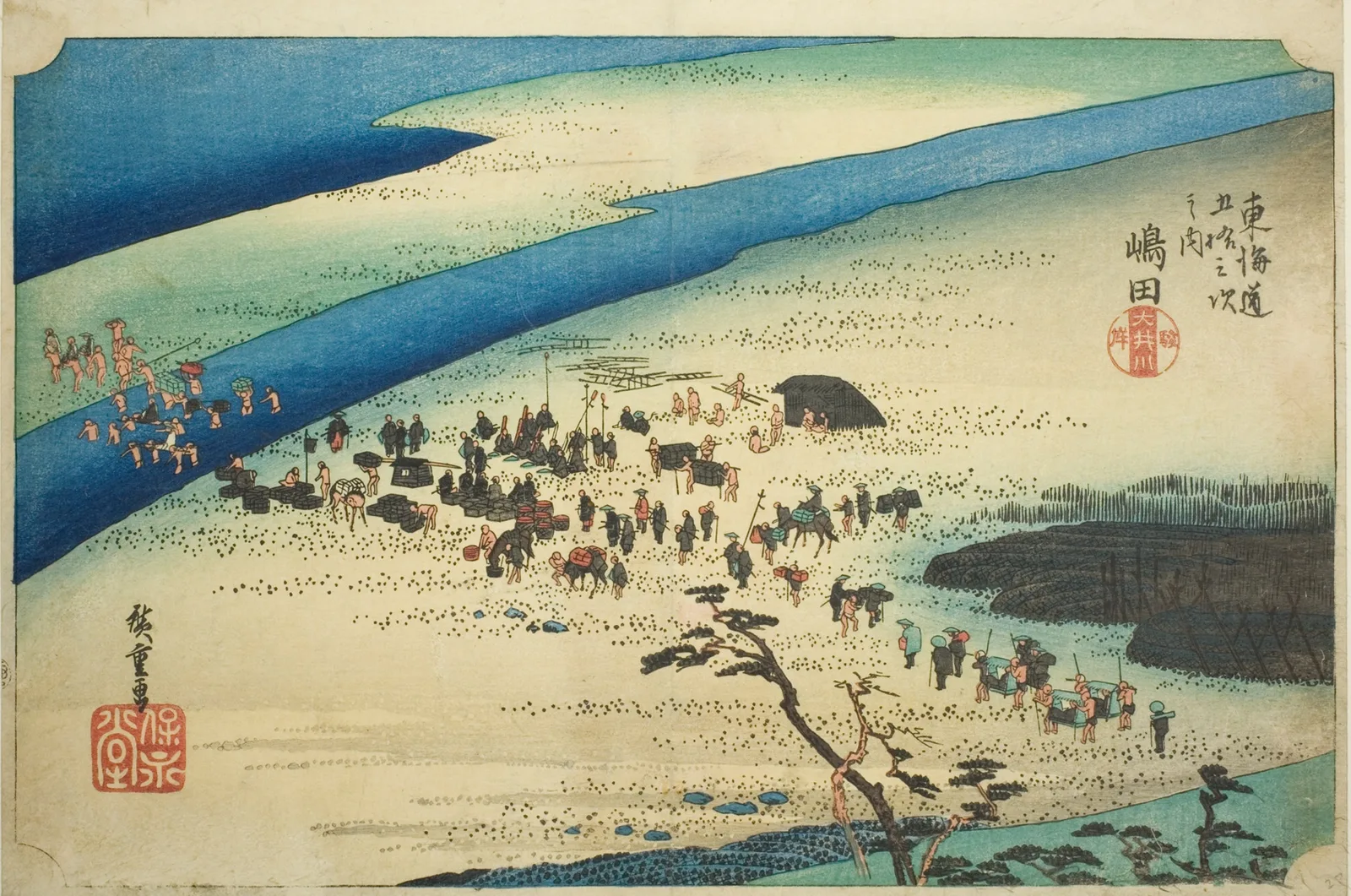
The Fifty-three Stations of the Tokaido (Hoeido edition) ・ 24
Suruga Bank of the Oi River at Shimada
東海道五拾三次之内 嶋田 大井川駿岸
The Oi River is drawn as if looking down from high in the sky, with a daimyo procession waiting its turn on the broad river bank and porters crossing the stream arranged in small figures. The large curve made by the blue stream and the white sandbars is the highlight.
- Artist
- Utagawa Hiroshige
- Date
- c. 1833-34 (Tenpo 4-5)
- Medium / format
- Woodblock print (ukiyo-e)
- Series
- The Fifty-three Stations of the Tokaido (Hoeido edition) 55 prints
- Place depicted
- Shimada-juku(Shizuoka)
About this work
The picture is drawn from a viewpoint as if looking down on the Oi River from far above, so that everything from the near bank to the stream in the distance can be seen at once. In reality one could not see it from so high a place; this viewpoint was chosen to convey the breadth of the river.
On the river bank a daimyo procession has gathered, and palanquins, baggage, and horses head one after another toward the river. At upper left, porters carry customers on their shoulders and on rendai and have already started crossing the stream. The people are all the size of beans, yet their movements and belongings are distinguished.
The Oi River was the greatest obstacle on the Tokaido. With neither bridge nor ferry, when the water rose crossing was closed and travelers were held up for days. The title's Sungan means the Suruga-side bank, that is, the bank on the side of Shimada-juku. It forms a pair with the next print, Kanaya.
River crossing at the Oi continued until 1870 (Meiji 3), when boats were permitted on the river. At the bottom of the picture, pine branches peek in, making the distance to the faraway river bank felt all the more. The flow of the river is drawn in blue bokashi, in vivid contrast with the white sandbars. A band of black forest continues on the bank at right.
The place today
Near the Oi River in Shimada, the Shimada-juku Oigawa Kawagoshi Site, with reconstructions of the river office and the banjuku (porters' lodgings), was designated a national historic site in 1966. You can walk through the river-crossing townscape. Downstream spans Horai Bridge, a wooden pedestrian bridge built in 1879 (897.4 m long).
Where can I see it?
Exhibitions change over time. Check each museum's exhibition information before you visit.
Museums that hold this work
- Tokyo National MuseumMuseum's page for this work (opens in a new tab)
Taito City, Tokyo Accession no. A-12499-28
Museums that hold this series (please check the museum's website for whether it holds this print)
- Shizuoka City Tokaido Hiroshige Museum of Art
Shimizu Ward, Shizuoka
All prints of the Hoeido edition were shown in the museum's collection exhibition Fifty-three Stations of the Tokaido (2024-25)
Museums abroad
- Art Institute of ChicagoMuseum's page for this work (opens in a new tab)
Chicago Accession no. 1925.3526
Frequently asked questions
- Who painted The Fifty-three Stations of the Tokaido: Suruga Bank of the Oi River at Shimada, and when?
- The Fifty-three Stations of the Tokaido: Suruga Bank of the Oi River at Shimada is by Utagawa Hiroshige, made in c. 1833-34 (Tenpo 4-5). Medium: Woodblock print (ukiyo-e).
- What place does The Fifty-three Stations of the Tokaido: Suruga Bank of the Oi River at Shimada show?
- It shows Shimada-juku (Shizuoka).
- Where can I see The Fifty-three Stations of the Tokaido: Suruga Bank of the Oi River at Shimada?
- It is held by Tokyo National Museum, Tokyo Fuji Art Museum, National Diet Library. Exhibitions change, so check each museum's information before you visit.
Sources and references
- Art Institute of Chicago: Shimada: The Suruga Bank of the Oi River (Shimada, Oigawa Sungan) (opens in a new tab) (checked 2026-10-18)
- ColBase(東京国立博物館): A-12499-28 (opens in a new tab) (checked 2026-10-18)
- 東京富士美術館 収蔵品: 東海道五拾三次之内 嶋田 大井川駿岸 (opens in a new tab) (checked 2026-10-18)
- 国立国会図書館デジタルコレクション: 東海道五拾三次 嶋田・大井川駿岸 (opens in a new tab) (checked 2026-10-18)
You may also like
More from Shizuoka
Discover more of the same region on our sister sites.