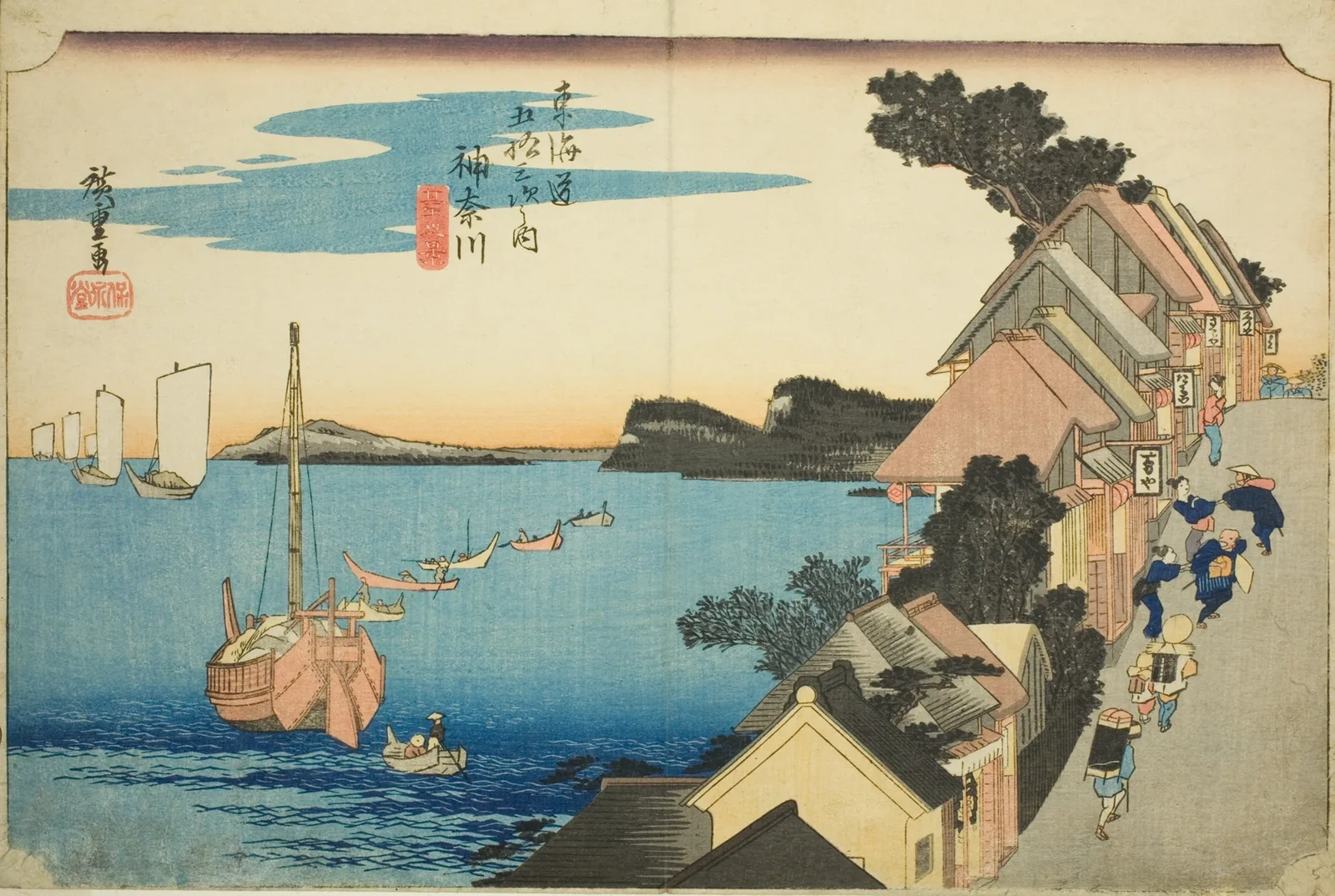
The Fifty-three Stations of the Tokaido (Hoeido edition) ・ 4
Scene on the Hill at Kanagawa
東海道五拾三次之内 神奈川 台之景
This print shows Daimachi in Kanagawa-juku, where teahouses line a steep slope overlooking the sea and the women of the shops tug at travelers' sleeves to draw them in. The calm inlet spreading out on the left makes a lively contrast with the bustle of the slope.
- Artist
- Utagawa Hiroshige
- Date
- c. 1833-34 (Tenpo 4-5)
- Medium / format
- Woodblock print (ukiyo-e)
- Series
- The Fifty-three Stations of the Tokaido (Hoeido edition) 55 prints
- Place depicted
- Kanagawa-juku(Kanagawa)
About this work
On the right side of the picture a slope climbs steeply from the foreground into the distance. Teahouses stand shoulder to shoulder along the road, and women who have come out to the front of the shops take the hands of passing travelers to lead them in. The travelers, digging in their heels as they are pulled along, show how lively this hillside post station was.
Climbing the slope in the foreground is a rokubu, a pilgrim who travels around temples and shrines across the country, with a box on his back. He pays no attention to the commotion of the touts and keeps walking silently. On the sea side of the teahouses a projecting terrace can be seen, suggesting that customers who went inside could enjoy the view of the inlet.
In the inlet on the left half, sailing ships and small boats float, and a headland overlaps in the distance. Daimachi in Kanagawa-juku was known as a district of teahouses lined up on a slope with a sweeping sea view. Hiroshige shows the slope and the sea together from a high viewpoint.
Looking down from the top of the slope, the rooftops line up diagonally and the sea opens out beyond them. The composition divides the picture diagonally between the slope on the right and the sea on the left, capturing in a single sheet the view unique to a post station on high ground. Indigo clouds trail across the sky, creating a sense of spaciousness against the bright sea.
The place today
Most of the buildings of Kanagawa-juku were lost to the earthquake and the wartime air raids, but the Daimachi slope still keeps some of its old atmosphere. The ward has put up information boards and developed it as the Kanagawa-juku Historic Road, and at the top of the slope stands a monument to the site of the Kanagawa-dai barrier gate. The sea that once spread below the slope has become a city district.
Where can I see it?
Exhibitions change over time. Check each museum's exhibition information before you visit.
Museums that hold this work
- Tokyo National MuseumMuseum's page for this work (opens in a new tab)
Taito City, Tokyo Accession no. A-12499-6
Museums that hold this series (please check the museum's website for whether it holds this print)
- Shizuoka City Tokaido Hiroshige Museum of Art
Shimizu Ward, Shizuoka
All prints of the Hoeido edition were shown in the museum's collection exhibition Fifty-three Stations of the Tokaido (2024-25)
Museums abroad
- Art Institute of ChicagoMuseum's page for this work (opens in a new tab)
Chicago Accession no. 1925.3502
Frequently asked questions
- Who painted The Fifty-three Stations of the Tokaido: Scene on the Hill at Kanagawa, and when?
- The Fifty-three Stations of the Tokaido: Scene on the Hill at Kanagawa is by Utagawa Hiroshige, made in c. 1833-34 (Tenpo 4-5). Medium: Woodblock print (ukiyo-e).
- What place does The Fifty-three Stations of the Tokaido: Scene on the Hill at Kanagawa show?
- It shows Kanagawa-juku (Kanagawa).
- Where can I see The Fifty-three Stations of the Tokaido: Scene on the Hill at Kanagawa?
- It is held by Tokyo National Museum, Tokyo Fuji Art Museum, National Diet Library. Exhibitions change, so check each museum's information before you visit.
Sources and references
- Art Institute of Chicago: Kanagawa: View of the Embankment (Kanagawa, dai no kei) (opens in a new tab) (checked 2026-10-18)
- ColBase(東京国立博物館): A-12499-6 (opens in a new tab) (checked 2026-10-18)
- 東京富士美術館 収蔵品: 東海道五拾三次之内 神奈川 台之景 (opens in a new tab) (checked 2026-10-18)
- 国立国会図書館デジタルコレクション: 東海道五拾三次 神奈川・台之景 (opens in a new tab) (checked 2026-10-18)
You may also like
More from Kanagawa
Discover more of the same region on our sister sites.