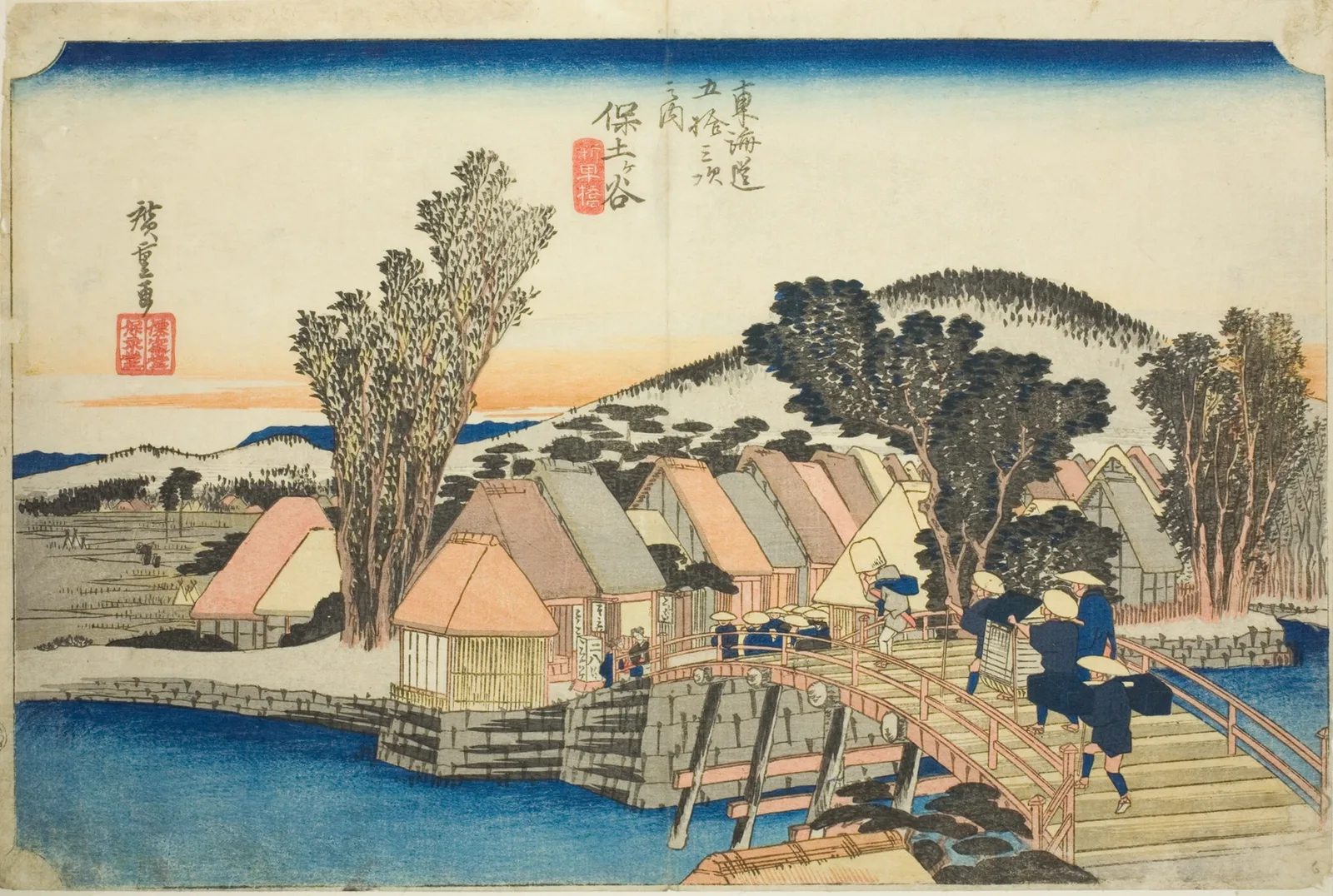
The Fifty-three Stations of the Tokaido (Hoeido edition) ・ 5
Shinmachi Bridge at Hodogaya
東海道五拾三次之内 保土ヶ谷 新町橋
This print shows travelers crossing Shinmachi Bridge (also called Katabira Bridge) over the Katabira River, with the row of houses of Hodogaya-juku beyond. The whole scene at the entrance to the post station can be seen, from the soba shop across the bridge and a palanquin party to the fields spreading behind the shops.
- Artist
- Utagawa Hiroshige
- Date
- c. 1833-34 (Tenpo 4-5)
- Medium / format
- Woodblock print (ukiyo-e)
- Series
- The Fifty-three Stations of the Tokaido (Hoeido edition) 55 prints
- Place depicted
- Hodogaya-juku(Kanagawa)
About this work
The wooden bridge in the foreground is Shinmachi Bridge, also known as Katabira Bridge. On the bridge, a party carrying a palanquin and a komuso (a monk who begs while playing the shakuhachi) in a deep woven hat head toward the post station, and beyond the bridge thatched and plank-roofed houses line the highway.
A sign reading Niha-chi (two-eight) can be seen on the shop at the foot of the bridge, showing that it is a soba shop. There is a figure at the front of the shop welcoming customers, suggesting a place where travelers could take a breath as soon as they entered the post station. The low part of the sky is tinged orange.
To the left of the row of houses, fields spread out, showing that behind the post station was countryside. Hiroshige layers the bridge, the post station, and the farmland diagonally so that the eye flows naturally from the river to the station. Hodogaya is the post station that comes after Kanagawa.
The name Shinmachi Bridge derives from the fact that the bridge was rebuilt when a new route was laid in 1648 (Keian 1). The vermilion of the bridge railings, the indigo of the river, and the pale colors of the thatched roofs combine into a calm evening view. Even the stone wall before the bridge and the shadows of the piers falling on the water are carefully drawn.
The place today
The course of the Katabira River was changed around 1965, and the site of the old Katabira Bridge is now Tennocho Station Front Park, which has a monument commemorating the bridge. A gate remains at the site of the Karube honjin, which was the center of the post station, and the pine-lined avenue along the old Tokaido has also been restored.
Where can I see it?
Exhibitions change over time. Check each museum's exhibition information before you visit.
Museums that hold this work
- Tokyo National MuseumMuseum's page for this work (opens in a new tab)
Taito City, Tokyo Accession no. A-12499-7
Museums that hold this series (please check the museum's website for whether it holds this print)
- Shizuoka City Tokaido Hiroshige Museum of Art
Shimizu Ward, Shizuoka
All prints of the Hoeido edition were shown in the museum's collection exhibition Fifty-three Stations of the Tokaido (2024-25)
Museums abroad
- Art Institute of ChicagoMuseum's page for this work (opens in a new tab)
Chicago Accession no. 1925.3503
Frequently asked questions
- Who painted The Fifty-three Stations of the Tokaido: Shinmachi Bridge at Hodogaya, and when?
- The Fifty-three Stations of the Tokaido: Shinmachi Bridge at Hodogaya is by Utagawa Hiroshige, made in c. 1833-34 (Tenpo 4-5). Medium: Woodblock print (ukiyo-e).
- What place does The Fifty-three Stations of the Tokaido: Shinmachi Bridge at Hodogaya show?
- It shows Hodogaya-juku (Kanagawa).
- Where can I see The Fifty-three Stations of the Tokaido: Shinmachi Bridge at Hodogaya?
- It is held by Tokyo National Museum, Tokyo Fuji Art Museum, National Diet Library. Exhibitions change, so check each museum's information before you visit.
Sources and references
- Art Institute of Chicago: Hodogaya: Shinmachi Bridge (Hodogaya, Shinmachibashi) (opens in a new tab) (checked 2026-10-18)
- ColBase(東京国立博物館): A-12499-7 (opens in a new tab) (checked 2026-10-18)
- 東京富士美術館 収蔵品: 東海道五拾三次之内 保土ヶ谷 新町橋 (opens in a new tab) (checked 2026-10-18)
- 国立国会図書館デジタルコレクション: 東海道五拾三次 保土ケ谷・新町橋 (opens in a new tab) (checked 2026-10-18)
You may also like
More from Kanagawa
Discover more of the same region on our sister sites.