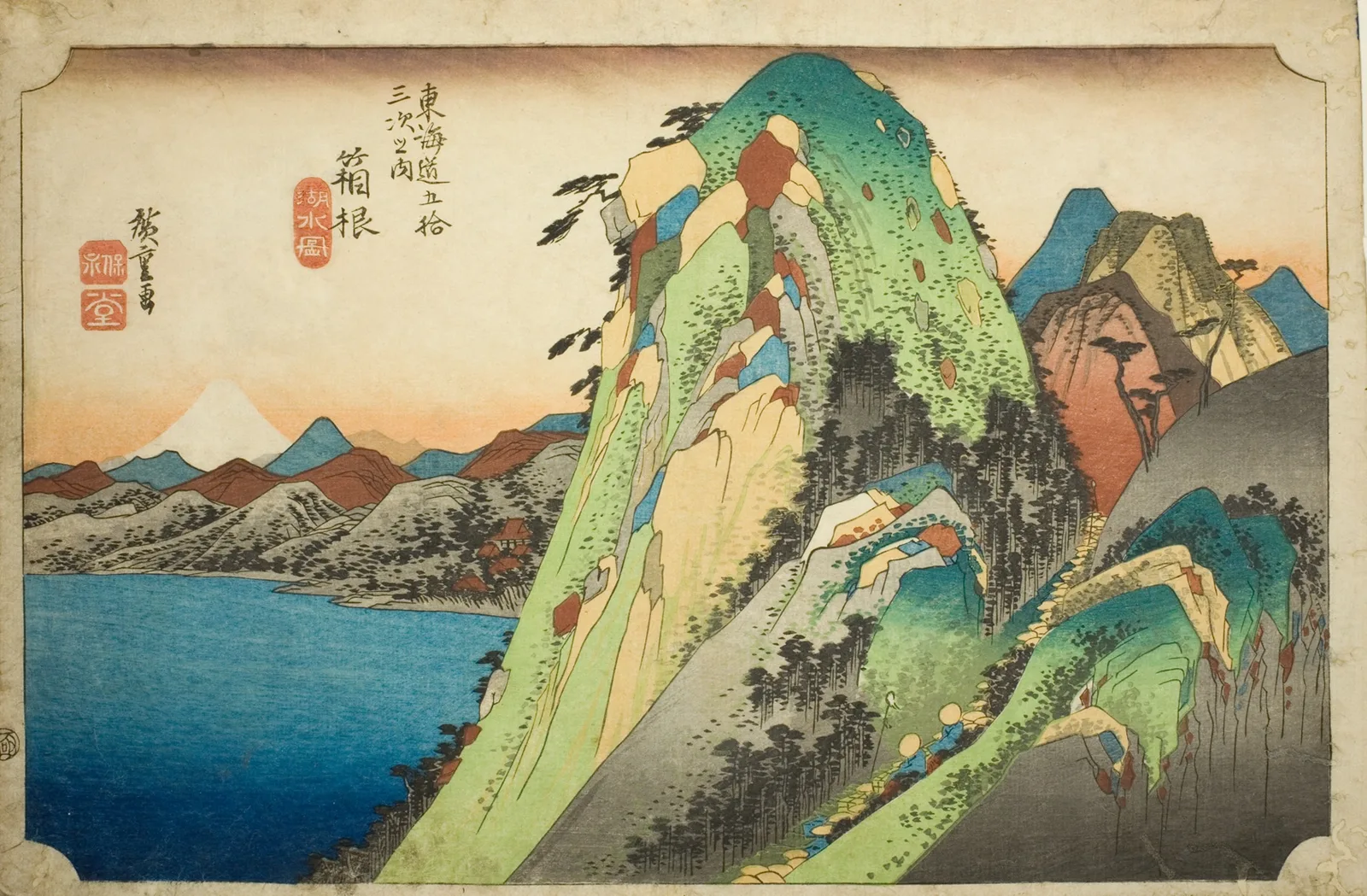
The Fifty-three Stations of the Tokaido (Hoeido edition) ・ 11
The Lake at Hakone
東海道五拾三次之内 箱根 湖水図
A steep rocky mountain towering at the center is painted in mosaic-like planes of green, yellow, blue, and red, with Lake Ashi to its left and a distant white Mount Fuji. Along the valley of the rock face, a daimyo procession winds down in a thin line.
- Artist
- Utagawa Hiroshige
- Date
- c. 1833-34 (Tenpo 4-5)
- Medium / format
- Woodblock print (ukiyo-e)
- Series
- The Fifty-three Stations of the Tokaido (Hoeido edition) 55 prints
- Place depicted
- Hakone-juku(Kanagawa)
- Seen in the distance
- Mount Fuji
About this work
The rocky mountain that fills most of the picture is painted like patchwork, with planes of different colors fitted along its contours. Rather than the actual color of the mountain, this is a way of drawing that expresses its steepness through color and form, making it one of the boldest prints in the Hoeido edition.
At the lower right of the rock face, along the steep path in the valley, tiny figures of a daimyo procession continue in a line. The smallness of the people strongly conveys the size of the mountain and the harshness of the road.
On the left, the lake spreads in deep blue, and beyond the ranges behind it a small snow-capped Mount Fuji peeks out. Hakone was a pass regarded as one of the most difficult on the Tokaido, and a checkpoint was also placed there. Through the contrast of the steep mountain and the quiet lake, Hiroshige expresses the character of the place.
Red and brown planes also overlap on the rocky mountain at right, suggesting the rich variety of rock faces in sunlight. The whiteness of Fuji and the deep blue of the lake create a quiet contrast beside the colorful rock. The Hakone checkpoint stood on the shore of Lake Ashi, and travelers were questioned there. This print does not show the checkpoint itself but represents Hakone through the scenery of lake and mountain.
The place today
The old Hakone Highway is designated a national historic site, and its stone pavement and cedar-lined avenue remain today. On the shore of Lake Ashi, the Hakone Checkpoint, restored to its late Edo appearance, has been fully open to the public since 2007. The view of Mount Fuji across the lake also continues to this day.
Where can I see it?
Exhibitions change over time. Check each museum's exhibition information before you visit.
Museums that hold this work
- Tokyo National MuseumMuseum's page for this work (opens in a new tab)
Taito City, Tokyo Accession no. A-12499-14
Museums that hold this series (please check the museum's website for whether it holds this print)
- Shizuoka City Tokaido Hiroshige Museum of Art
Shimizu Ward, Shizuoka
All prints of the Hoeido edition were shown in the museum's collection exhibition Fifty-three Stations of the Tokaido (2024-25)
Museums abroad
- Art Institute of ChicagoMuseum's page for this work (opens in a new tab)
Chicago Accession no. 1939.1362
Frequently asked questions
- Who painted The Fifty-three Stations of the Tokaido: The Lake at Hakone, and when?
- The Fifty-three Stations of the Tokaido: The Lake at Hakone is by Utagawa Hiroshige, made in c. 1833-34 (Tenpo 4-5). Medium: Woodblock print (ukiyo-e).
- What place does The Fifty-three Stations of the Tokaido: The Lake at Hakone show?
- It shows Hakone-juku (Kanagawa).
- Where can I see The Fifty-three Stations of the Tokaido: The Lake at Hakone?
- It is held by Tokyo National Museum, Tokyo Fuji Art Museum, National Diet Library. Exhibitions change, so check each museum's information before you visit.
Sources and references
- Art Institute of Chicago: Hakone: View of the Lake (Hakone, kosui no zu) (opens in a new tab) (checked 2026-10-18)
- ColBase(東京国立博物館): A-12499-14 (opens in a new tab) (checked 2026-10-18)
- 東京富士美術館 収蔵品: 東海道五拾三次之内 箱根 湖水図 (opens in a new tab) (checked 2026-10-18)
- 国立国会図書館デジタルコレクション: 東海道五拾三次 箱根・湖水図 (opens in a new tab) (checked 2026-10-18)
You may also like
More from Kanagawa
Discover more of the same region on our sister sites.