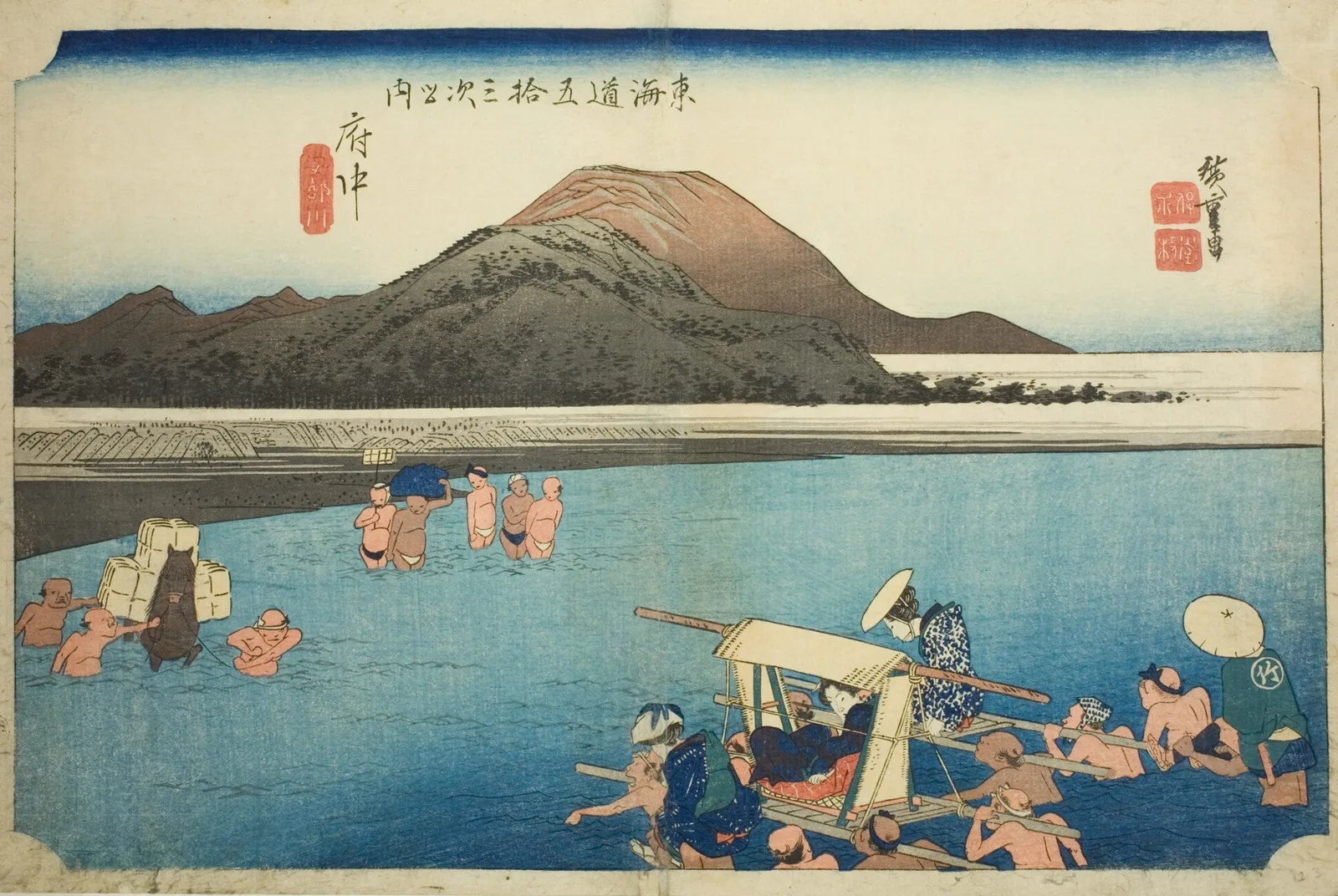
The Fifty-three Stations of the Tokaido (Hoeido edition) ・ 20
The Abe River near Fuchu
東海道五拾三次之内 府中 安部川
This print shows travelers crossing the Abe River in various ways, with some carried on platforms in their palanquins and others on porters' backs. The blue mountains in the back and the broad river bank convey the leisurely terrain of Sunpu.
- Artist
- Utagawa Hiroshige
- Date
- c. 1833-34 (Tenpo 4-5)
- Medium / format
- Woodblock print (ukiyo-e)
- Series
- The Fifty-three Stations of the Tokaido (Hoeido edition) 55 prints
- Place depicted
- Fuchu-juku (Sunpu)(Shizuoka)
About this work
In the foreground, a woman traveler, palanquin and all, is placed on a rendai and carried across the river by many porters. Beside her can be seen people crossing on porters' backs and others on their shoulders. Like the Sakawa and Oi Rivers, the Abe River was one that people crossed on foot with the help of porters.
From the far bank, porters leading a horse loaded with baggage into the river, and a party walking in water up to their waists, are crossing toward us. Across the river, people go back and forth in different directions and in different ways.
Fuchu, also called Sunpu, was the castle town where Tokugawa Ieyasu spent his later years. The Abe River flows to its west, and after crossing it one heads to the next station, Mariko-juku. Hiroshige spreads the blue of the water across the whole picture, showing both the trouble and the bustle of the river crossing at the same time.
At the right edge of the picture, a figure in a kimono marked on the back and with a hat slung behind him is in the water along with the porters. The three bands of blue stream in front, white gravel bank in the middle, and mountains in the back give the wide horizontal picture a stable breadth. The top edge of the sky is shaded in deep indigo, echoing the blue of the river.
The place today
The Abekawa Bridge of the former National Route 1 spans the Abe River and is a nationally registered tangible cultural property. At the foot of the bridge stand shops selling the local specialty, Abekawa mochi. The site of Sunpu Castle, the center of Fuchu, is now a park, with the Tatsumi Yagura, Higashi-mon Gate, and Hitsujisaru Yagura restored.
Where can I see it?
Exhibitions change over time. Check each museum's exhibition information before you visit.
Museums that hold this work
- Tokyo National MuseumMuseum's page for this work (opens in a new tab)
Taito City, Tokyo Accession no. A-12499-23
Museums that hold this series (please check the museum's website for whether it holds this print)
- Shizuoka City Tokaido Hiroshige Museum of Art
Shimizu Ward, Shizuoka
All prints of the Hoeido edition were shown in the museum's collection exhibition Fifty-three Stations of the Tokaido (2024-25)
Museums abroad
- Art Institute of ChicagoMuseum's page for this work (opens in a new tab)
Chicago Accession no. 1925.3521
Frequently asked questions
- Who painted The Fifty-three Stations of the Tokaido: The Abe River near Fuchu, and when?
- The Fifty-three Stations of the Tokaido: The Abe River near Fuchu is by Utagawa Hiroshige, made in c. 1833-34 (Tenpo 4-5). Medium: Woodblock print (ukiyo-e).
- What place does The Fifty-three Stations of the Tokaido: The Abe River near Fuchu show?
- It shows Fuchu-juku (Sunpu) (Shizuoka).
- Where can I see The Fifty-three Stations of the Tokaido: The Abe River near Fuchu?
- It is held by Tokyo National Museum, Tokyo Fuji Art Museum, National Diet Library. Exhibitions change, so check each museum's information before you visit.
Sources and references
- Art Institute of Chicago: Fuchu: The Abe River (Fuchu, Abekawa) (opens in a new tab) (checked 2026-10-18)
- ColBase(東京国立博物館): A-12499-23 (opens in a new tab) (checked 2026-10-18)
- 東京富士美術館 収蔵品: 東海道五拾三次之内 府中 安部川 (opens in a new tab) (checked 2026-10-18)
- 国立国会図書館デジタルコレクション: 東海道五拾三次 府中・安部川 (opens in a new tab) (checked 2026-10-18)
You may also like
More from Shizuoka
Discover more of the same region on our sister sites.