Famous Places in the Sixty-odd Provinces ・ 39
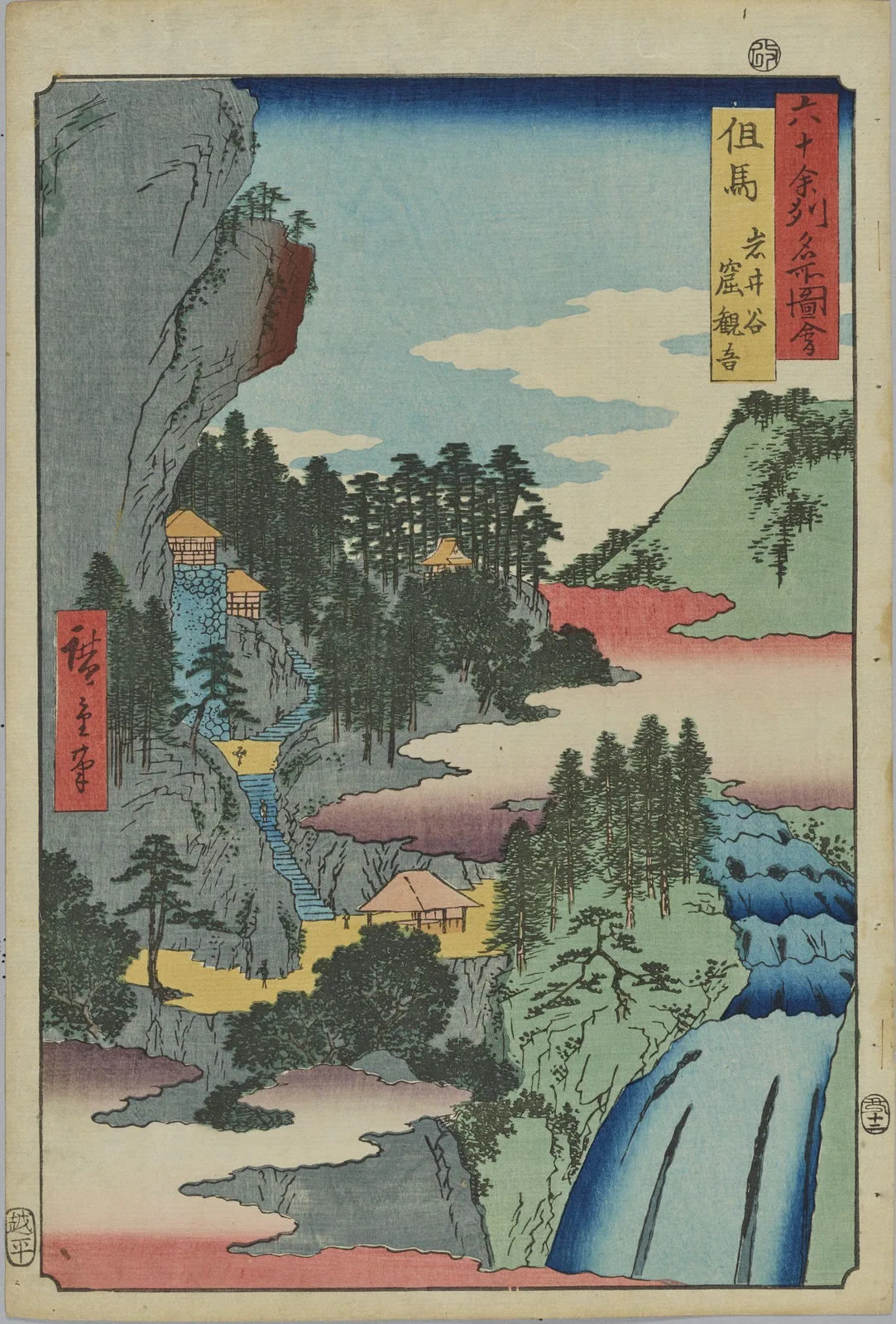
Tajima Province: The Cave Kannon in Iwai Valley
六十余州名所図会 但馬 岩井谷 窟観音
This print shows the Cave Kannon, set in the mountains of Tajima Province (northern Hyogo Prefecture). A small hall clings to a sheer rock wall, a long flight of stone steps descends into the valley, and a blue waterfall pours vigorously down in the foreground.
- Artist
- Utagawa Hiroshige
- Date
- 1853 (Kaei 6)
- Medium / format
- Woodblock print (ukiyo-e)
- Series
- Famous Places in the Sixty-odd Provinces 69 prints
- Place depicted
- Iwaya Kannon, Washihara-ji Temple(Hyogo)
About this work
A large gray rock wall occupies the left side of the picture, and partway up it a small hall built on stilts stands pressed against the rock. Stone steps lead from the hall down to the valley, where a thatched building sits below. At lower right a blue waterfall drops in white streaks, and green mountains overlap behind.
The gray of the rock face, the deep green of the cedar grove, and the indigo of the waterfall give the picture firmness, while bands of pink and yellow mist drift through the valley. The tall format is sandwiched between rock wall and waterfall on either side, with the mist in the middle creating depth, a composition fitting a sacred site deep in the mountains.
The "cave Kannon of Iwai Valley" in the title is said to be the Iwaya Kannon, the inner sanctuary of Garyu-ji temple in Iwatsu, Asago, Hyogo Prefecture today. It is a place where a group of stone Buddhas is enshrined beneath a great rock, and is thought to have been known in the Edo period as a sacred site of Tajima. Pilgrims are thought to have reached the temple's inner sanctuary by following a mountain path along the valley.
Tajima on the San'indo road is placed in the series next to Tango's Amanohashidate. The Art Institute of Chicago does not hold this print, and the image is of an impression held by the Tokyo National Museum. The National Diet Library's impression has the same composition. A sacred site with a hall built on a steep crag is a subject shared with the series' prints of Horai-ji in Mikawa and the Abuto Kannon in Bingo.
The place today
The Iwaya Kannon is an inner sanctuary about a kilometer up the valley from Garyu-ji, where a group of stone Buddhas said to date from the Kamakura period, including an Eleven-Headed Kannon and a Thousand-Armed Kannon, is enshrined beneath a large rock. The stone Buddhas are designated cultural properties of Hyogo Prefecture and are put on view on Setsubun, at the great festival in April, and on the morning of the 18th of each month.
Where can I see it?
Exhibitions change over time. Check each museum's exhibition information before you visit.
Museums that hold this work
- Tokyo National MuseumMuseum's page for this work (opens in a new tab)
Taito City, Tokyo Accession no. A-12499-232
- National Diet LibraryMuseum's page for this work (opens in a new tab)
Chiyoda City, Tokyo Accession no. 寄別1-9-2-4
Included in Dai Nihon Rokujuyoshu Meisho Zue
Museums abroad
- Art Institute of ChicagoMuseum's page for this work (opens in a new tab)
Chicago
Most of the views, including the gift of Mr. and Mrs. Harold G. Henderson (1965.952 onward)
Frequently asked questions
- Who painted Famous Places in the Sixty-odd Provinces: Tajima Province: The Cave Kannon in Iwai Valley, and when?
- Famous Places in the Sixty-odd Provinces: Tajima Province: The Cave Kannon in Iwai Valley is by Utagawa Hiroshige, made in 1853 (Kaei 6). Medium: Woodblock print (ukiyo-e).
- What place does Famous Places in the Sixty-odd Provinces: Tajima Province: The Cave Kannon in Iwai Valley show?
- It shows Iwaya Kannon, Washihara-ji Temple (Hyogo).
- Where can I see Famous Places in the Sixty-odd Provinces: Tajima Province: The Cave Kannon in Iwai Valley?
- It is held by Tokyo National Museum, National Diet Library. Exhibitions change, so check each museum's information before you visit.
Sources and references
- ColBase(東京国立博物館): 六十余州名所図会 但馬 岩井谷 窟観音 (opens in a new tab) (checked 2026-10-19)
- 国立国会図書館デジタルコレクション: 六十余州名所図会 但馬 岩井谷窟観音 (opens in a new tab) (checked 2026-10-19)
You may also like
More from Hyogo
Discover more of the same region on our sister sites.