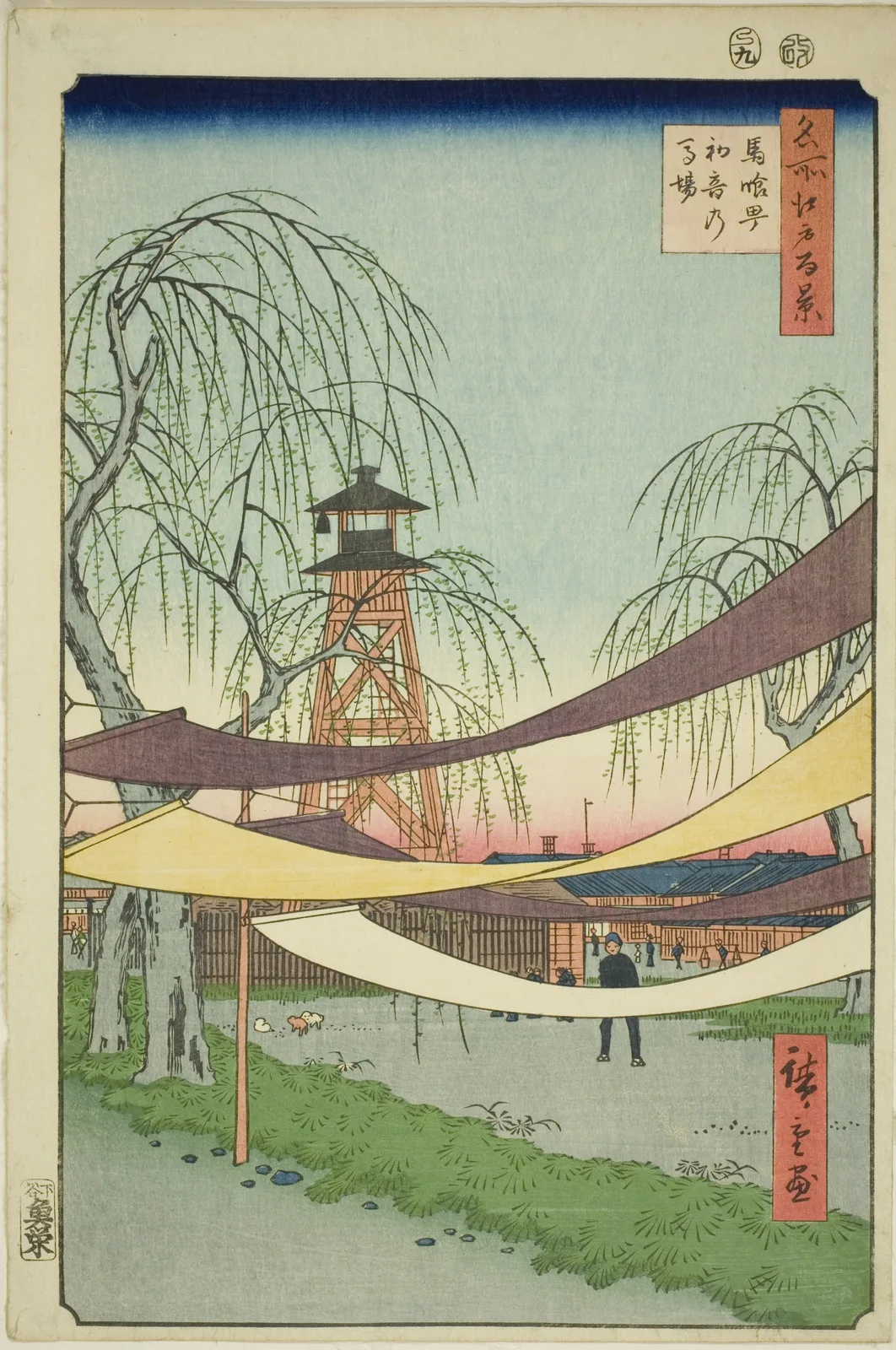
One Hundred Famous Views of Edo ・ 6
The Hatsune Riding Grounds at Bakuro-cho
名所江戸百景 馬喰町初音の馬場
This print shows the Hatsune Riding Grounds at Bakuro-cho. Long cloths hung out by dyers stretch in many strands among willow trees, with a tall fire lookout tower rising behind them. The breadth of the riding ground and the life of the town overlap in a single scene.
- Artist
- Utagawa Hiroshige
- Date
- September 1857 (Ansei 4)
- Medium / format
- Woodblock print (ukiyo-e)
- Series
- One Hundred Famous Views of Edo 119 prints
- Place depicted
- Bakurocho(Tokyo)
About this work
From the grassy foreground to the riding ground behind, long cloths dyed yellow, white and purple are stretched in many horizontal lines. Budding willows hang their branches at left and right, and a fire lookout tower rises at center rear. A lone figure stands under the cloths, and beyond that the roofs of townhouses continue.
The horizontal bands of flowing cloth and the vertical lines of the tower and willow trunks divide the picture like a lattice. The combination of the pale colors of the dusk sky and the vivid colors of the cloth sets off the stillness of the wide riding ground.
The Hatsune Riding Grounds is said to have been one of the oldest riding grounds in Edo, and it is told that the name came from the Hatsune Inari Shrine nearby. The wide open space was also used for drying cloth dyed by nearby dyers, and the fire lookout watched over a town that suffered many fires.
This is the sixth print of the Spring section. A major feature of the print is that it shows the place through cloth and a tower, without depicting the horses from which the famous place took its name. The censor's seal dates it to September 1857 (Ansei 4). The hanging cloths show the work of the nearby dyers and bring the everyday life of an artisans' town directly into the famous view. Depicting the unremarkable scenery of an urban vacant lot as a famous place reflects Hiroshige's interests in his later years.
The place today
The site of the riding grounds is around today's Nihombashi Bakurocho in Chuo Ward, and no trace of its appearance then remains. In the Edo period Bakurocho prospered as a town of inns and wholesalers, and it is still known as a district gathering wholesalers of clothing and sundries. Together with nearby Asakusabashi, it conveys the atmosphere of a wholesale district.
Where can I see it?
Exhibitions change over time. Check each museum's exhibition information before you visit.
Museums that hold this work
- Tokyo National MuseumMuseum's page for this work (opens in a new tab)
Taito City, Tokyo Accession no. A-12499-324
- National Diet LibraryMuseum's page for this work (opens in a new tab)
Chiyoda City, Tokyo Accession no. 寄別1-8-2-1イ
Another impression is also held under Yoribetsu 1-8-2-1 (pid 1312242)
Museums abroad
- Art Institute of ChicagoMuseum's page for this work (opens in a new tab)
Chicago Accession no. 1925.3759
Frequently asked questions
- Who painted One Hundred Famous Views of Edo: The Hatsune Riding Grounds at Bakuro-cho, and when?
- One Hundred Famous Views of Edo: The Hatsune Riding Grounds at Bakuro-cho is by Utagawa Hiroshige, made in September 1857 (Ansei 4). Medium: Woodblock print (ukiyo-e).
- What place does One Hundred Famous Views of Edo: The Hatsune Riding Grounds at Bakuro-cho show?
- It shows Bakurocho (Tokyo).
- Where can I see One Hundred Famous Views of Edo: The Hatsune Riding Grounds at Bakuro-cho?
- It is held by Tokyo National Museum, National Diet Library. Exhibitions change, so check each museum's information before you visit.
Sources and references
- Art Institute of Chicago: The Hatsune Riding Grounds at Bakuro-cho (Bakuro-cho Hatsune no Baba), from the series "One Hundred Famous Views of Edo (Meisho Edo hyakkei)" (opens in a new tab) (checked 2026-10-19)
- ColBase(東京国立博物館): 名所江戸百景 馬喰町初音の馬場 (opens in a new tab) (checked 2026-10-19)
- 国立国会図書館デジタルコレクション: 名所江戸百景 馬喰町初音の馬場 (opens in a new tab) (checked 2026-10-19)
You may also like
More from Tokyo
Discover more of the same region on our sister sites.