Famous Places in the Sixty-odd Provinces ・ 33
Noto Province: Bay of Waterfalls
六十余州名所図会 能登 滝之浦
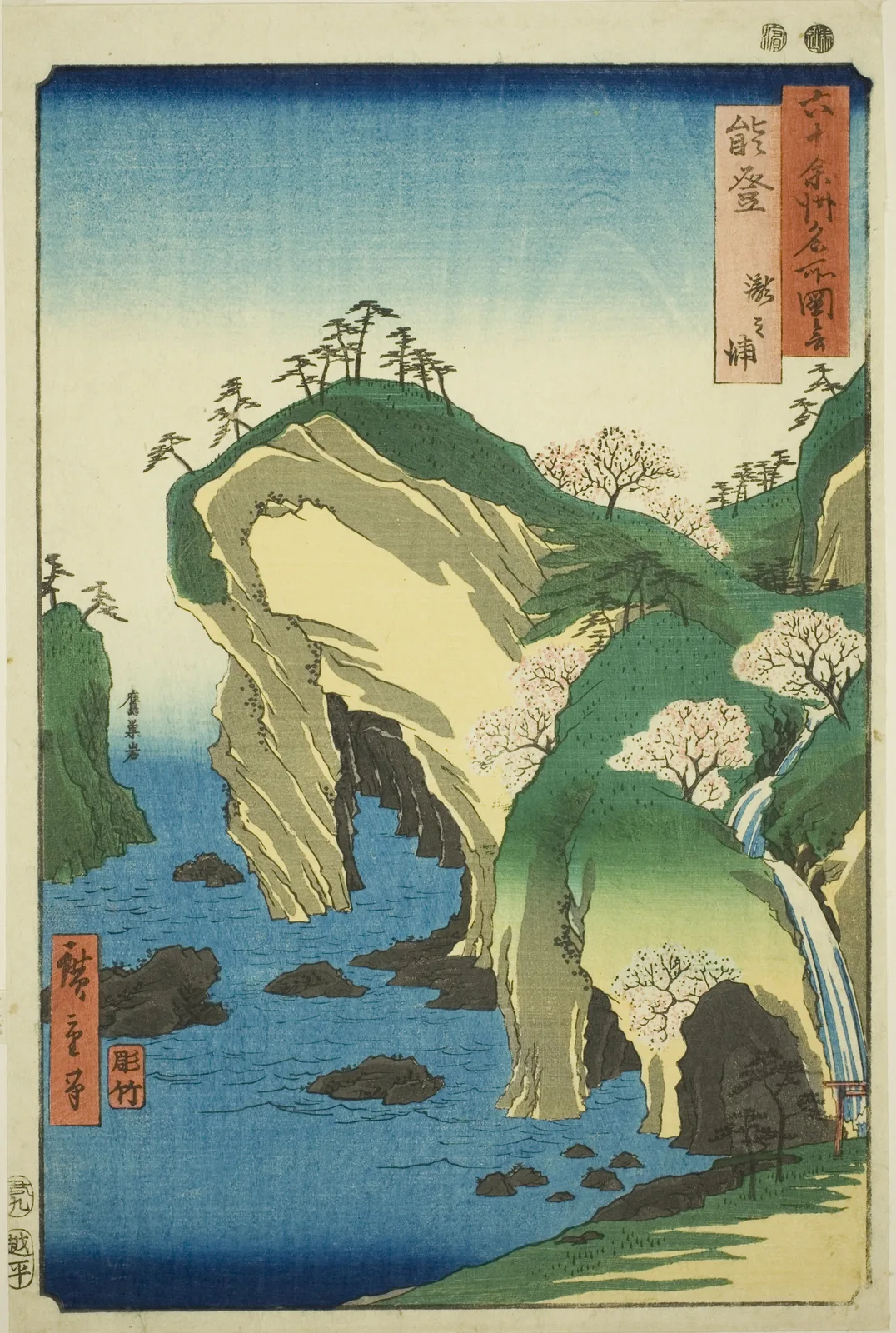
This print shows Taki no Ura in Noto Province, with a sea-jutting cliff, a rock arch, and a waterfall dropping from a cliff covered in cherry blossoms. Blue sea flows in beneath a large hole in the rock, and the contrast between spring blossoms and rugged rock catches the eye.
- Artist
- Utagawa Hiroshige
- Date
- 1853 (Kaei 6)
- Medium / format
- Woodblock print (ukiyo-e)
- Series
- Famous Places in the Sixty-odd Provinces 69 prints
- Place depicted
- Ganmon, Noto Kongo Coast(Ishikawa)
About this work
Left of center, a large ocher rock juts into the sea, and below it an arch opens its mouth to let seawater in. The top of the rock is covered in green, with pines standing in a row. On the slope at right, cherry trees bloom here and there, a single waterfall drops from the cliff edge into the sea, and a small torii gate can be seen beneath it. To the left of the rock is also a small pine-covered cape, which sets off the depth of the arch.
The sky and sea are shaded from indigo to light blue, and the ocher of the rock, the green of the slope, and the pale pink of the cherry blossoms stand out brightly. The shadow of the dark rock in the foreground suggests the depth of the cave, and the whole picture is filled with the light of a spring seashore.
Taki no Ura is said to be an old name for the area around Ganmon, in the Noto Kongo coast of present-day Shika. Ganmon is a rock arch formed by wave erosion, and the Fudo Falls that drops nearby is thought to be depicted large in this print.
The west coast of the Noto Peninsula, facing the open sea, is a rugged shoreline of rocks and caves. Hiroshige adds cherry blossoms and a waterfall to this strange scenery and presents it as a spring sight. The National Diet Library also holds an impression with the same composition.
The place today
Ganmon is in Shika, Hakui District, Ishikawa Prefecture, and is a representative scenic spot of the Noto Kongo area in Noto Hanto Quasi-National Park. An arch about 6 m wide and 15 m high opens in the rock of the cape, and visitors can walk through it along a promenade. Nearby are Takanosu Iwa and Fudo Falls, and sightseeing boats have also run to view the cliffs from the sea.
Where can I see it?
Exhibitions change over time. Check each museum's exhibition information before you visit.
Museums that hold this work
- Tokyo National MuseumMuseum's page for this work (opens in a new tab)
Taito City, Tokyo Accession no. A-12499-226
- National Diet LibraryMuseum's page for this work (opens in a new tab)
Chiyoda City, Tokyo Accession no. 寄別1-9-2-4
Included in Dai Nihon Rokujuyoshu Meisho Zue
Museums abroad
- Art Institute of ChicagoMuseum's page for this work (opens in a new tab)
Chicago Accession no. 1965.977
Frequently asked questions
- Who painted Famous Places in the Sixty-odd Provinces: Noto Province: Bay of Waterfalls, and when?
- Famous Places in the Sixty-odd Provinces: Noto Province: Bay of Waterfalls is by Utagawa Hiroshige, made in 1853 (Kaei 6). Medium: Woodblock print (ukiyo-e).
- What place does Famous Places in the Sixty-odd Provinces: Noto Province: Bay of Waterfalls show?
- It shows Ganmon, Noto Kongo Coast (Ishikawa).
- Where can I see Famous Places in the Sixty-odd Provinces: Noto Province: Bay of Waterfalls?
- It is held by Tokyo National Museum, National Diet Library. Exhibitions change, so check each museum's information before you visit.
Sources and references
- Art Institute of Chicago: Noto Province: Bay of Waterfalls (Noto, Taki no ura) (opens in a new tab) (checked 2026-10-19)
- ColBase(東京国立博物館): 六十余州名所図会 能登 滝之浦 (opens in a new tab) (checked 2026-10-19)
- 国立国会図書館デジタルコレクション: 六十余州名所図会 能登 滝之浦 (opens in a new tab) (checked 2026-10-19)
You may also like
More from Ishikawa
Discover more of the same region on our sister sites.
Ikimono Kokuho
Natural Monument animals of Ishikawa
- Bean Goose (including Taiga and Tundra Bean Geese)
- Greater White-fronted Goose
- Hokuriku Salamander
- Anchor-marked Tiger Beetle