The Sixty-nine Stations of the Kisokaido ・ 4
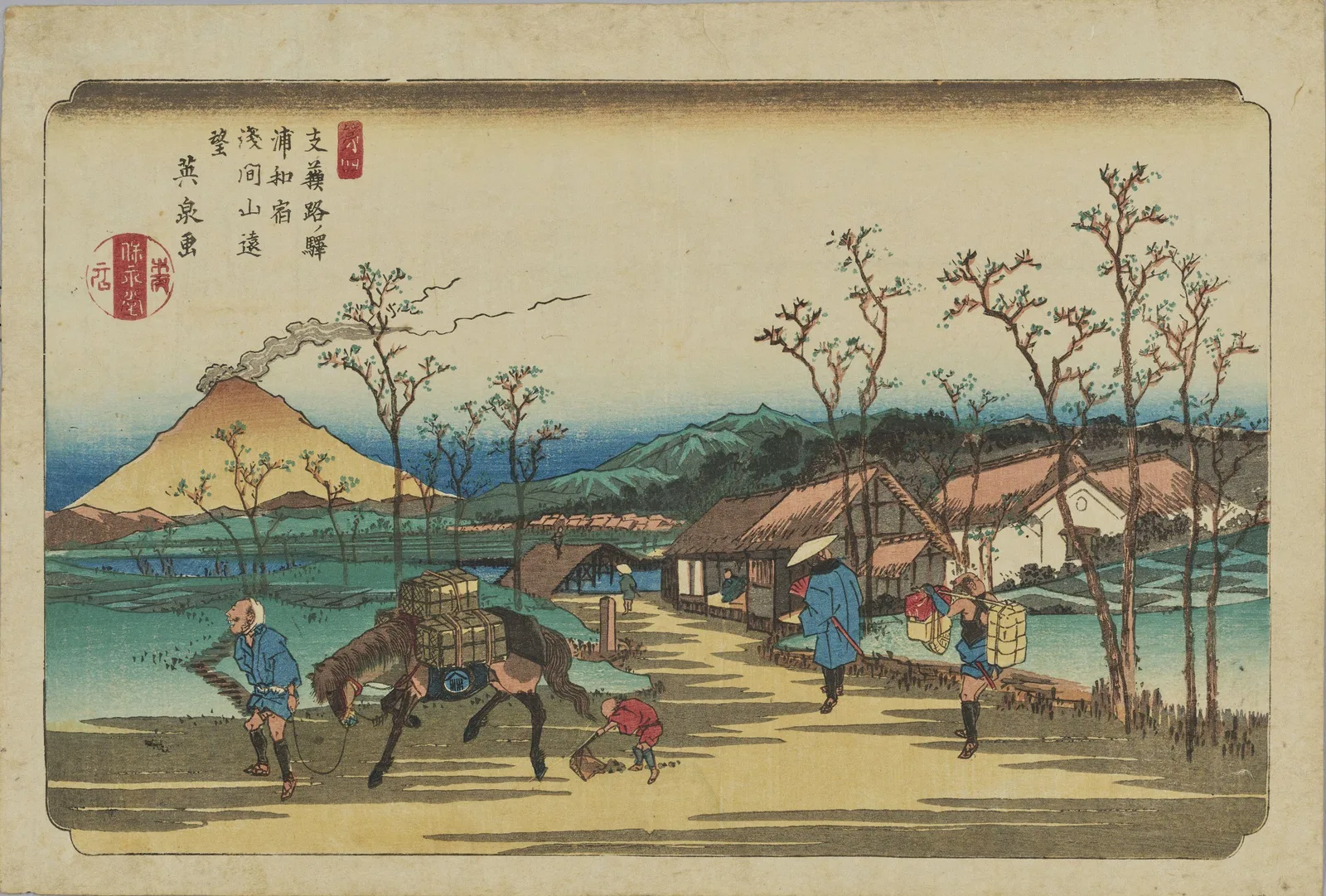
Distant View of Mount Asama from Urawa Station
支蘇路ノ駅 浦和宿 浅間山遠望
A print of the road on the outskirts of Urawa-juku seen through early-spring trees. Beyond the road, where an old man leads a loaded horse and a child walks, teahouse roofs line up, and in the distance Mount Asama can be seen sending up smoke.
- Artist
- Keisai Eisen
- Date
- c. 1835-36 (Tenpo 6-7)
- Medium / format
- Woodblock print (ukiyo-e)
- Series
- The Sixty-nine Stations of the Kisokaido 71 prints
- Place depicted
- Urawa-juku(Saitama)
- Seen in the distance
- Mount Asama
About this work
On the road in the foreground, an old man pulls a horse loaded on its back by a rope, and at his feet a child gathers something with a rake-like tool. In the middle walk a traveler in a hat and blue robe and a man carrying a wooden box on his back. Thin trees just beginning to bud line both sides of the road, and beyond them are straw-roofed teahouses and white-walled houses.
At the back left an ocher mountain spews smoke, and green ranges overlap to its right. The rice field in the foreground is filled with water and shines white. Eisen unifies the sky in pale yellow and depicts the hazy air of spring with the mountain's smoke and the lines of the thin branches.
Urawa-juku was the third station from Edo, and although small as a post town, it bustled as a market town with markets held on days ending in 2 and 7. Mount Asama cannot actually be seen from Urawa, and the "Distant View of Mount Asama" in the title is thought to be a device indicating the road ahead.
This is a print by Eisen, with the title written as "Shiso-ji no eki" and bearing the signature and the publisher's seal. Eisen's way of writing the title is not consistent, and he changes the characters from print to print, such as "Kisokaido," "Kiso Kaido," and "Shisoji." Adding a distant mountain to the station at the start of the journey, this print evokes anticipation of the road ahead.
The place today
Urawa-juku corresponds to the center of today's Urawa Ward, Saitama City. In Nakacho 2-chome remains the site of the Hoshino family, who served as honjin, and along the old Nakasendo statues also evoke the bustle of the market. Urawa has now grown into a large city as the prefectural capital of Saitama.
Where can I see it?
Exhibitions change over time. Check each museum's exhibition information before you visit.
Museums that hold this work
- Tokyo National MuseumMuseum's page for this work (opens in a new tab)
Taito City, Tokyo Accession no. A-12499-68
- National Diet LibraryMuseum's page for this work (opens in a new tab)
Chiyoda City, Tokyo Accession no. 寄別2-2-1-5
Included in Kisokaido Rokujukyu-tsugi
Museums abroad
Frequently asked questions
- Who painted The Sixty-nine Stations of the Kisokaido: Distant View of Mount Asama from Urawa Station, and when?
- The Sixty-nine Stations of the Kisokaido: Distant View of Mount Asama from Urawa Station is by Keisai Eisen, made in c. 1835-36 (Tenpo 6-7). Medium: Woodblock print (ukiyo-e).
- What place does The Sixty-nine Stations of the Kisokaido: Distant View of Mount Asama from Urawa Station show?
- It shows Urawa-juku (Saitama).
- Where can I see The Sixty-nine Stations of the Kisokaido: Distant View of Mount Asama from Urawa Station?
- It is held by Tokyo National Museum, National Diet Library. Exhibitions change, so check each museum's information before you visit.
Sources and references
- ColBase(東京国立博物館): 支蘇路ノ駅 浦和宿 浅間山遠望 (opens in a new tab) (checked 2026-10-19)
- 国立国会図書館デジタルコレクション: 第四 支蘇路ノ駅浦和宿浅間山遠望 (opens in a new tab) (checked 2026-10-19)
You may also like
More from Saitama
Discover more of the same region on our sister sites.