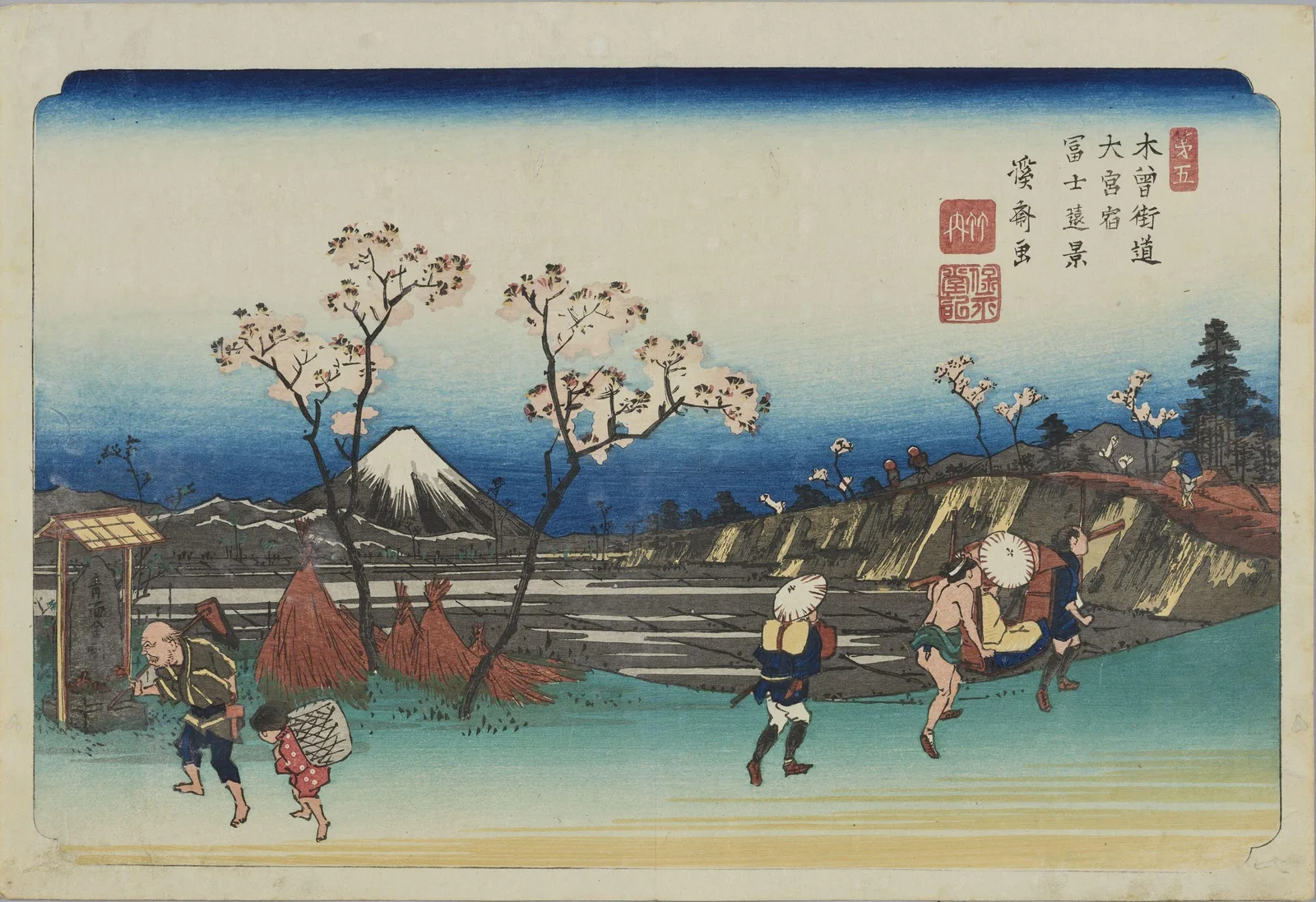
The Sixty-nine Stations of the Kisokaido ・ 5
Distant View of Mount Fuji from Omiya Station
木曽街道 大宮宿 冨士遠景
A print of a country path near Omiya-juku, with cherry trees in full bloom and Mount Fuji in the distance. Palanquin bearers run with a passenger, a pair who look like parent and child walk past a shrine in the foreground, and snowy Fuji rises beyond the fields.
- Artist
- Keisai Eisen
- Date
- c. 1835-36 (Tenpo 6-7)
- Medium / format
- Woodblock print (ukiyo-e)
- Series
- The Sixty-nine Stations of the Kisokaido 71 prints
- Place depicted
- Omiya-juku(Saitama)
- Seen in the distance
- Mount Fuji
About this work
At the left foreground stands a small roofed shrine, in front of which a man carrying a load and a child with a basket on the back walk. At right, two palanquin bearers run briskly with a passenger, and a traveler in a hat follows them. In the middle, several piles of reddish-brown rice straw are stacked, with a little smoke rising.
In the center of the picture two blossoming cherry trees stretch up, and between their branches snow-covered Mount Fuji peeks out. To the right an ocher cliff continues, with cherry trees lined up on top of it too. The sky is deep indigo above and pale near the horizon, making the sense of distance clear.
The name Omiya comes from Hikawa Shrine, the Ichinomiya (first shrine) of Musashi Province, and the post town is said to have been established to the west, moved from the shrine's approach. From this area in the middle of the Kanto Plain, Mount Fuji could be seen far away on clear days.
This is a print by Eisen, titled "Kisokaido," with his signature and the publisher's seal. Near the start of the series, Eisen adds Mount Asama in the distance at Urawa and Mount Fuji at Omiya and Konosu, drawing in the mountains visible from the Kanto Plain like landmarks of the journey.
The place today
Omiya-juku corresponds to today's Omiya Ward, Saitama City, and Hikawa Shrine and its approach of about 2 kilometers are still symbols of Omiya. Almost none of the station's buildings survive, but Kitazawa Inari is enshrined on the roof of the department store built on the site of the Kishu Takaba Honjin, preserving a trace of the post town.
Where can I see it?
Exhibitions change over time. Check each museum's exhibition information before you visit.
Museums that hold this work
- Tokyo National MuseumMuseum's page for this work (opens in a new tab)
Taito City, Tokyo Accession no. A-12499-69
- National Diet LibraryMuseum's page for this work (opens in a new tab)
Chiyoda City, Tokyo Accession no. 寄別2-2-1-5
Included in Kisokaido Rokujukyu-tsugi
Museums abroad
Frequently asked questions
- Who painted The Sixty-nine Stations of the Kisokaido: Distant View of Mount Fuji from Omiya Station, and when?
- The Sixty-nine Stations of the Kisokaido: Distant View of Mount Fuji from Omiya Station is by Keisai Eisen, made in c. 1835-36 (Tenpo 6-7). Medium: Woodblock print (ukiyo-e).
- What place does The Sixty-nine Stations of the Kisokaido: Distant View of Mount Fuji from Omiya Station show?
- It shows Omiya-juku (Saitama).
- Where can I see The Sixty-nine Stations of the Kisokaido: Distant View of Mount Fuji from Omiya Station?
- It is held by Tokyo National Museum, National Diet Library. Exhibitions change, so check each museum's information before you visit.
Sources and references
- ColBase(東京国立博物館): 木曽街道 大宮宿 冨士遠景 (opens in a new tab) (checked 2026-10-19)
- 国立国会図書館デジタルコレクション: 第五 木曽街道大宮宿富士遠景 (opens in a new tab) (checked 2026-10-19)
You may also like
More from Saitama
Discover more of the same region on our sister sites.