The Sixty-nine Stations of the Kisokaido ・ 14
Takasaki
木曽海道六拾九次之内 高崎
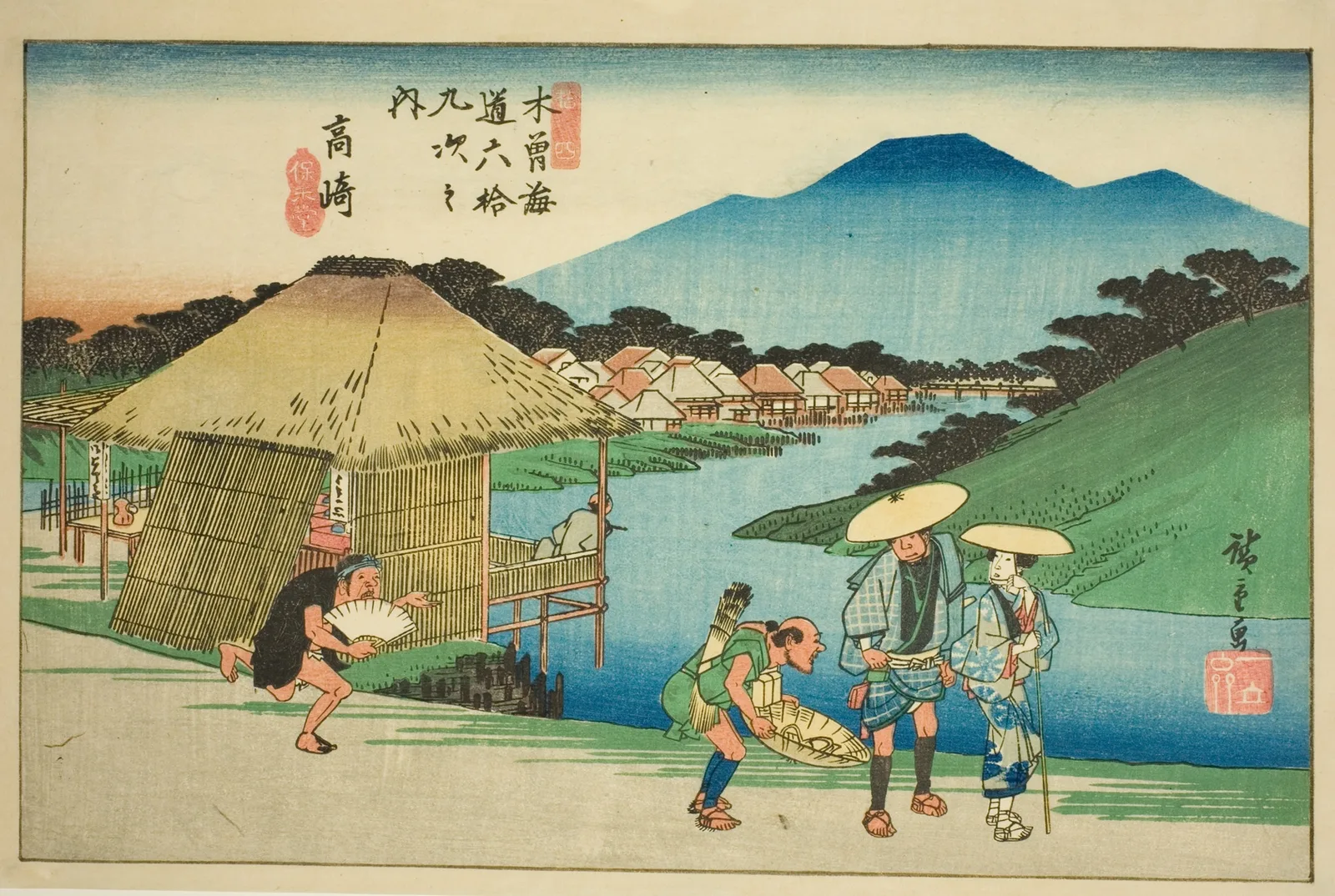
A print by Hiroshige of the riverside on the outskirts of Takasaki-juku. In front of a teahouse, men stoop and approach a pair of travelers, and beyond the river, houses and a bridge stand, with blue mountains rising large behind.
- Artist
- Utagawa Hiroshige
- Date
- c. 1835-38 (Tenpo 6-9)
- Medium / format
- Woodblock print (ukiyo-e)
- Series
- The Sixty-nine Stations of the Kisokaido 71 prints
- Place depicted
- Takasaki-juku(Gunma)
About this work
At the right foreground, a pair of travelers in hats have stopped, and a man holding a basket bends low, speaking to them. At left a man with a fan in hand runs over from the teahouse. The teahouse is a straw-roofed hut enclosed with reed screens, and customers can be seen inside.
A river flows leisurely through the middle, a row of houses continues on the far bank, and a bridge spans it at back right. The green embankment on the right and the blue mountains behind give the picture a calm breadth. It is a print characteristic of Hiroshige, who puts the amusement of a scene of travel into the gestures of the figures.
Takasaki was a post town that doubled as a castle town, and it had no honjin, only inns. The Mikuni Kaido also branched off from the station, making it a key point of transportation in Joshu. The river depicted is thought to be the Karasu River, which flows west of the station.
This is a print by Hiroshige and bears the seal of the publisher Hoeido. The impression in the Art Institute of Chicago is the same design as that in the Tokyo National Museum. Hiroshige used in this mountainous series too the method he had cultivated in the Tokaido series of drawing small exchanges between travelers, adding human warmth to the landscape.
The place today
Takasaki-juku corresponds to the center of today's Takasaki City, Gunma Prefecture, and the layout of the castle town survives in the urban area. Almost none of the station's buildings remain, but the Karasu River still flows west of the city, and on clear days the mountains of Joshu such as Mount Haruna can be seen from the riverside.
Where can I see it?
Exhibitions change over time. Check each museum's exhibition information before you visit.
Museums that hold this work
- Tokyo National MuseumMuseum's page for this work (opens in a new tab)
Taito City, Tokyo Accession no. A-12499-78
- National Diet LibraryMuseum's page for this work (opens in a new tab)
Chiyoda City, Tokyo Accession no. 寄別2-2-1-5
Included in Kisokaido Rokujukyu-tsugi
Museums abroad
- Art Institute of ChicagoMuseum's page for this work (opens in a new tab)
Chicago Accession no. 1939.2219
Frequently asked questions
- Who painted The Sixty-nine Stations of the Kisokaido: Takasaki, and when?
- The Sixty-nine Stations of the Kisokaido: Takasaki is by Utagawa Hiroshige, made in c. 1835-38 (Tenpo 6-9). Medium: Woodblock print (ukiyo-e).
- What place does The Sixty-nine Stations of the Kisokaido: Takasaki show?
- It shows Takasaki-juku (Gunma).
- Where can I see The Sixty-nine Stations of the Kisokaido: Takasaki?
- It is held by Tokyo National Museum, National Diet Library. Exhibitions change, so check each museum's information before you visit.
Sources and references
- Art Institute of Chicago: No. 14: Takasaki, from the series "Sixty-nine Stations of the Kisokaido (Kisokaido rokujukyu tsugi no uchi)" (opens in a new tab) (checked 2026-10-19)
- ColBase(東京国立博物館): 木曽海道六拾九次之内 高崎 (opens in a new tab) (checked 2026-10-19)
- 国立国会図書館デジタルコレクション: 拾四 木曽海道六拾九次之内高崎 (opens in a new tab) (checked 2026-10-19)
You may also like
More from Gunma
Discover more of the same region on our sister sites.