The Sixty-nine Stations of the Kisokaido ・ 13
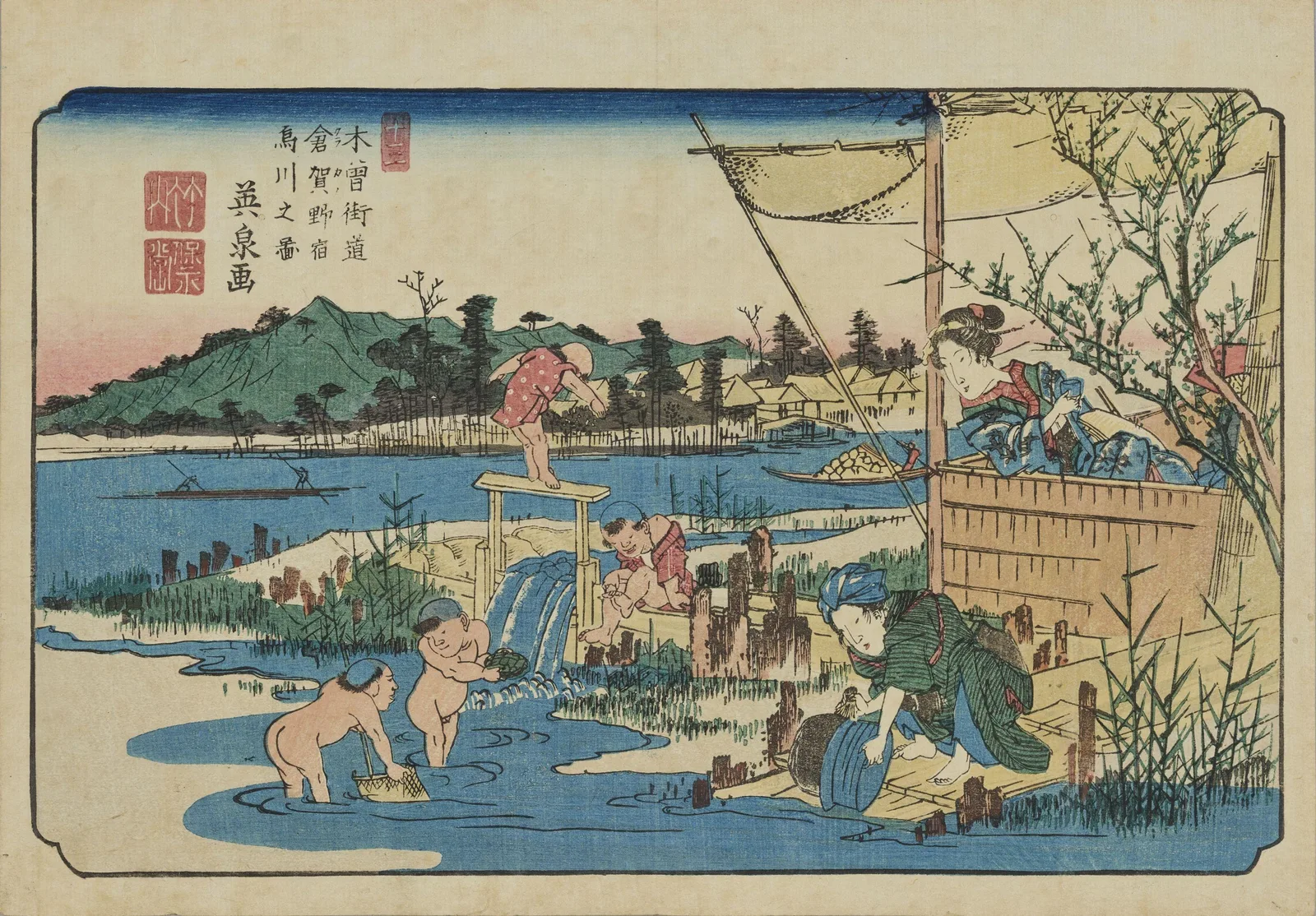
View of the Karasu River at Kuragano Station
木曽街道 倉賀野宿 烏川之図
A print of the bank of the Karasu River beside Kuragano-juku. Children catch fish in the spray of a weir, a teahouse woman by the river leans out to watch, and on the far bank can be seen boats with cargo and a row of village houses.
- Artist
- Keisai Eisen
- Date
- c. 1835-36 (Tenpo 6-7)
- Medium / format
- Woodblock print (ukiyo-e)
- Series
- The Sixty-nine Stations of the Kisokaido 71 prints
About this work
In the foreground, naked children wade into the shallows, chasing fish with baskets in hand. On top of the wooden weir stands a child in a red robe, and you can almost hear the sound of falling water. At right a woman with a hand towel on her head washes a tub, and from the board fence above her a woman with her hair done up peers at the river.
At upper right a sail-cloth awning is stretched, and the branches of what looks like a plum tree extend. Beyond the river are boats with cargo and boatmen with poles, and on the far bank continue green mountains and houses. The composition gathers people's movements in the foreground and shows the river's expanse in the distance.
Kuragano prospered as the uppermost river port on the Tone River water transport route, and boats loaded with tribute rice and other goods went down the Karasu River toward Edo. The Nikko Reiheishi Kaido also branched off from the station.
This is a print by Eisen, titled "Kiso Kaido," with his signature and the publisher's seal. Near the start of the series, Eisen adds Mount Asama at Urawa and Mount Fuji at Omiya and Konosu in the distance, drawing in the mountains visible from the Kanto Plain like landmarks of the journey. Here he conveys vividly the life of the station's river port through the figures of children and women. After Hiroshige's prints began at Shinmachi, Eisen took charge of this Kuragano and the three Joshu prints of Itahana and Sakamoto.
The place today
Kuragano-juku corresponds to today's Kuragano-machi, Takasaki City, Gunma Prefecture. The river port declined as the river became shallower after the eruption of Mount Asama in 1783 (Tenmei 3), and declined further with the opening of the railway. Today the building of a waki-honjin and the stone lantern at the fork of the Reiheishi Kaido convey slightly the appearance of those days.
Where can I see it?
Exhibitions change over time. Check each museum's exhibition information before you visit.
Museums that hold this work
- Tokyo National MuseumMuseum's page for this work (opens in a new tab)
Taito City, Tokyo Accession no. A-12499-77
- National Diet LibraryMuseum's page for this work (opens in a new tab)
Chiyoda City, Tokyo Accession no. 寄別2-2-1-5
Included in Kisokaido Rokujukyu-tsugi
Museums abroad
Frequently asked questions
- Who painted The Sixty-nine Stations of the Kisokaido: View of the Karasu River at Kuragano Station, and when?
- The Sixty-nine Stations of the Kisokaido: View of the Karasu River at Kuragano Station is by Keisai Eisen, made in c. 1835-36 (Tenpo 6-7). Medium: Woodblock print (ukiyo-e).
- What place does The Sixty-nine Stations of the Kisokaido: View of the Karasu River at Kuragano Station show?
- It shows Kuragano-juku, Karasu River (Gunma).
- Where can I see The Sixty-nine Stations of the Kisokaido: View of the Karasu River at Kuragano Station?
- It is held by Tokyo National Museum, National Diet Library. Exhibitions change, so check each museum's information before you visit.
Sources and references
- ColBase(東京国立博物館): 木曽街道 倉賀野宿 烏川之図 (opens in a new tab) (checked 2026-10-19)
- 国立国会図書館デジタルコレクション: 十三 木曽街道倉賀野宿烏川之図 (opens in a new tab) (checked 2026-10-19)
You may also like
More from Gunma
Discover more of the same region on our sister sites.