The Sixty-nine Stations of the Kisokaido ・ 22
Otai
木曽海道六拾九次之内 小田井
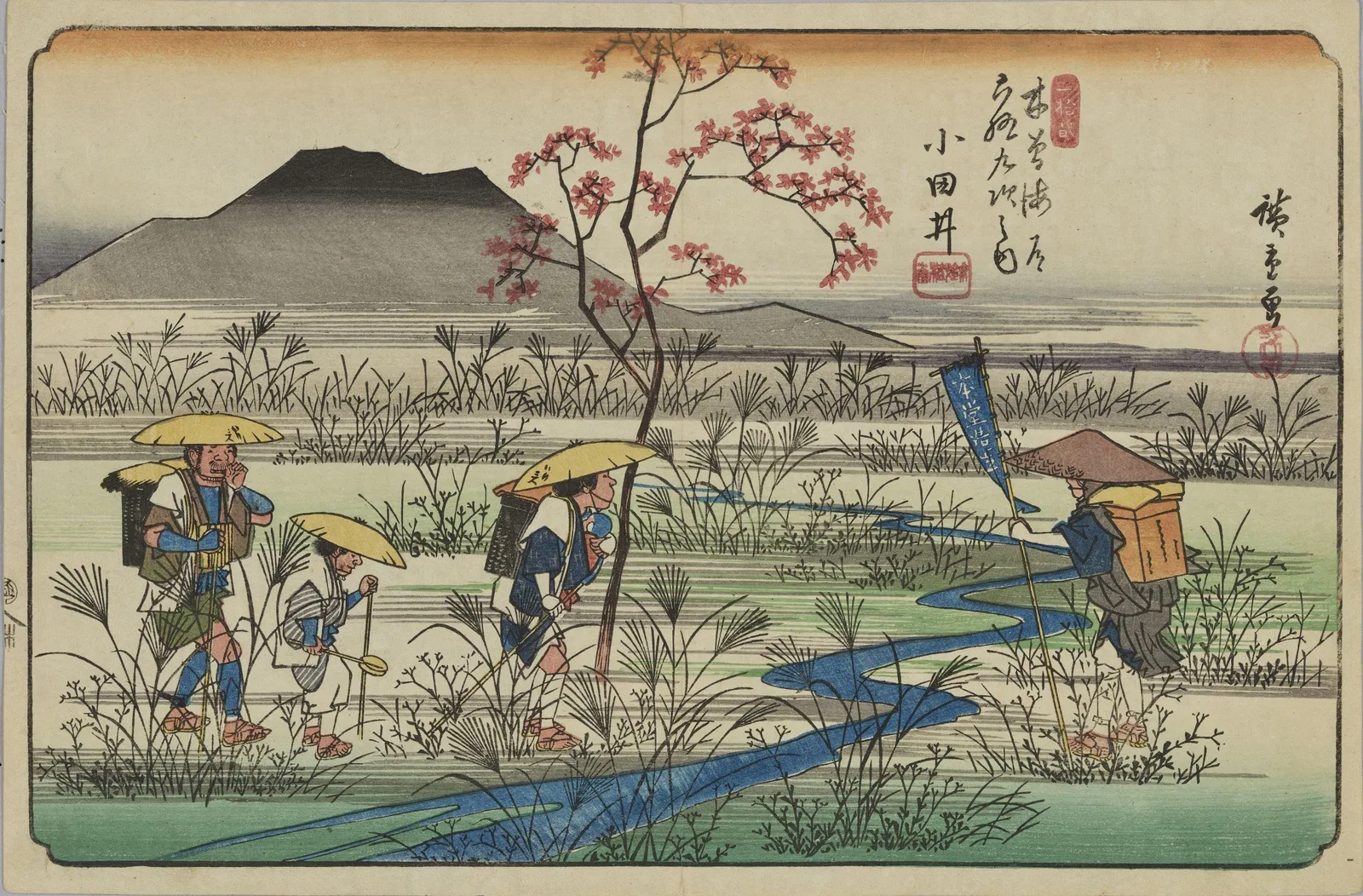
Hiroshige's print shows travelers walking beside a stream through a field of rustling pampas grass near Otai. Hatted travelers and a pilgrim go their separate ways, while red-leafed trees and the black shadow of mountains behind evoke the loneliness of an autumn highland.
- Artist
- Utagawa Hiroshige
- Date
- c. 1835-38 (Tenpo 6-9)
- Medium / format
- Woodblock print (ukiyo-e)
- Series
- The Sixty-nine Stations of the Kisokaido 71 prints
- Place depicted
- Otai-juku(Nagano)
About this work
A blue stream winds through the field in the foreground, with pampas grass and other plants thick on both banks. At left, three travelers in broad hats walk together, and at right a figure who seems to be a pilgrim, holding a banner and carrying a pack, moves ahead. In the center a single slender tree spreads its reddened leaves.
The sky and distance are handled in gray and ink gradations, with the black shadow of mountains lying across the horizon. The grass, which fills most of the picture, is drawn in fine lines, and the blue of the stream and the vermilion of the autumn leaves catch the eye in a restrained palette. The figures are scattered, giving the feel of a journey in which each person walks the wide field at his own pace.
Otai was a post town between Oiwake and Iwamurada, located on the highland that spreads south of Mount Asama. When daimyo used the Oiwake route, princesses and women attendants are said to have often stayed at this post town, and it was also called the "Princesses' Post Town."
This is a design by Utagawa Hiroshige. Rather than the row of houses in the town, it depicts the scenery of the fields outside it, choosing a quiet moment on the road that differs from the bustle one might imagine from the name of the post town. The mountain in the background may represent Mount Asama.
The place today
The site of Otai-juku is in Miyota, where along the old road one can see rows of houses with white-walled storehouses and latticed windows, including the sites of the honjin and the wholesale office. It is a calm settlement with a view of Mount Asama to the north, and each summer the Otai-juku Festival, which conveys the history of the post town, is held.
Where can I see it?
Exhibitions change over time. Check each museum's exhibition information before you visit.
Museums that hold this work
- Tokyo National MuseumMuseum's page for this work (opens in a new tab)
Taito City, Tokyo Accession no. A-12499-87
- National Diet LibraryMuseum's page for this work (opens in a new tab)
Chiyoda City, Tokyo Accession no. 寄別2-2-1-5
Included in Kisokaido Rokujukyu-tsugi
Museums abroad
Frequently asked questions
- Who painted The Sixty-nine Stations of the Kisokaido: Otai, and when?
- The Sixty-nine Stations of the Kisokaido: Otai is by Utagawa Hiroshige, made in c. 1835-38 (Tenpo 6-9). Medium: Woodblock print (ukiyo-e).
- What place does The Sixty-nine Stations of the Kisokaido: Otai show?
- It shows Otai-juku (Nagano).
- Where can I see The Sixty-nine Stations of the Kisokaido: Otai?
- It is held by Tokyo National Museum, National Diet Library. Exhibitions change, so check each museum's information before you visit.
Sources and references
- ColBase(東京国立博物館): 木曽海道六拾九次之内 小田井 (opens in a new tab) (checked 2026-10-19)
- 国立国会図書館デジタルコレクション: 二拾貮 木曽海道六拾九次之内小田井 (opens in a new tab) (checked 2026-10-19)
- Wikipedia: 木曽海道六十九次 (opens in a new tab) (checked 2026-10-19)
You may also like
More from Nagano
Discover more of the same region on our sister sites.