The Sixty-nine Stations of the Kisokaido ・ 19
Karuizawa
木曽海道六拾九次之内 軽井沢
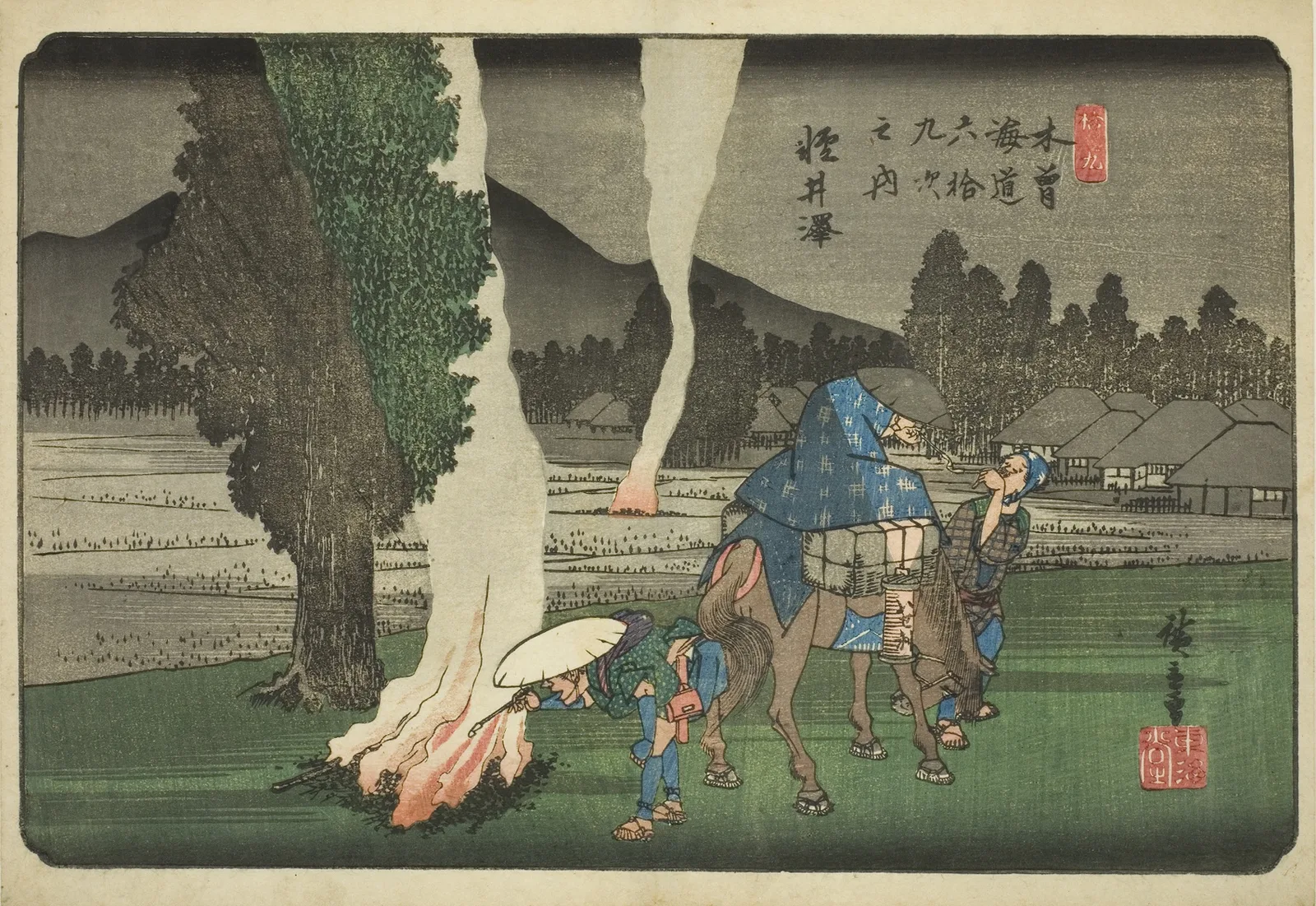
This print shows a night at Karuizawa, the first post town in Shinano Province after the Usui Pass. A traveler lights his pipe at a roadside bonfire, while a rider on horseback borrows a flame from a lantern, all set before the dark rooftops of the town.
- Artist
- Utagawa Hiroshige
- Date
- c. 1835-38 (Tenpo 6-9)
- Medium / format
- Woodblock print (ukiyo-e)
- Series
- The Sixty-nine Stations of the Kisokaido 71 prints
- Place depicted
- Karuizawa-juku(Nagano)
About this work
A large cedar stands at the left foreground, and a bonfire burns at its base. A traveler in a broad hat bends over to light his pipe from the fire, while at right a rider on horseback takes a light from the lantern a packhorse driver holds out. Beyond them lie open fields and the roofs of the town, ringed by trees.
Most of the picture sinks into night tones of gray and ink, so that only the vermilion of the fire and the rising white smoke stand out. Another fire, like a field burning, rises in the distant paddies, and the two plumes of smoke divide the picture vertically. The mountains behind are rendered as black silhouettes.
Karuizawa lay at the western foot of the Usui Pass, a lodging place for travelers who had just crossed it and for those about to take it on. Together with Kutsukake and Oiwake it was counted among the three Asama Nekoshi post towns, known as stations on the highland at the base of Mount Asama.
The series was begun by Keisai Eisen and taken over partway through by Utagawa Hiroshige. This print is Hiroshige's work and follows Sakamoto, the eighteenth design drawn by Eisen. It is regarded as a strongly lyrical piece, combining a night scene with firelight in a way typical of Hiroshige.
The place today
The site of Karuizawa-juku corresponds to today's Kyu-Karuizawa Ginza street. After the Meiji era it was transformed into a summer retreat opened up by foreign missionaries and others. Little of the post town's character remains, but the Tsuruya Ryokan, said to have begun as a travelers' inn, still operates at the far end of the street.
Where can I see it?
Exhibitions change over time. Check each museum's exhibition information before you visit.
Museums that hold this work
- Tokyo National MuseumMuseum's page for this work (opens in a new tab)
Taito City, Tokyo Accession no. A-12499-83
- National Diet LibraryMuseum's page for this work (opens in a new tab)
Chiyoda City, Tokyo Accession no. 寄別2-2-1-5
Included in Kisokaido Rokujukyu-tsugi
Museums abroad
- Art Institute of ChicagoMuseum's page for this work (opens in a new tab)
Chicago Accession no. 1932.210
Frequently asked questions
- Who painted The Sixty-nine Stations of the Kisokaido: Karuizawa, and when?
- The Sixty-nine Stations of the Kisokaido: Karuizawa is by Utagawa Hiroshige, made in c. 1835-38 (Tenpo 6-9). Medium: Woodblock print (ukiyo-e).
- What place does The Sixty-nine Stations of the Kisokaido: Karuizawa show?
- It shows Karuizawa-juku (Nagano).
- Where can I see The Sixty-nine Stations of the Kisokaido: Karuizawa?
- It is held by Tokyo National Museum, National Diet Library. Exhibitions change, so check each museum's information before you visit.
Sources and references
- Art Institute of Chicago: No. 19: Karuizawa, from the series "Sixty-nine Stations of the Kisokaido (Kisokaido rokujukyu tsugi no uchi)" (opens in a new tab) (checked 2026-10-19)
- ColBase(東京国立博物館): 木曽海道六拾九次之内 軽井沢 (opens in a new tab) (checked 2026-10-19)
- 国立国会図書館デジタルコレクション: 拾九 木曽海道六拾九次之内軽井沢 (opens in a new tab) (checked 2026-10-19)
- Wikipedia: 木曽海道六十九次 (opens in a new tab) (checked 2026-10-19)
You may also like
More from Nagano
Discover more of the same region on our sister sites.