Thirty-six Views of Mount Fuji ・ 41
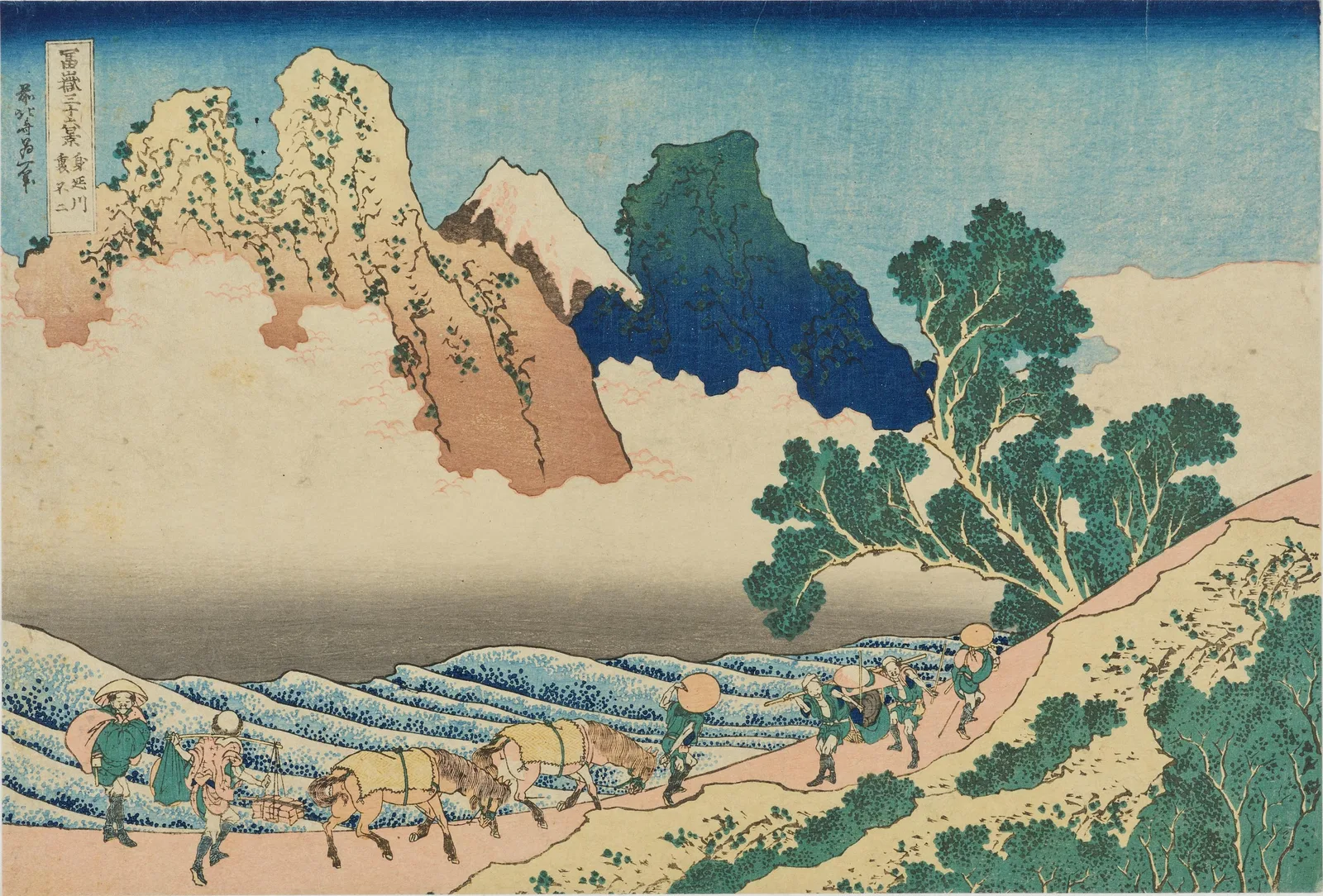
The Back of Fuji from the Minobu River
冨嶽三十六景 身延川裏不二
The snow-covered summit of Fuji peeks out between twisted-looking rocky mountains. Billowing clouds, rapids rippling in many layers, and travelers and packhorses on a slope depict Fuji as seen from the Kai side in a rugged manner.
- Artist
- Katsushika Hokusai
- Date
- c. 1830-33 (Tenpo 1-4)
- Medium / format
- Woodblock print (ukiyo-e)
- Series
- Thirty-six Views of Mount Fuji 46 prints
- Place depicted
- Minobu(Yamanashi)
- Seen in the distance
- Mount Fuji
About this work
Fuji, at upper left of the picture, is wedged between two rocky mountains painted in brown and indigo and shows only its snowy summit. The rocky mountains have twisted outlines, and vine-like plants coil around them. White clouds billow up from below the mountains, and the boundary between mountain and cloud is vague.
At the bottom of the picture, the river's current overlaps in many layers of fine-lined waves, conveying the force of the rapids. On the slope along the river, people carrying loads, people carrying goods on shoulder poles, and people leading horses with loads climb in a line. At the right a large tree spreads its branches. Plants and trees grow thick on the slope on the right side of the path.
The "Ura Fuji" of the title means Fuji seen from the side of Kai Province (today's Yamanashi Prefecture), and the Tokyo Fuji Art Museum explains that it was called this at the time. As for the Minobu River, there is one theory that it means the Fuji River and another that it is the river flowing around Kuonji, head temple of the Nichiren sect.
This is one of the ten prints added after the 36. The museum also holds an impression of the same design with a different arrangement of colors on the rocky mountains, showing that the impression changes depending on the printing.
The place today
In Minobu Town along the Fuji River stands Kuonji on Mount Minobu, the head temple of the Nichiren sect, and the temple town continues to the Sanmon gate. Temple lodgings are scattered in the Higashi-dani and Nishi-dani valleys of the mountain, preserving the character of a pilgrimage town.
Where can I see it?
Exhibitions change over time. Check each museum's exhibition information before you visit.
Museums that hold this work
- Tokyo National MuseumMuseum's page for this work (opens in a new tab)
Taito City, Tokyo Accession no. A-11177
From the set of 34 sheets of Thirty-six Views of Mount Fuji
- Edo-Tokyo MuseumMuseum's page for this work (opens in a new tab)
Sumida City, Tokyo Accession no. 92202784
Museums that hold this series (please check the museum's website for whether it holds this print)
Frequently asked questions
- Who painted Thirty-six Views of Mount Fuji: The Back of Fuji from the Minobu River, and when?
- Thirty-six Views of Mount Fuji: The Back of Fuji from the Minobu River is by Katsushika Hokusai, made in c. 1830-33 (Tenpo 1-4). Medium: Woodblock print (ukiyo-e).
- What place does Thirty-six Views of Mount Fuji: The Back of Fuji from the Minobu River show?
- It shows Minobu (Yamanashi).
- Where can I see Thirty-six Views of Mount Fuji: The Back of Fuji from the Minobu River?
- It is held by Tokyo National Museum, Tokyo Fuji Art Museum, Edo-Tokyo Museum. Exhibitions change, so check each museum's information before you visit.
Sources and references
- ColBase 東京国立博物館 冨嶽三十六景(34枚) (opens in a new tab) (checked 2026-10-18)
- 山梨県立博物館「博物館資料のなかの『富士山』 葛飾北斎 冨嶽三十六景」 (opens in a new tab) (checked 2026-10-18)
- 江戸東京博物館デジタルアーカイブス 冨嶽三十六景 身延川裏不二 (opens in a new tab) (checked 2026-10-18)
You may also like
More from Yamanashi
Discover more of the same region on our sister sites.