One Hundred Famous Views of Edo ・ 35
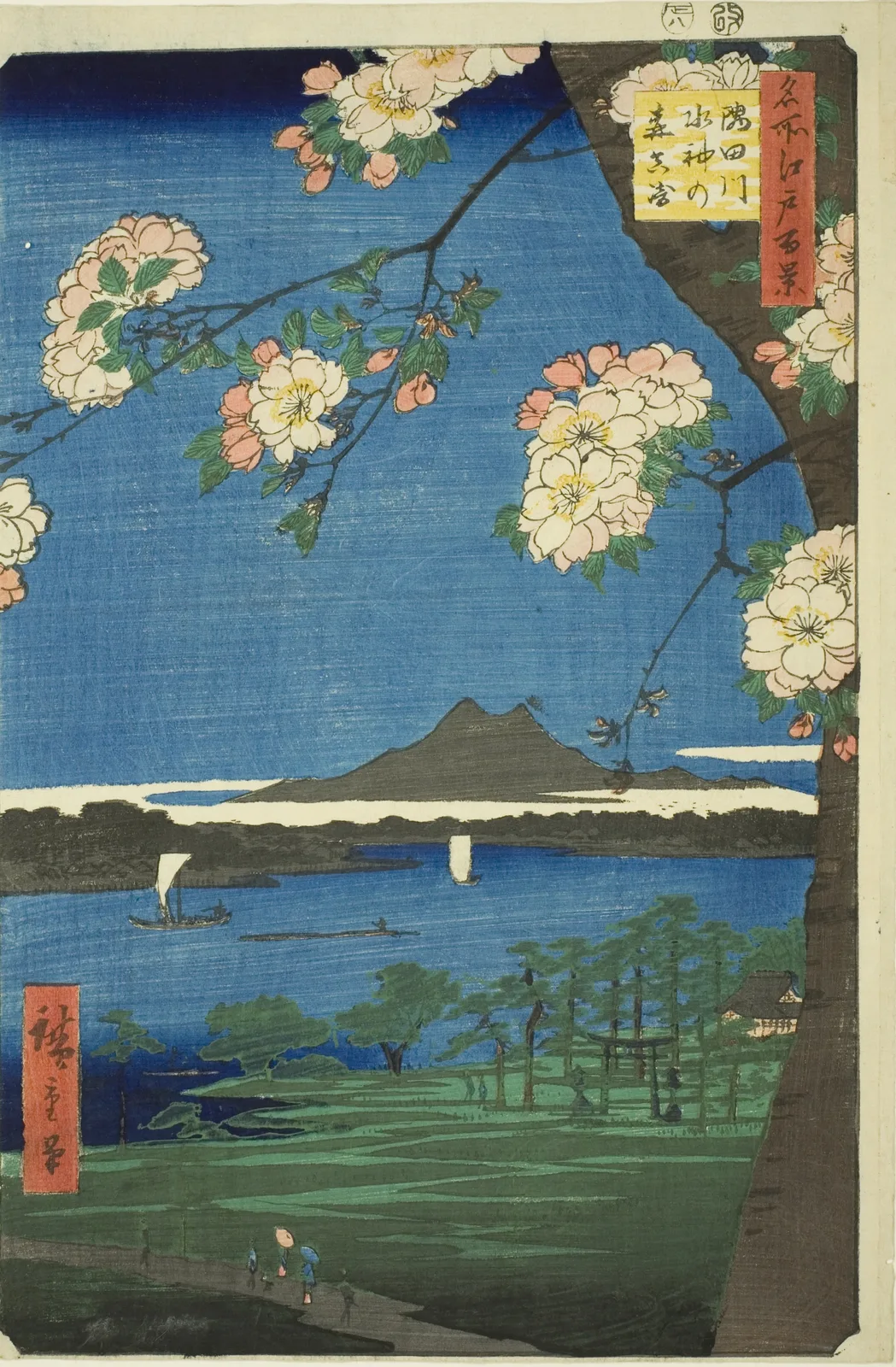
Suijin Shrine and Massaki on the Sumida River
名所江戸百景 隅田川水神の森真崎
Through branches of double-flowered cherry in full bloom, this print surveys the Suijin grove on the bank of the Sumida River and the Massaki area on the opposite shore, with distant Mount Tsukuba. The pale crimson of the blossoms stands out against the deep indigo of the sky and river, a view typical of the Sumida River in spring.
- Artist
- Utagawa Hiroshige
- Date
- August 1856 (Ansei 3)
- Medium / format
- Woodblock print (ukiyo-e)
- Series
- One Hundred Famous Views of Edo 119 prints
- Seen in the distance
- Mount Tsukuba
About this work
Branches of double-flowered cherry extending from a thick trunk frame the top and right of the picture. Below them the Sumida River spreads, with sailboats passing. On the bank at lower right the Suijin grove, with a torii, is thick, and people walk along the road in the foreground. Beyond the low bank of Massaki across the river, Mount Tsukuba with its two peaks rises.
The deep indigo of sky and river occupies most of the picture, and the double-flowered cherry blossoms float up large in pale crimson and white. The composition that arranges foreground branches at the edge of the picture and lets the distant view show between them is a technique used repeatedly in the series.
The Suijin grove is the woods of a shrine enshrining the guardian deity of the Sumida River, corresponding to today's Sumidagawa Shrine. Across the river at Massaki stood Massaki Inari, and the teahouses in front of its gate were famous for dengaku. Together with Mukojima, it was a famous place for blossom viewing and boating.
This print belongs to the Spring section and, as a pair with the following View from Massaki of Suijin Shrine, Uchigawa Inlet, and Sekiya, is composed so that the two banks of the river look at each other. It is a splendid spring print that shows a famous place through branches of blossoms.
The place today
Sumidagawa Shrine still stands in Tsutsumidori 2-chome, Sumida Ward, and has been worshipped as the water god by people connected with water transport. It is surrounded by an expressway and housing complexes, but cherries are planted on the embankment along the river, and in spring the blossoms can be enjoyed along with the Minami-Senju side across the river.
Where can I see it?
Exhibitions change over time. Check each museum's exhibition information before you visit.
Museums that hold this work
- Tokyo National MuseumMuseum's page for this work (opens in a new tab)
Taito City, Tokyo Accession no. A-12499-352
- National Diet LibraryMuseum's page for this work (opens in a new tab)
Chiyoda City, Tokyo Accession no. 寄別1-8-2-1イ
Museums abroad
- Art Institute of ChicagoMuseum's page for this work (opens in a new tab)
Chicago Accession no. 1939.1408
Frequently asked questions
- Who painted One Hundred Famous Views of Edo: Suijin Shrine and Massaki on the Sumida River, and when?
- One Hundred Famous Views of Edo: Suijin Shrine and Massaki on the Sumida River is by Utagawa Hiroshige, made in August 1856 (Ansei 3). Medium: Woodblock print (ukiyo-e).
- What place does One Hundred Famous Views of Edo: Suijin Shrine and Massaki on the Sumida River show?
- It shows Sumida River, Sumidagawa Shrine (Suijin no Mori) (Tokyo).
- Where can I see One Hundred Famous Views of Edo: Suijin Shrine and Massaki on the Sumida River?
- It is held by Tokyo National Museum, National Diet Library. Exhibitions change, so check each museum's information before you visit.
Sources and references
- Art Institute of Chicago: Suijin Shrine and Massaki on the Sumida River (Sumidagawa Suijin no mori Massaki), from the series "One Hundred Famous Views of Edo (Meisho Edo hyakkei)" (opens in a new tab) (checked 2026-10-19)
- ColBase(東京国立博物館): 名所江戸百景 隅田川水神の森真崎 (opens in a new tab) (checked 2026-10-19)
- 国立国会図書館デジタルコレクション: 名所江戸百景 隅田川水神の森真崎 (opens in a new tab) (checked 2026-10-19)
You may also like
More from Tokyo
Discover more of the same region on our sister sites.