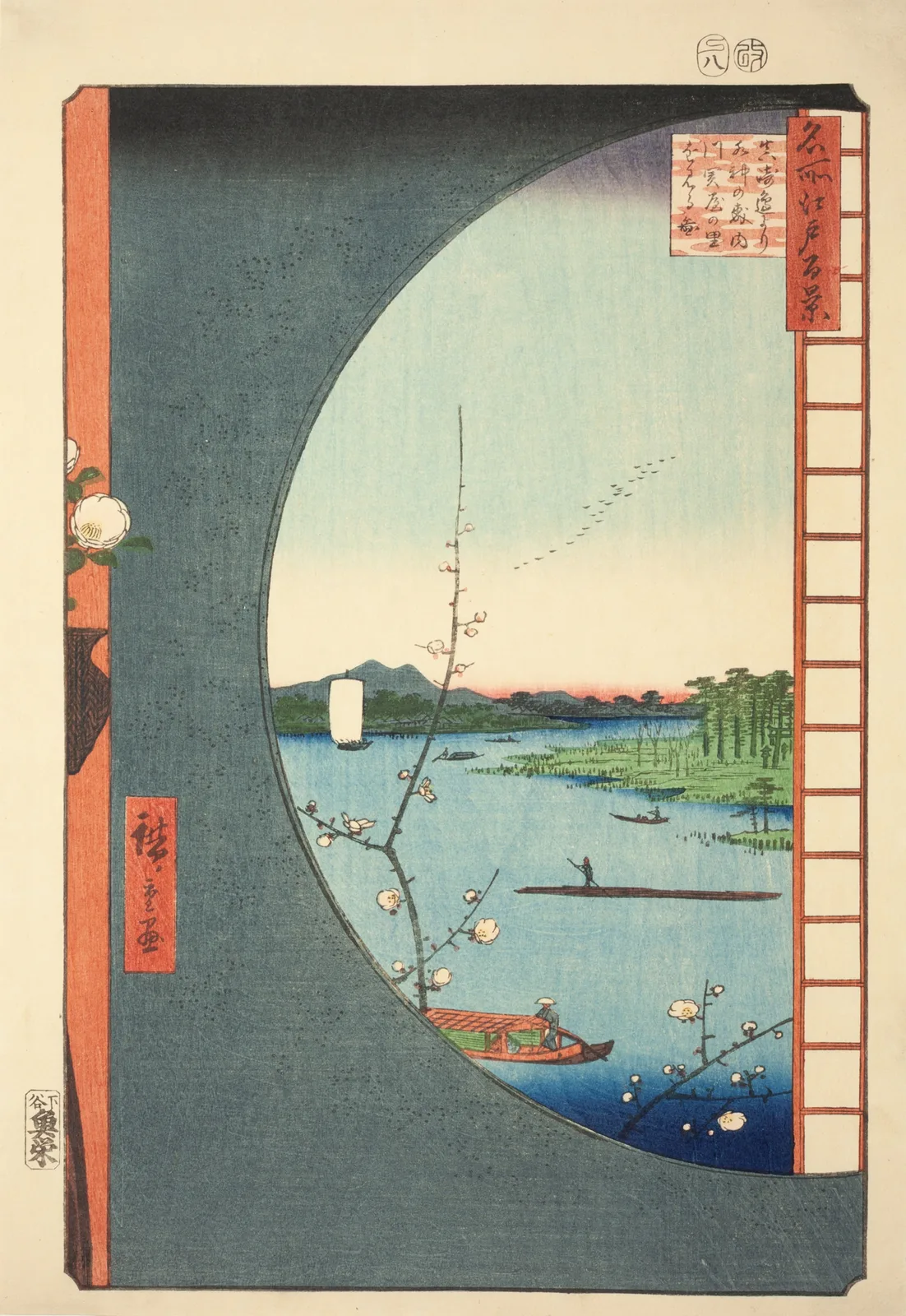
One Hundred Famous Views of Edo ・ 36
View from Massaki of Suijin Shrine, Uchigawa Inlet, and Sekiya
名所江戸百景 真崎辺より水神の森内川関屋の里を見る図
From the round window of a Massaki teahouse, this print surveys the Suijin grove, the Uchigawa Inlet and Sekiya village, with distant Mount Tsukuba. Within the circular frame of the window fit plum branches, boats on the river and a line of geese, cutting out a quiet early-spring view.
- Artist
- Utagawa Hiroshige
- Date
- August 1857 (Ansei 4)
- Medium / format
- Woodblock print (ukiyo-e)
- Series
- One Hundred Famous Views of Edo 119 prints
- Seen in the distance
- Mount Tsukuba
About this work
A large round window opened in the wall of the room occupies most of the picture. Outside the window plum branches extend, and beyond them boats float on the Sumida River and the Uchigawa Inlet. At right are the trees of the Suijin grove, in the distance Sekiya village and Mount Tsukuba, and geese cross the sky. At the left edge a hanging flower vase holding white flowers peeks in.
The gray-green of the wall and the vermilion of the pillar surround the round window, and only within it is the picture filled with bright sky and the blue of water. The composition, like a frame looking out from the interior, places the viewer too in the position of a guest seated in the room enjoying the scenery.
Massaki is on the west bank of the Sumida River, around today's Minami-Senju, where restaurants and teahouses lined the area around Massaki Inari and sold the view across the river of the Suijin grove and Sekiya village. Sekiya village was countryside near Senju, a place also depicted in Katsushika Hokusai's Thirty-six Views of Mount Fuji.
This print belongs to the Spring section and, in contrast to the preceding print, views the far side of the river from the Massaki side. The bold composition using the room of a teahouse as a frame is thought to render directly the viewpoint of Edo people enjoying famous places.
The place today
Massaki Inari was enshrined together with nearby Ishihama Shrine at the end of the Taisho era and is still worshipped in its precincts in Minami-Senju 3-chome, Arakawa Ward. The riverbank where teahouses once lined up has become a district of high-rise housing, and the embankment looking toward the grove of Sumidagawa Shrine across the river has been developed as a promenade along the Sumida River.
Where can I see it?
Exhibitions change over time. Check each museum's exhibition information before you visit.
Museums that hold this work
- Tokyo National MuseumMuseum's page for this work (opens in a new tab)
Taito City, Tokyo Accession no. A-12499-354
- National Diet LibraryMuseum's page for this work (opens in a new tab)
Chiyoda City, Tokyo Accession no. 寄別1-8-2-1イ
Museums abroad
- Art Institute of ChicagoMuseum's page for this work (opens in a new tab)
Chicago Accession no. 1965.1033
Frequently asked questions
- Who painted One Hundred Famous Views of Edo: View from Massaki of Suijin Shrine, Uchigawa Inlet, and Sekiya, and when?
- One Hundred Famous Views of Edo: View from Massaki of Suijin Shrine, Uchigawa Inlet, and Sekiya is by Utagawa Hiroshige, made in August 1857 (Ansei 4). Medium: Woodblock print (ukiyo-e).
- What place does One Hundred Famous Views of Edo: View from Massaki of Suijin Shrine, Uchigawa Inlet, and Sekiya show?
- It shows Sumidagawa Shrine (Suijin no Mori), Sekiya Village (Tokyo).
- Where can I see One Hundred Famous Views of Edo: View from Massaki of Suijin Shrine, Uchigawa Inlet, and Sekiya?
- It is held by Tokyo National Museum, National Diet Library. Exhibitions change, so check each museum's information before you visit.
Sources and references
- Art Institute of Chicago: View from Massaki of Suijin Shrine, Uchigawa Inlet, and Sekiya (Massaki hen yori Suijin no mori Uchigawa Sekiya no sato o miru zu), from the series "One Hundred Famous Views of Edo (Meisho Edo hyakkei)" (opens in a new tab) (checked 2026-10-19)
- ColBase(東京国立博物館): 名所江戸百景 真崎辺より水神の森内川関屋の里を見る図 (opens in a new tab) (checked 2026-10-19)
- 国立国会図書館デジタルコレクション: 名所江戸百景 真崎辺より水神の森内川関屋の里を見る図 (opens in a new tab) (checked 2026-10-19)
You may also like
More from Tokyo
Discover more of the same region on our sister sites.