One Hundred Famous Views of Edo ・ 27
The Plum Orchard at Kamata
名所江戸百景 蒲田の梅園
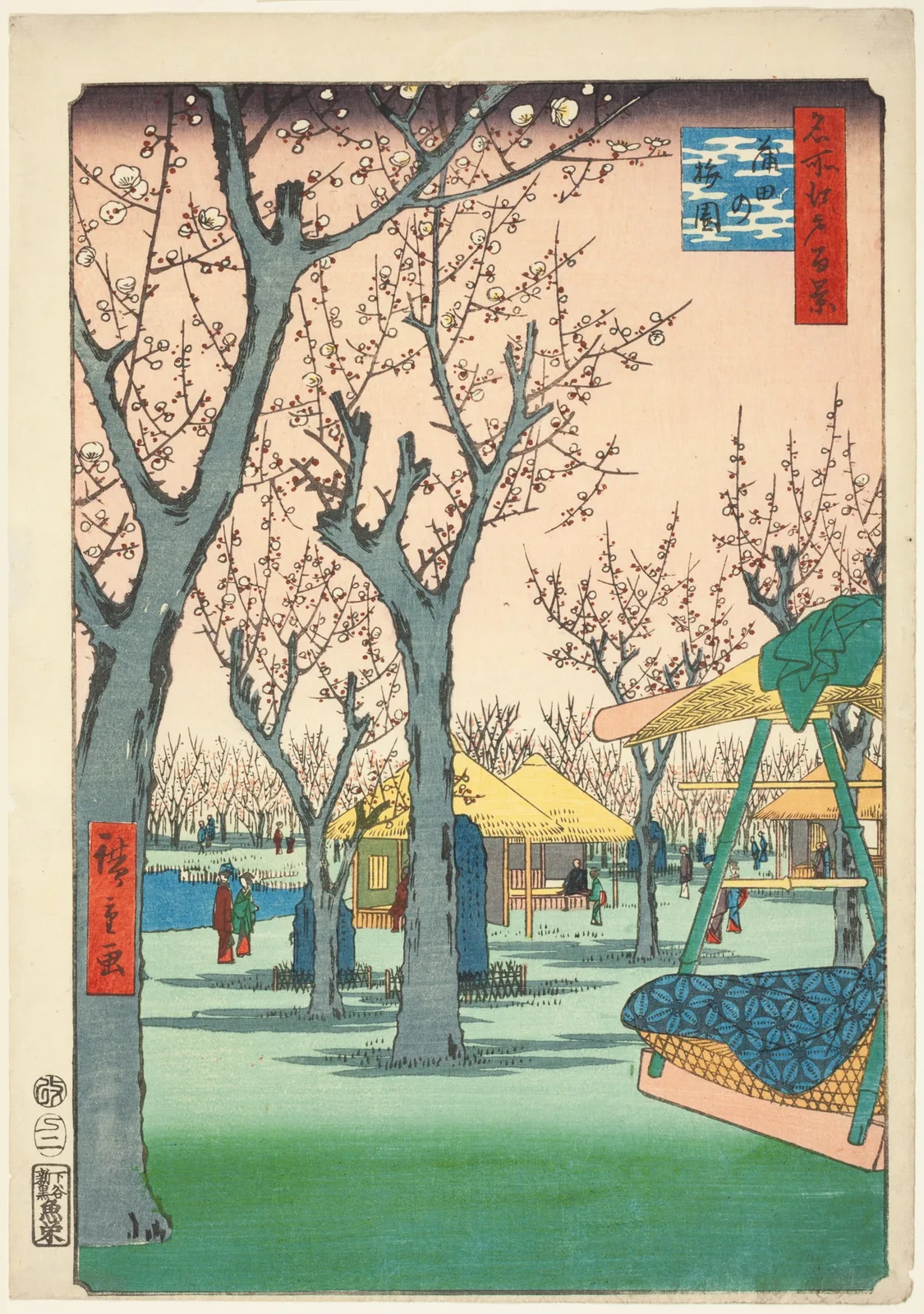
This print shows the Plum Garden at Kamata, near the Tokaido, seen through plum trees in full bloom. White flowers open in spots under a pale crimson sky, and the roofs of teahouses, women walking about and a palanquin set in the foreground convey the bustle of a day of plum viewing.
- Artist
- Utagawa Hiroshige
- Date
- February 1857 (Ansei 4)
- Medium / format
- Woodblock print (ukiyo-e)
- Series
- One Hundred Famous Views of Edo 119 prints
- Place depicted
- Kamata(Tokyo)
About this work
Plum trees with thick trunks line the picture from front to back, with white flowers opening at the tips of their branches. Among the trees stands a thatched teahouse where elegantly dressed women stroll. At front right sits a palanquin with a blue bedding cover in a hemp-leaf pattern, and at back left a patch of blue from a pond peeks through.
The sky is crimson at the top and softly gradated to pale below, setting off the white of the plum blossoms. The blue-green of the ground and the gray of the trunks create a calm tone, and the palanquin, boldly cropped at the edge of the picture, has the effect of placing the viewer at the entrance of the garden.
The Plum Garden at Kamata is said to have begun when the Yamamoto family, who sold the traveling medicine Wachusan in Kamata village on the Tokaido, planted plum trees in their garden. It doubled as a teahouse where travelers rested and was loved as a plum-viewing spot to which people extended their trips from Edo. Many visitors are thought to have arrived by palanquin.
It stands alongside Plum Garden at Kameido as a famous plum spot of the Spring section. The Metropolitan Museum of Art also holds the same print, and impressions with very similar tones of color can be seen. The composition keeps figures small and conveys the atmosphere of the place through the trees and the palanquin.
The place today
The site of the Plum Garden is now Seiseki Kamata Umeyashiki Park in Kamata 3-chome, Ota Ward. It is named Seiseki, meaning sacred site, because Emperor Meiji visited many times, and the plum trees in the park still bloom in early spring. The nearby Keikyu Line station is also named Umeyashiki.
Where can I see it?
Exhibitions change over time. Check each museum's exhibition information before you visit.
Museums that hold this work
- Tokyo National MuseumMuseum's page for this work (opens in a new tab)
Taito City, Tokyo Accession no. A-12499-345
- National Diet LibraryMuseum's page for this work (opens in a new tab)
Chiyoda City, Tokyo Accession no. 寄別1-8-2-1イ
Museums abroad
- Art Institute of ChicagoMuseum's page for this work (opens in a new tab)
Chicago Accession no. 1939.1461
- The Metropolitan Museum of ArtMuseum's page for this work (opens in a new tab)
New York Accession no. JP2510
Frequently asked questions
- Who painted One Hundred Famous Views of Edo: The Plum Orchard at Kamata, and when?
- One Hundred Famous Views of Edo: The Plum Orchard at Kamata is by Utagawa Hiroshige, made in February 1857 (Ansei 4). Medium: Woodblock print (ukiyo-e).
- What place does One Hundred Famous Views of Edo: The Plum Orchard at Kamata show?
- It shows Kamata (Tokyo).
- Where can I see One Hundred Famous Views of Edo: The Plum Orchard at Kamata?
- It is held by Tokyo National Museum, National Diet Library. Exhibitions change, so check each museum's information before you visit.
Sources and references
- Art Institute of Chicago: The Plum Orchard at Kamata (Kamata no umezono), from the series "One Hundred Famous Views of Edo (Meisho Edo hyakkei)" (opens in a new tab) (checked 2026-10-19)
- ColBase(東京国立博物館): 名所江戸百景 蒲田の梅園 (opens in a new tab) (checked 2026-10-19)
- 国立国会図書館デジタルコレクション: 名所江戸百景 蒲田の梅園 (opens in a new tab) (checked 2026-10-19)
- The Metropolitan Museum of Art: Plum Garden at Kamata (Kamata no umezono), from the series One Hundred Famous Views of Edo (Meisho Edo hyakkei) (JP2510) (opens in a new tab) (checked 2026-10-19)
You may also like
More from Tokyo
Discover more of the same region on our sister sites.