One Hundred Famous Views of Edo ・ 107
Fukagawa Susaki and Jumantsubo
名所江戸百景 深川洲崎十万坪
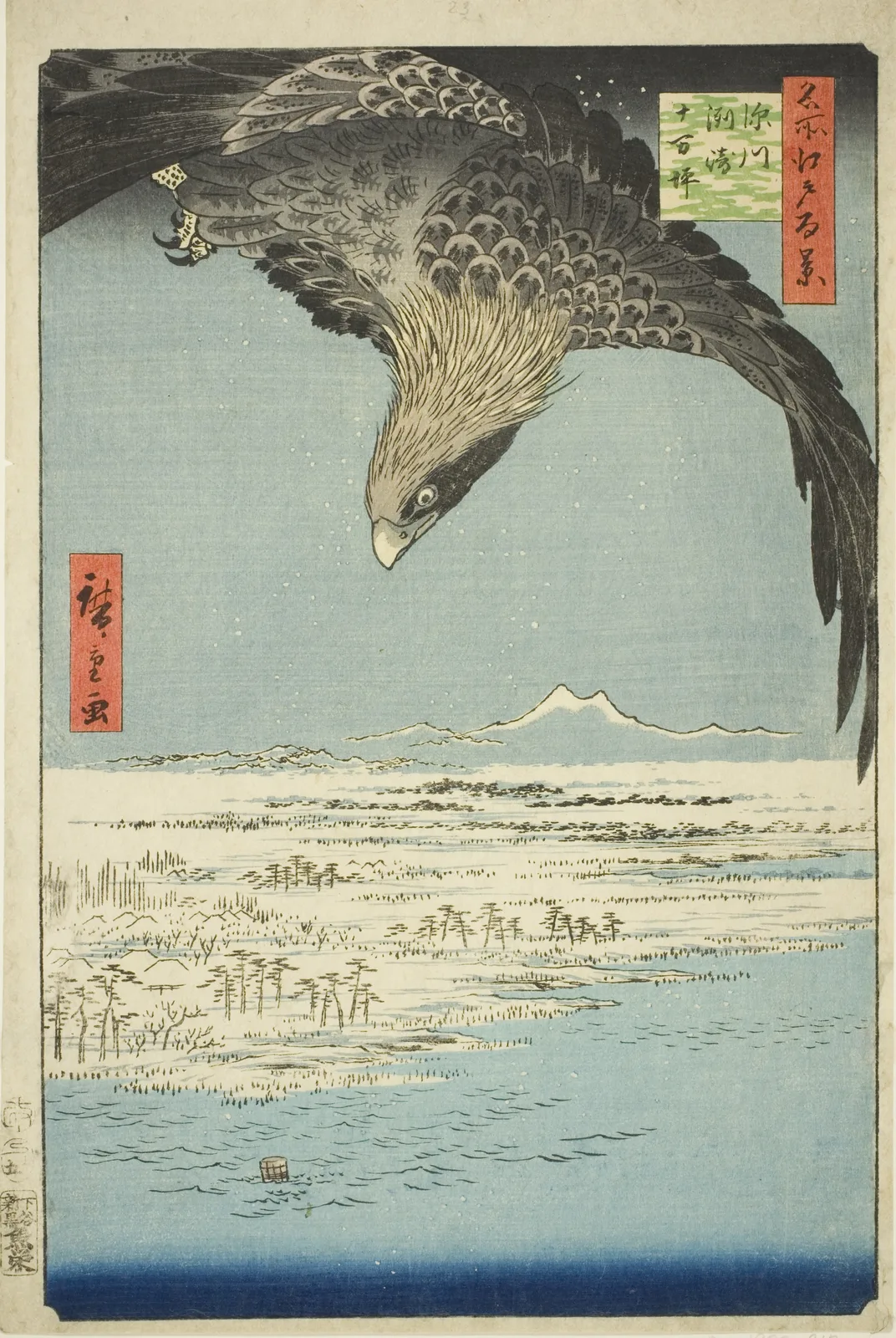
The snow-covered Jumantsubo of Fukagawa, seen from the height of an eagle swooping down from the sky. The large eagle at the top of the picture, the broad white plain, and the distant mountain make this widely known as a bold composition.
- Artist
- Utagawa Hiroshige
- Date
- Intercalary 5th month, 1857 (Ansei 4)
- Medium / format
- Woodblock print (ukiyo-e)
- Series
- One Hundred Famous Views of Edo 119 prints
- Place depicted
- Jumantsubo(Tokyo)
- Seen in the distance
- Mount Tsukuba
About this work
At the top of the picture an eagle with wings spread turns its head downward as if searching for prey. Below it spread the snowy plain of Jumantsubo and the seashore, with something like a tub floating on the water. On the far horizon a snow-covered mountain appears small and white. The viewer looks down on the winter plain from the same height as the eagle.
The picture is unified by three elements: the dark brown feathers of the eagle, the indigo sky, and the white snowfield. Drawing the bird large and the ground small to show height and breadth at once, it is an especially bold composition even within this series. The fine detailing of the feathers also shows the printers' skill.
Jumantsubo was a new field developed during the Kyoho era by reclaiming the seashore east of Fukagawa, and was called Jumantsubo ("one hundred thousand tsubo") for its size. A lonely place with few people, it is thought to have been where birds gathered in winter. The distant mountain is said to be Mt. Tsukuba.
This print belongs to the winter section and, together with the cranes of "Minowa, Kanasugi, Mikawashima," is a leading example of the prints that make a bird the protagonist. Many impressions also survive in museums abroad, including the Metropolitan Museum of Art and the Art Institute of Chicago.
The place today
The Jumantsubo area is said to correspond to today's Senda, Sengoku, and Kaihin in Koto Ward, and after the Meiji era it became a factory district and, after the war, a residential area. No trace of the plain remains, but canals such as the Onagi and Yokojukken Rivers survive around it and preserve a hint of the new-field landscape.
Where can I see it?
Exhibitions change over time. Check each museum's exhibition information before you visit.
Museums that hold this work
- Tokyo National MuseumMuseum's page for this work (opens in a new tab)
Taito City, Tokyo Accession no. A-12499-426
- National Diet LibraryMuseum's page for this work (opens in a new tab)
Chiyoda City, Tokyo Accession no. 寄別1-8-2-1イ
Museums abroad
- Art Institute of ChicagoMuseum's page for this work (opens in a new tab)
Chicago Accession no. 1932.213
- The Metropolitan Museum of ArtMuseum's page for this work (opens in a new tab)
New York Accession no. JP2520
Frequently asked questions
- Who painted One Hundred Famous Views of Edo: Fukagawa Susaki and Jumantsubo, and when?
- One Hundred Famous Views of Edo: Fukagawa Susaki and Jumantsubo is by Utagawa Hiroshige, made in Intercalary 5th month, 1857 (Ansei 4). Medium: Woodblock print (ukiyo-e).
- What place does One Hundred Famous Views of Edo: Fukagawa Susaki and Jumantsubo show?
- It shows Jumantsubo (Tokyo).
- Where can I see One Hundred Famous Views of Edo: Fukagawa Susaki and Jumantsubo?
- It is held by Tokyo National Museum, National Diet Library. Exhibitions change, so check each museum's information before you visit.
Sources and references
- Art Institute of Chicago: Fukagawa Susaki and Jumantsubo (Fukagawa Susaki Jumantsubo), from the series "One Hundred Famous Views of Edo (Meisho Edo hyakkei)" (opens in a new tab) (checked 2026-10-19)
- ColBase(東京国立博物館): 名所江戸百景 深川洲崎十万坪 (opens in a new tab) (checked 2026-10-19)
- 国立国会図書館デジタルコレクション: 名所江戸百景 深川洲崎十万坪 (opens in a new tab) (checked 2026-10-19)
- The Metropolitan Museum of Art: “Jūmantsubo Plain at Fukagawa Susaki,” from the series One Hundred Famous Views of Edo (JP2520) (opens in a new tab) (checked 2026-10-19)
- Wikipedia: One Hundred Famous Views of Edo (opens in a new tab) (checked 2026-10-19)
You may also like
More from Tokyo
Discover more of the same region on our sister sites.