One Hundred Famous Views of Edo ・ 69
The Hall of Thirty-three Bays at Fukagawa
名所江戸百景 深川三十三間堂
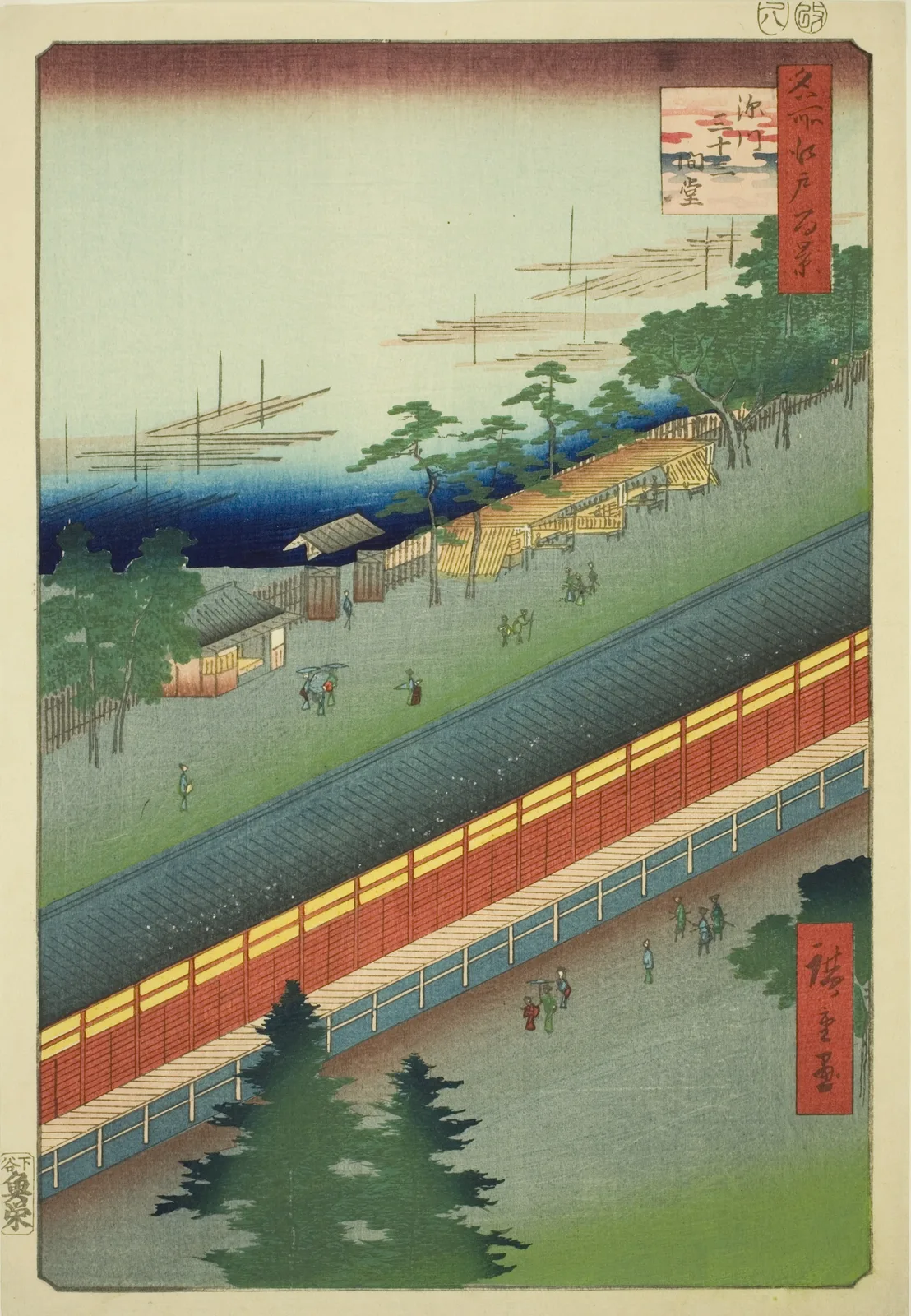
The Sanjusangendo in Fukagawa seen diagonally from a height. A long vermilion hall crosses the picture, and beyond it spreads a waterside where timber floats in the Kiba lumberyards. It shows a building of Edo that no longer exists.
- Artist
- Utagawa Hiroshige
- Date
- August 1857 (Ansei 4)
- Medium / format
- Woodblock print (ukiyo-e)
- Series
- One Hundred Famous Views of Edo 119 prints
- Place depicted
- Fukagawa Sanjusangendo(Tokyo)
About this work
A long vermilion hall crosses the middle of the picture diagonally from lower left to upper right. In the foreground are a cedar tree and people walking in front of the hall. Beyond the hall a road continues lined with teahouses and houses, and further on a water surface with floating timber spreads out, where masts stand like a forest. Small figures of people passing beneath the hall's veranda are also drawn.
The vermilion of the hall and gray of the roof, the blue of the water, and the green of the trees are vividly contrasted. The long hall drawn large on a diagonal emphasizes its length.
The Sanjusangendo in Fukagawa was a hall built on the model of the Sanjusangendo in Kyoto, where the archery contest of shooting arrows from one end of the hall to the other, known as toshiya, was held. The nearby Kiba was a gathering place for timber that supported the building of the city of Edo. The hall is said to have been moved from Asakusa to Fukagawa in the Genroku era and became one of Fukagawa's sights.
This print belongs to the summer section, and its censor's seal dates it to the eighth month of Ansei 4 (1857). Because the hall was demolished in the Meiji period, this print also serves as a record of a lost Edo building.
The place today
Fukagawa Sanjusangendo was demolished in 1872 and no longer exists. The site is near 2-chome, Tomioka, Koto Ward, east of Tomioka Hachiman Shrine, where an information board and a relief stand. The nearby place name Kazuya comes from toshiya. It can be visited together with Tomioka Hachiman Shrine.
Where can I see it?
Exhibitions change over time. Check each museum's exhibition information before you visit.
Museums that hold this work
- Tokyo National MuseumMuseum's page for this work (opens in a new tab)
Taito City, Tokyo Accession no. A-12499-390
- National Diet LibraryMuseum's page for this work (opens in a new tab)
Chiyoda City, Tokyo Accession no. 寄別1-8-2-1イ
- National Diet LibraryMuseum's page for this work (opens in a new tab)
Chiyoda City, Tokyo Accession no. 寄別1-8-2-1
Museums abroad
- Art Institute of ChicagoMuseum's page for this work (opens in a new tab)
Chicago Accession no. 1939.1477
Frequently asked questions
- Who painted One Hundred Famous Views of Edo: The Hall of Thirty-three Bays at Fukagawa, and when?
- One Hundred Famous Views of Edo: The Hall of Thirty-three Bays at Fukagawa is by Utagawa Hiroshige, made in August 1857 (Ansei 4). Medium: Woodblock print (ukiyo-e).
- What place does One Hundred Famous Views of Edo: The Hall of Thirty-three Bays at Fukagawa show?
- It shows Fukagawa Sanjusangendo (Tokyo).
- Where can I see One Hundred Famous Views of Edo: The Hall of Thirty-three Bays at Fukagawa?
- It is held by Tokyo National Museum, National Diet Library. Exhibitions change, so check each museum's information before you visit.
Sources and references
- Art Institute of Chicago: The Hall of Thirty-three Bays at Fukagawa (Fukagawa Sanjusangendo), from the series "One Hundred Famous Views of Edo (Meisho Edo hyakkei)" (opens in a new tab) (checked 2026-10-19)
- ColBase(東京国立博物館): 名所江戸百景 深川三十三間堂 (opens in a new tab) (checked 2026-10-19)
- Wikipedia: One Hundred Famous Views of Edo (opens in a new tab) (checked 2026-10-19)
You may also like
More from Tokyo
Discover more of the same region on our sister sites.