One Hundred Famous Views of Edo ・ 56
Mannen Bridge, Fukagawa
名所江戸百景 深川万年橋
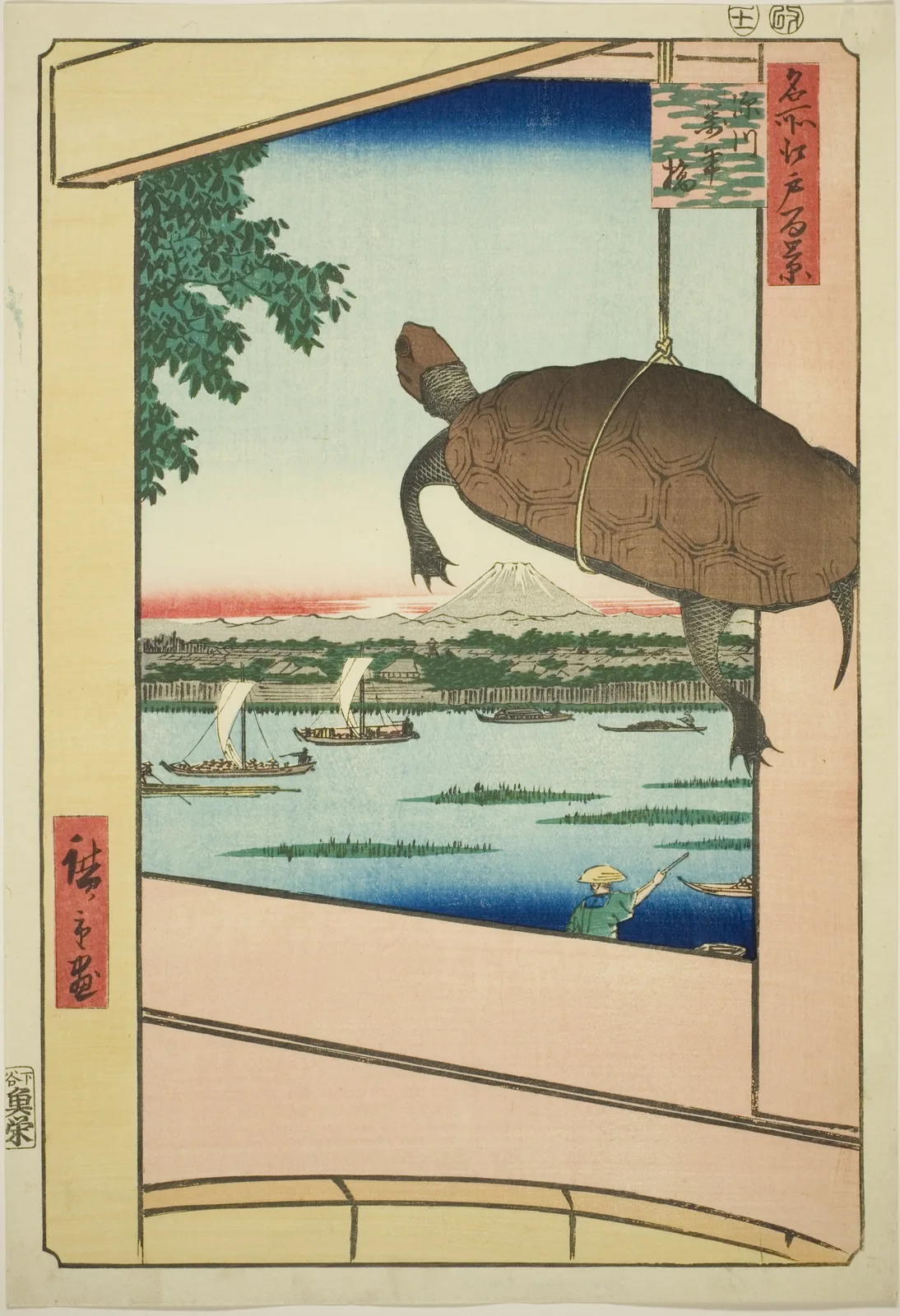
A turtle hanging from the handle of a wooden bucket is drawn large from atop Mannen Bridge in Fukagawa, with the Sumida River and Mount Fuji beyond. It is known for its eccentric composition that uses the bridge railing and the bucket as a frame. It is a playful picture that turns everyday objects into a picture frame.
- Artist
- Utagawa Hiroshige
- Date
- November 1857 (Ansei 4)
- Medium / format
- Woodblock print (ukiyo-e)
- Series
- One Hundred Famous Views of Edo 119 prints
- Place depicted
- Mannen Bridge(Tokyo)
- Seen in the distance
- Mount Fuji
About this work
The foreground consists of the rim of a bucket and the bridge railing, with a turtle hanging on a rope that descends from above. Beyond the turtle the surface of the Onagi and Sumida rivers spreads out, with sailboats and small boats floating on it. Above the trees on the far shore, a white Mount Fuji rises into a sunset sky. On the nearer river, a man in a small boat works a pole.
The scenery is cut into a rectangle by the wooden frame of bucket and railing, with the turtle floating inside it. The contrast of the brown turtle, white Fuji, and blue river is vivid, and the idea of using everyday tools in the foreground works well.
The hanging turtle is said to have been sold for the hojoe ceremony of releasing living creatures. This was a rite of earning merit by releasing creatures into the river, and turtles and eels were sold at the foot of the bridge. One can also sense the playful pairing of the name Mannen (ten thousand years) with the turtle, said to live ten thousand years. The bustle of boats on the river conveys the waterside life of Fukagawa.
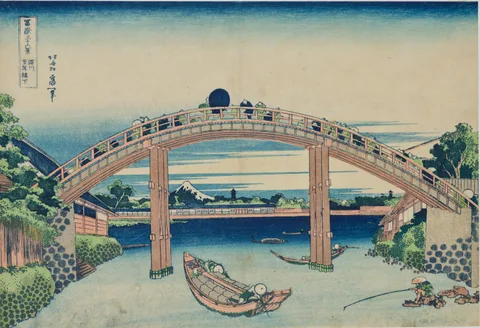
This print belongs to the summer section, and its censor's seal dates it to the eleventh month of Ansei 4 (1857). Hokusai also depicted Mannen Bridge in "Thirty-six Views of Mount Fuji." This print, with the turtle placed in front, is one of the most popular in the series.
The place today
Mannen Bridge still spans the point where the Onagi River flows into the Sumida River, and the present bridge is a steel arch bridge completed in 1930. Nearby are Basho Inari Shrine, said to mark the site of Basho's hermitage, and the Basho-an Historic Site Observation Garden overlooking the Sumida River, where strollers visit. Mannen Bridge remains a walking route today.
Where can I see it?
Exhibitions change over time. Check each museum's exhibition information before you visit.
Museums that hold this work
- Tokyo National MuseumMuseum's page for this work (opens in a new tab)
Taito City, Tokyo Accession no. A-12499-370
- National Diet LibraryMuseum's page for this work (opens in a new tab)
Chiyoda City, Tokyo Accession no. 寄別1-8-2-1イ
- National Diet LibraryMuseum's page for this work (opens in a new tab)
Chiyoda City, Tokyo Accession no. 寄別1-8-2-1
Museums abroad
- Art Institute of ChicagoMuseum's page for this work (opens in a new tab)
Chicago Accession no. 1939.1473
Frequently asked questions
- Who painted One Hundred Famous Views of Edo: Mannen Bridge, Fukagawa, and when?
- One Hundred Famous Views of Edo: Mannen Bridge, Fukagawa is by Utagawa Hiroshige, made in November 1857 (Ansei 4). Medium: Woodblock print (ukiyo-e).
- What place does One Hundred Famous Views of Edo: Mannen Bridge, Fukagawa show?
- It shows Mannen Bridge (Tokyo).
- Where can I see One Hundred Famous Views of Edo: Mannen Bridge, Fukagawa?
- It is held by Tokyo National Museum, National Diet Library. Exhibitions change, so check each museum's information before you visit.
Sources and references
- Art Institute of Chicago: Mannen Bridge, Fukagawa (Fukagawa Mannenbashi), from the series "One Hundred Famous Views of Edo (Meisho Edo hyakkei)" (opens in a new tab) (checked 2026-10-19)
- ColBase(東京国立博物館): 名所江戸百景 深川万年橋 (opens in a new tab) (checked 2026-10-19)
- Wikipedia: One Hundred Famous Views of Edo (opens in a new tab) (checked 2026-10-19)
You may also like
More from Tokyo
Discover more of the same region on our sister sites.