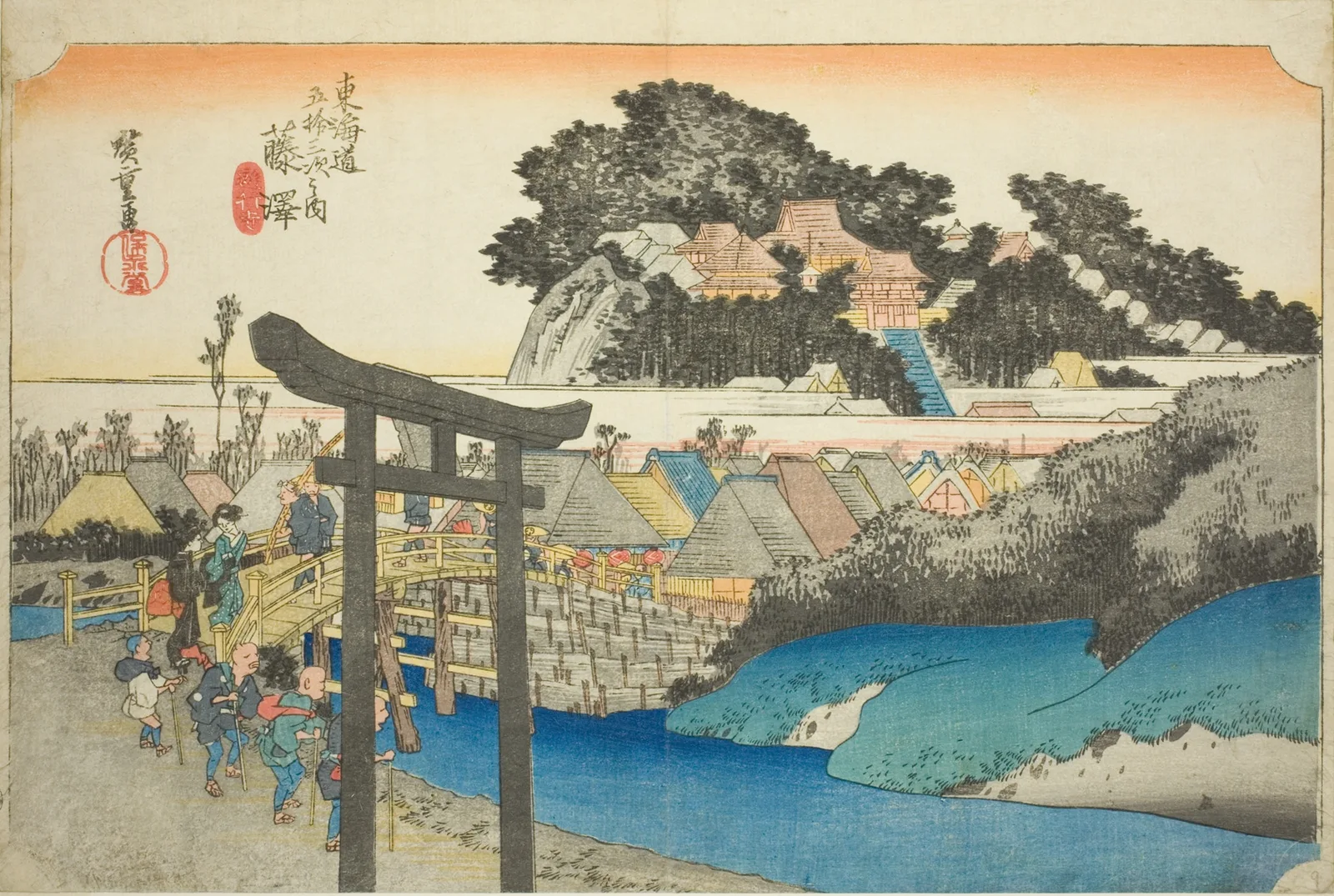
The Fifty-three Stations of the Tokaido (Hoeido edition) ・ 7
Yugyoji Temple at Fujisawa
東海道五拾三次之内 藤沢 遊行寺
A large torii gate stands in the foreground, with a bridge, the houses of Fujisawa-juku, and Yugyoji Temple on its hill beyond. Four zato about to pass through the torii tell us that this is the pilgrimage road to Enoshima.
- Artist
- Utagawa Hiroshige
- Date
- c. 1833-34 (Tenpo 4-5)
- Medium / format
- Woodblock print (ukiyo-e)
- Series
- The Fifty-three Stations of the Tokaido (Hoeido edition) 55 prints
- Place depicted
- Fujisawa-juku(Kanagawa)
About this work
The dark torii in the foreground divides the picture vertically, and through it a bridge, the post station, and a temple on a hill can be seen. Hiroshige seems to have been so fond of this torii that he drew it again from a different angle in another series.
This torii stood at the entrance to the approach to Enoshima Benzaiten, and from here the road to Enoshima branched off. Four zato (blind men) with staffs are walking under the torii, and a woman traveler can also be seen on the bridge.
The river in the foreground is the Sakai River, and the hall on the hill in the back is Yugyoji (Shojoko-ji). Fujisawa-juku developed as a temple town at the gate of Yugyoji. The upper part of the sky is dyed vermilion, and the temple grove, the roofs of the post station, and the blue river are clearly distinguished.
The foot of the bridge over the Sakai River was the starting point of the Enoshima road to Enoshima. At that time a notice board and a signpost were also placed beside the bridge. The black pillars of the torii act as a frame dividing the post station, the temple, and the sky. The stone steps leading to the temple are painted blue and stand out among the deep green of the grove. The roofs of the houses of the post station are also varied in yellow, indigo, and gray.
The place today
Yugyoji (Shojoko-ji) is the head temple of the Ji sect, and most of its present buildings were rebuilt after the Great Kanto Earthquake. Near the vermilion Yugyoji Bridge over the Sakai River is the starting point of the Enoshima road, and the foundation stones of the first torii of Enoshima Benzaiten are placed at the entrance of the Yugyoji Museum.
Where can I see it?
Exhibitions change over time. Check each museum's exhibition information before you visit.
Museums that hold this work
- Tokyo National MuseumMuseum's page for this work (opens in a new tab)
Taito City, Tokyo Accession no. A-12499-10
Museums that hold this series (please check the museum's website for whether it holds this print)
- Shizuoka City Tokaido Hiroshige Museum of Art
Shimizu Ward, Shizuoka
All prints of the Hoeido edition were shown in the museum's collection exhibition Fifty-three Stations of the Tokaido (2024-25)
Museums abroad
- Art Institute of ChicagoMuseum's page for this work (opens in a new tab)
Chicago Accession no. 1925.3506
Frequently asked questions
- Who painted The Fifty-three Stations of the Tokaido: Yugyoji Temple at Fujisawa, and when?
- The Fifty-three Stations of the Tokaido: Yugyoji Temple at Fujisawa is by Utagawa Hiroshige, made in c. 1833-34 (Tenpo 4-5). Medium: Woodblock print (ukiyo-e).
- What place does The Fifty-three Stations of the Tokaido: Yugyoji Temple at Fujisawa show?
- It shows Fujisawa-juku (Kanagawa).
- Where can I see The Fifty-three Stations of the Tokaido: Yugyoji Temple at Fujisawa?
- It is held by Tokyo National Museum, Tokyo Fuji Art Museum, National Diet Library. Exhibitions change, so check each museum's information before you visit.
Sources and references
- Art Institute of Chicago: Fujisawa: Yugyo Temple (Fujisawa, Yugyoji) (opens in a new tab) (checked 2026-10-18)
- ColBase(東京国立博物館): A-12499-10 (opens in a new tab) (checked 2026-10-18)
- 東京富士美術館 収蔵品: 東海道五拾三次之内 藤沢 遊行寺 (opens in a new tab) (checked 2026-10-18)
- 国立国会図書館デジタルコレクション: 東海道五拾三次 藤沢・遊行寺 (opens in a new tab) (checked 2026-10-18)
You may also like
More from Kanagawa
Discover more of the same region on our sister sites.