Irises
燕子花図屏風
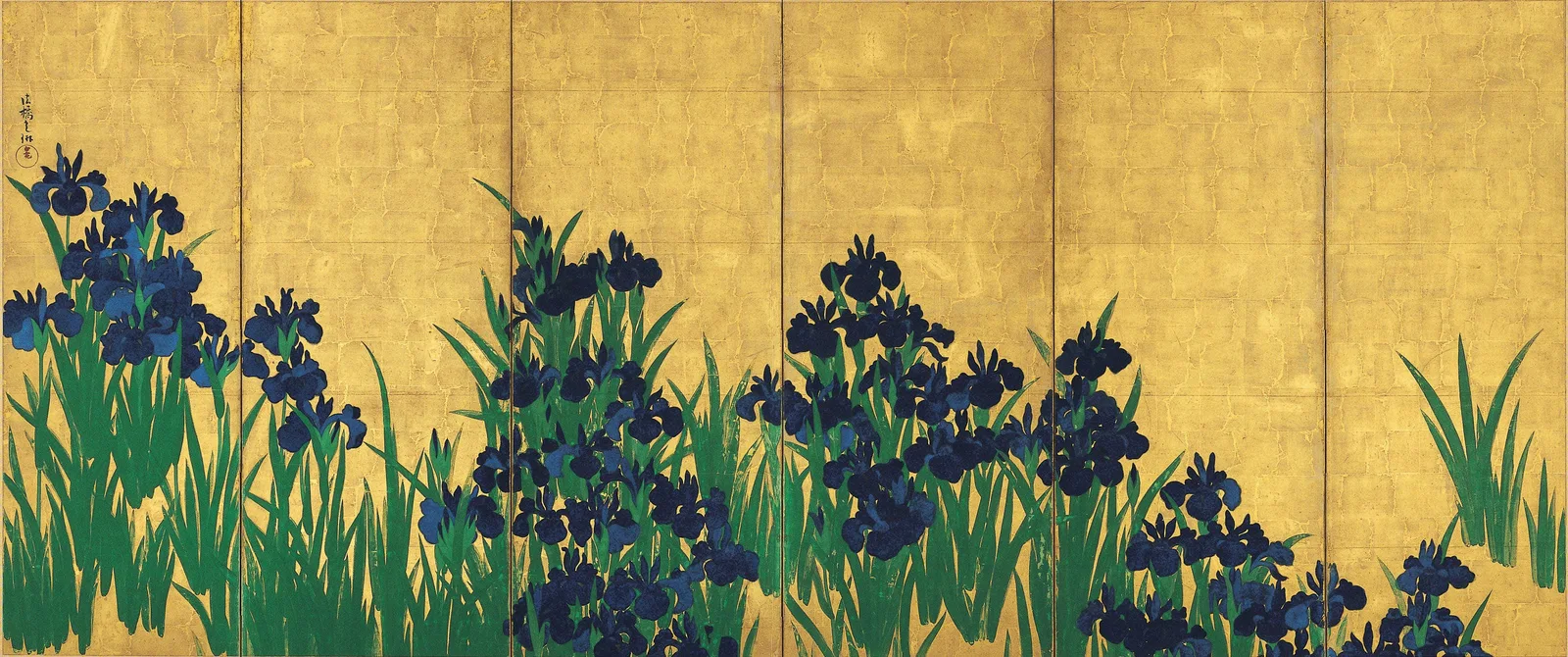
A pair of six-panel screens depicting clusters of irises in ultramarine and malachite green alone on a ground of pure gold. The repetition of flowers and leaves flows like waves across the two screens, making this a National Treasure in which Ogata Korin's design sense stands out.
- Artist
- Ogata Korin
- Date
- Edo period, 18th century
- Medium / format
- Folding screen
About this work
The background is gold alone, with neither ground nor water painted. On it, clusters of irises are painted with flowers in ultramarine of varying depth and leaves in malachite green. The clusters of flowers change position, high on the right screen and low on the left, and seen across both screens they create a rhythm that sways up and down.
The petals are given a plump look by making use of the thickness of the paint. In some of the flower shapes, traces of repeatedly using the same stencil can be seen, heightening a design quality like the patterns on a kimono. Only flowers and leaves are painted, but the large picture is built by the ingenuity of their arrangement.
In the background lies the Azuma Kudari scene from section nine of The Tales of Ise. At Yatsuhashi, a famous place for irises, the protagonist composed a poem about his feelings on the journey. Korin paints neither bridge nor figure, and evokes the tale with irises alone.
Ogata Korin was born into a family of high-class kimono merchants in Kyoto and revered Tawaraya Sotatsu. This work was bought in 1914 by the first Nezu Kaichiro, who laid the foundation for the Nezu Museum, and he showed it at exhibitions and tea gatherings. It was designated a National Treasure in 1951.
Where can I see it?
Exhibitions change over time. Check each museum's exhibition information before you visit.
Museums that hold this work
- Nezu MuseumMuseum's page for this work (opens in a new tab)
Minato City, Tokyo
Frequently asked questions
- Who painted Irises, and when?
- Irises is by Ogata Korin, made in Edo period, 18th century. Medium: Folding screen.
- Where can I see Irises?
- It is held by Nezu Museum. Exhibitions change, so check each museum's information before you visit.
Sources and references
- 根津美術館 コレクション 燕子花図 (opens in a new tab) (checked 2026-10-18)
- 文化遺産オンライン 紙本金地著色燕子花図〈尾形光琳筆/六曲屏風〉 (opens in a new tab) (checked 2026-10-18)
You may also like
More from Tokyo
Discover more of the same region on our sister sites.