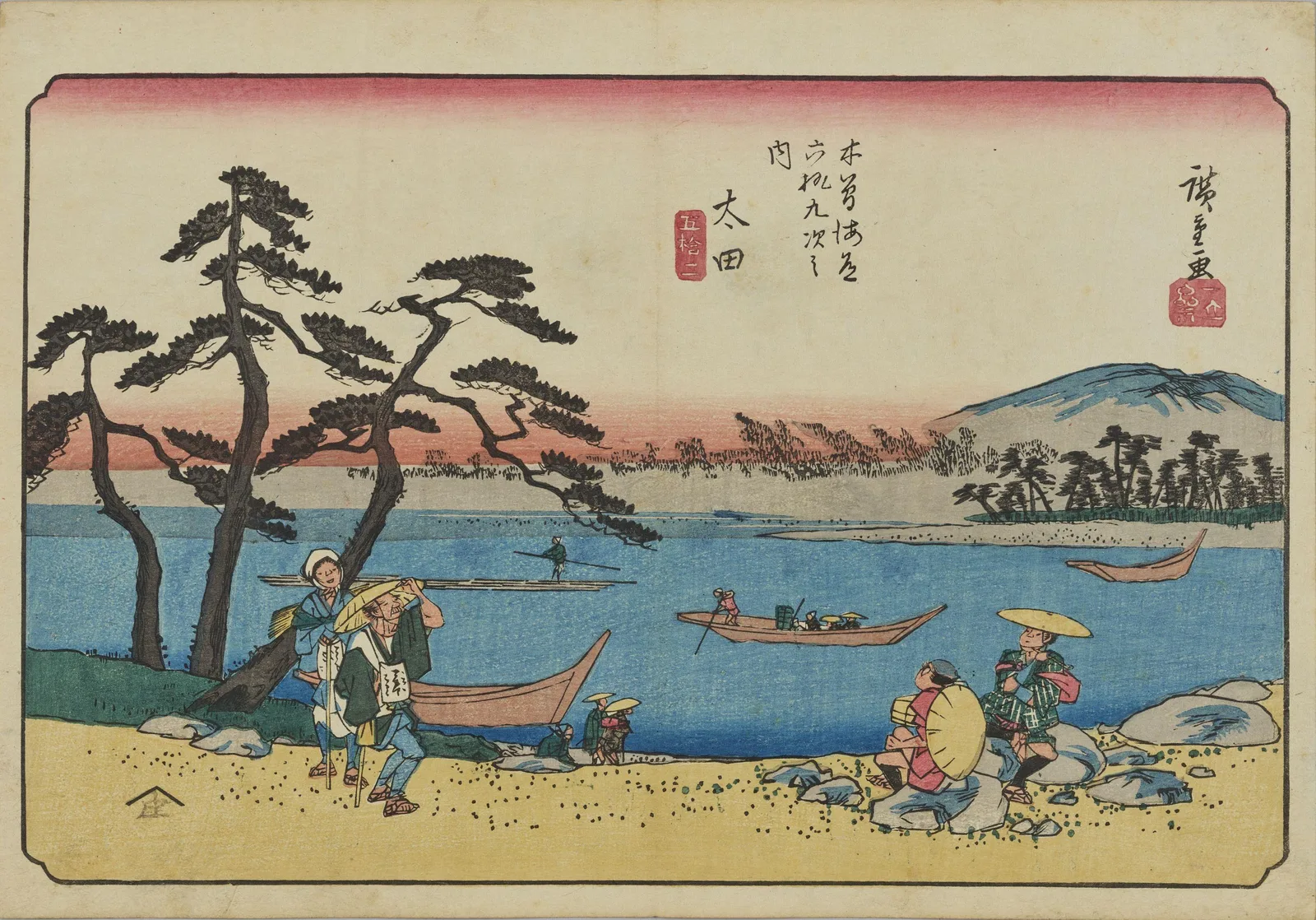
The Sixty-nine Stations of the Kisokaido ・ 52
Ota
木曽海道六拾九次之内 太田
A view of the Ota ferry, counted as one of the Nakasendo's three great hardships. On the Kiso River bank travelers wait for the ferry, and boats carrying people and cargo float on the water. Under a sunset sky, pine woods and mountains can be seen on the far shore.
- Artist
- Utagawa Hiroshige
- Date
- c. 1835-38 (Tenpo 6-9)
- Medium / format
- Woodblock print (ukiyo-e)
- Series
- The Sixty-nine Stations of the Kisokaido 71 prints
About this work
On the bank in the foreground, a person who looks like a pilgrim with a staff and travelers seated on stones wait for a boat. At the base of a pine at left a boat has been hauled up, and in mid-river a ferry carrying people and cargo heads for the far bank. In the back, a person poling a boat is also visible.
The indigo of the river occupies a large horizontal band of the picture, contrasting with the sky above in red gradation. The black branches of the pine at left tighten the picture, and the mountains and pine woods at right rear convey the width of the river.
Ota was a post town in Mino, at the foot of the Ota ferry across the Kiso River. This ferry was counted among the three great hardships of the Nakasendo, together with the Kiso Kakehashi and the Usui Pass. On the far bank was the Imawatari landing, from which the road continued to Fushimi-juku. One honjin and one waki-honjin were placed in the post town.
This is by Hiroshige. With its composition combining people waiting for the ferry and a broad river, it can be said to depict the highway's hardship as a calm sunset scene. What remains in the memory is that it turns its eye not to the severity of the hardship but to the peaceful time spent waiting for a boat.
The place today
Ota-juku is in Minokamo, Gifu Prefecture, where the waki-honjin Hayashi family residence, an Important Cultural Property, and others remain and convey the look of the post town. Ferries ran until the Ota Bridge was built in 1927, and stone paving still remains at the ferry landing sites on both banks, evoking the past.
Where can I see it?
Exhibitions change over time. Check each museum's exhibition information before you visit.
Museums that hold this work
- Tokyo National MuseumMuseum's page for this work (opens in a new tab)
Taito City, Tokyo Accession no. A-12499-120
- National Diet LibraryMuseum's page for this work (opens in a new tab)
Chiyoda City, Tokyo Accession no. 寄別2-2-1-5
Included in Kisokaido Rokujukyu-tsugi
Museums abroad
Frequently asked questions
- Who painted The Sixty-nine Stations of the Kisokaido: Ota, and when?
- The Sixty-nine Stations of the Kisokaido: Ota is by Utagawa Hiroshige, made in c. 1835-38 (Tenpo 6-9). Medium: Woodblock print (ukiyo-e).
- What place does The Sixty-nine Stations of the Kisokaido: Ota show?
- It shows Ota-juku, Ota Ferry Crossing Site (Gifu).
- Where can I see The Sixty-nine Stations of the Kisokaido: Ota?
- It is held by Tokyo National Museum, National Diet Library. Exhibitions change, so check each museum's information before you visit.
Sources and references
- ColBase(東京国立博物館): 木曽海道六拾九次之内 太田 (opens in a new tab) (checked 2026-10-19)
- 国立国会図書館デジタルコレクション: 五拾二 木曽海道六拾九次之内太田 (opens in a new tab) (checked 2026-10-19)
- Wikipedia: 木曽海道六十九次 (opens in a new tab) (checked 2026-10-19)
- Wikipedia: 太田橋 (木曽川)(太田の渡し) (opens in a new tab) (checked 2026-10-19)
You may also like
More from Gifu
Discover more of the same region on our sister sites.
Matsuri Biyori
Festivals in Gifu
- Takayama Festival Yatai Float Event
- Furukawa Festival Okoshi-daiko and Yatai Float Event
- Ogaki Festival Yama Float Event
- Gujo Odori