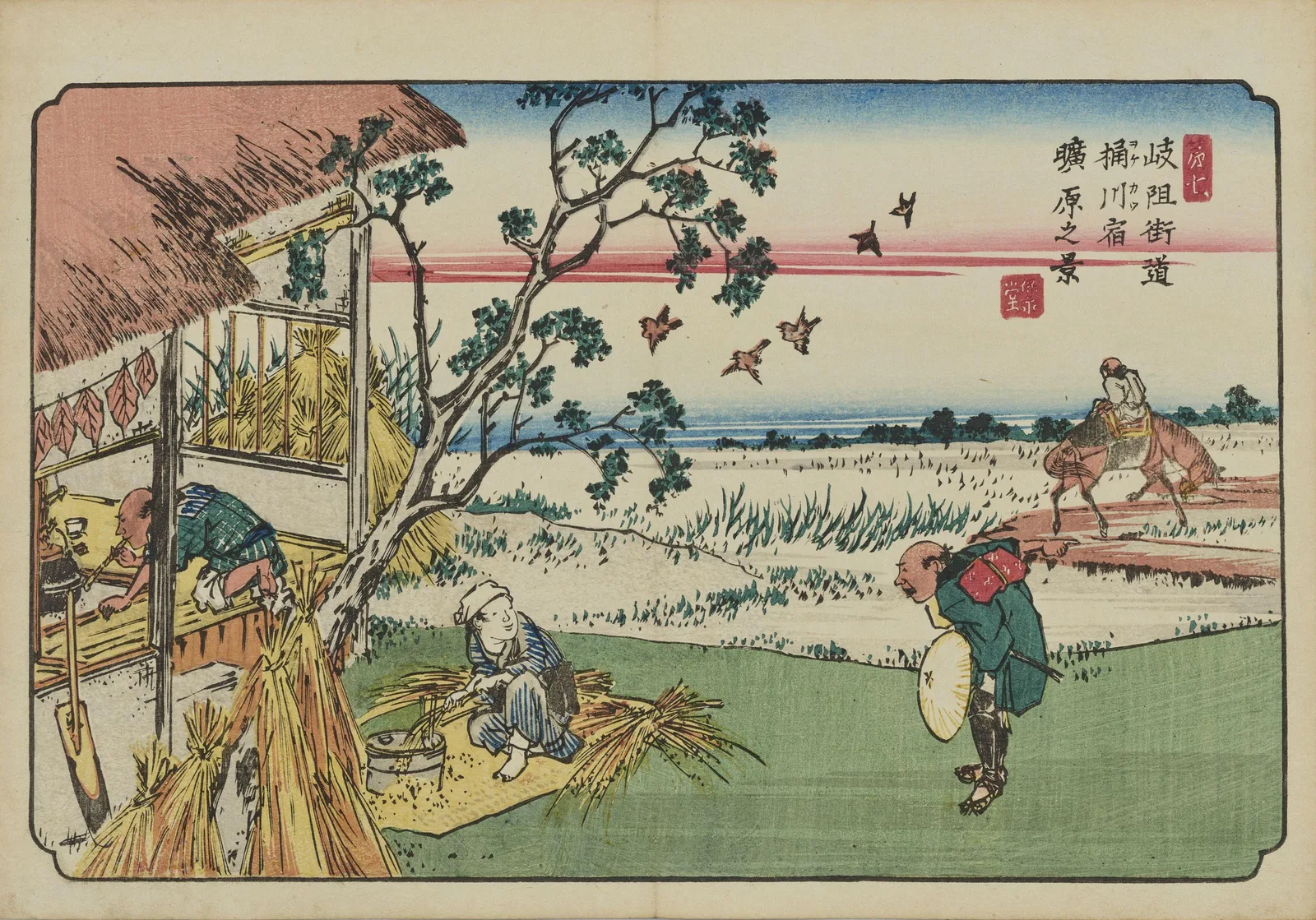
The Sixty-nine Stations of the Kisokaido ・ 7
View of the Open Plain at Okegawa Station
岐阻街道 桶川宿 広原之景
A print of the broad fields around Okegawa-juku. Beyond a straw-roofed farmhouse, where people work with straw on the veranda and a traveler bows low in greeting, a flat plain stretches endlessly under a sunset sky.
- Artist
- Keisai Eisen
- Date
- c. 1835-36 (Tenpo 6-7)
- Medium / format
- Woodblock print (ukiyo-e)
- Series
- The Sixty-nine Stations of the Kisokaido 71 prints
- Place depicted
- Okegawa-juku(Saitama)
About this work
At the left foreground stands a deep-eaved straw-roofed house, on whose veranda a man leans out, and something like red leaves hangs from the eaves. In the yard a woman sits handling cut ears of grain, and in front of her a traveler holding his hat bows deeply. Bundles of straw are propped beside the house.
In the middle a young tree spreads its branches, and a flock of sparrows flies about. Beyond it a broad grassy plain continues to the horizon, with a person on horseback traveling a distant road. Red horizontal clouds trail across the sky, and Eisen captures human life and the broad land in a single picture.
Okegawa-juku was a station where safflower, indigo, wheat, and other crops produced in the neighborhood were gathered, and the safflower in particular was known as the second-best producing area after Mogami. "Koh-gen" (broad plain) in the title is a word for a wide, open field.
This is a print by Eisen, with the title written as "Kiso Kaido." It has no signature but bears the publisher's seal. Even among Eisen's prints that draw figures large, this one combines a wide field landscape with human life, and has something in common with the pastoral landscapes of the later Hiroshige.
The place today
Okegawa-juku lies along the old Nakasendo in today's Okegawa City, Saitama Prefecture, and part of the building of the Fukawa family, who served as honjin, survives as a Saitama Prefecture Tangible Cultural Property. Merchant houses with storehouse-style construction from the post-town era are also scattered about, and the history as a safflower-producing area is still used to revitalize the town.
Where can I see it?
Exhibitions change over time. Check each museum's exhibition information before you visit.
Museums that hold this work
- Tokyo National MuseumMuseum's page for this work (opens in a new tab)
Taito City, Tokyo Accession no. A-12499-71
- National Diet LibraryMuseum's page for this work (opens in a new tab)
Chiyoda City, Tokyo Accession no. 寄別2-2-1-5
Included in Kisokaido Rokujukyu-tsugi
Museums abroad
Frequently asked questions
- Who painted The Sixty-nine Stations of the Kisokaido: View of the Open Plain at Okegawa Station, and when?
- The Sixty-nine Stations of the Kisokaido: View of the Open Plain at Okegawa Station is by Keisai Eisen, made in c. 1835-36 (Tenpo 6-7). Medium: Woodblock print (ukiyo-e).
- What place does The Sixty-nine Stations of the Kisokaido: View of the Open Plain at Okegawa Station show?
- It shows Okegawa-juku (Saitama).
- Where can I see The Sixty-nine Stations of the Kisokaido: View of the Open Plain at Okegawa Station?
- It is held by Tokyo National Museum, National Diet Library. Exhibitions change, so check each museum's information before you visit.
Sources and references
- ColBase(東京国立博物館): 岐阻街道 桶川宿 広原之景 (opens in a new tab) (checked 2026-10-19)
- 国立国会図書館デジタルコレクション: 第七 岐阻街道桶川宿曠原之景 (opens in a new tab) (checked 2026-10-19)
You may also like
More from Saitama
Discover more of the same region on our sister sites.