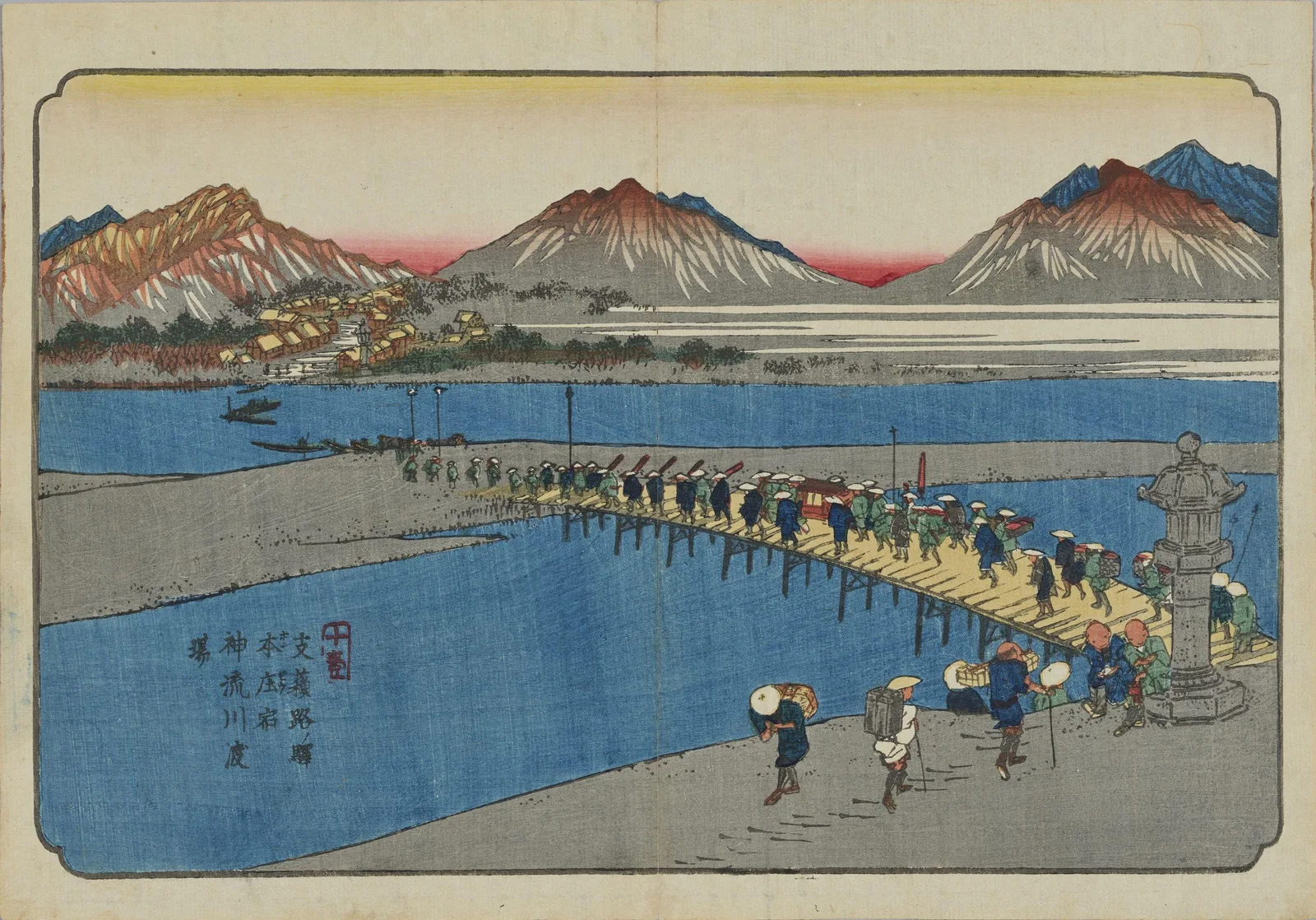
The Sixty-nine Stations of the Kisokaido ・ 11
The Kanna River Crossing at Honjo Station
支蘇路ノ駅 本庄宿 神流川渡場
A print of the Kanna River crossing between Honjo-juku and Shinmachi-juku. A party that looks like a daimyo procession crosses a long temporary plank bridge, a tall stone lantern stands in the foreground, and in the distance Joshu's mountains stretch, dyed red.
- Artist
- Keisai Eisen
- Date
- c. 1835-36 (Tenpo 6-7)
- Medium / format
- Woodblock print (ukiyo-e)
- Series
- The Sixty-nine Stations of the Kisokaido 71 prints
About this work
A narrow plank bridge crosses the center of the picture diagonally. People in hats, carrying loads and spears, cross it in a single line, and a red palanquin can also be seen in the middle. On the riverbank in the foreground travelers carrying loads walk toward the bridge, and at the far right a tall stone lantern stands.
The river is painted blue, and a white riverbed spreads widely. On the far bank can be seen a village of clustered houses and small boats, with reddish mountains rising beyond. By giving large space to the broad riverbed and mountains and drawing the line of people in fine detail, the picture conveys the breadth of the river.
The Kanna River flows along the border between Musashi and Kozuke provinces, and it is said that each flood washed away the route and travelers sometimes lost their way at night. So in 1815 (Bunka 12) a marker lantern was built on the Shinmachi-juku side. The lantern on the right is considered to be this sight-line lantern.
This is a print by Eisen, with the title written as "Shiso-ji no eki." It depicts Honjo, the last station of Musashi Province, and marks a break in the Eisen prints that had continued from the beginning of the series, with Hiroshige's prints starting from the next station, Shinmachi. Eisen went on to draw prints of Joshu, Shinshu, and Mino here and there afterward.
The place today
The Kanna River is now spanned by the Kannagawa Bridge of National Route 17. The sight-line lantern was moved in the Meiji era and did not return, and a stone lantern restored in 1978 stands at the entrance of Shinmachi-juku. The gate of the Tamura Honjin of Honjo-juku was moved and remains in front of the Honjo City Museum of History and Folklore.
Where can I see it?
Exhibitions change over time. Check each museum's exhibition information before you visit.
Museums that hold this work
- Tokyo National MuseumMuseum's page for this work (opens in a new tab)
Taito City, Tokyo Accession no. A-12499-75
- National Diet LibraryMuseum's page for this work (opens in a new tab)
Chiyoda City, Tokyo Accession no. 寄別2-2-1-5
Included in Kisokaido Rokujukyu-tsugi
Museums abroad
Frequently asked questions
- Who painted The Sixty-nine Stations of the Kisokaido: The Kanna River Crossing at Honjo Station, and when?
- The Sixty-nine Stations of the Kisokaido: The Kanna River Crossing at Honjo Station is by Keisai Eisen, made in c. 1835-36 (Tenpo 6-7). Medium: Woodblock print (ukiyo-e).
- What place does The Sixty-nine Stations of the Kisokaido: The Kanna River Crossing at Honjo Station show?
- It shows Honjo-juku, Kanna River (Saitama, Gunma).
- Where can I see The Sixty-nine Stations of the Kisokaido: The Kanna River Crossing at Honjo Station?
- It is held by Tokyo National Museum, National Diet Library. Exhibitions change, so check each museum's information before you visit.
Sources and references
- ColBase(東京国立博物館): 支蘇路ノ駅 本庄宿 神流川渡場 (opens in a new tab) (checked 2026-10-19)
- 国立国会図書館デジタルコレクション: 十壱 支蘇路ノ駅本庄宿神流川渡場 (opens in a new tab) (checked 2026-10-19)
You may also like
More from Saitama
Discover more of the same region on our sister sites.