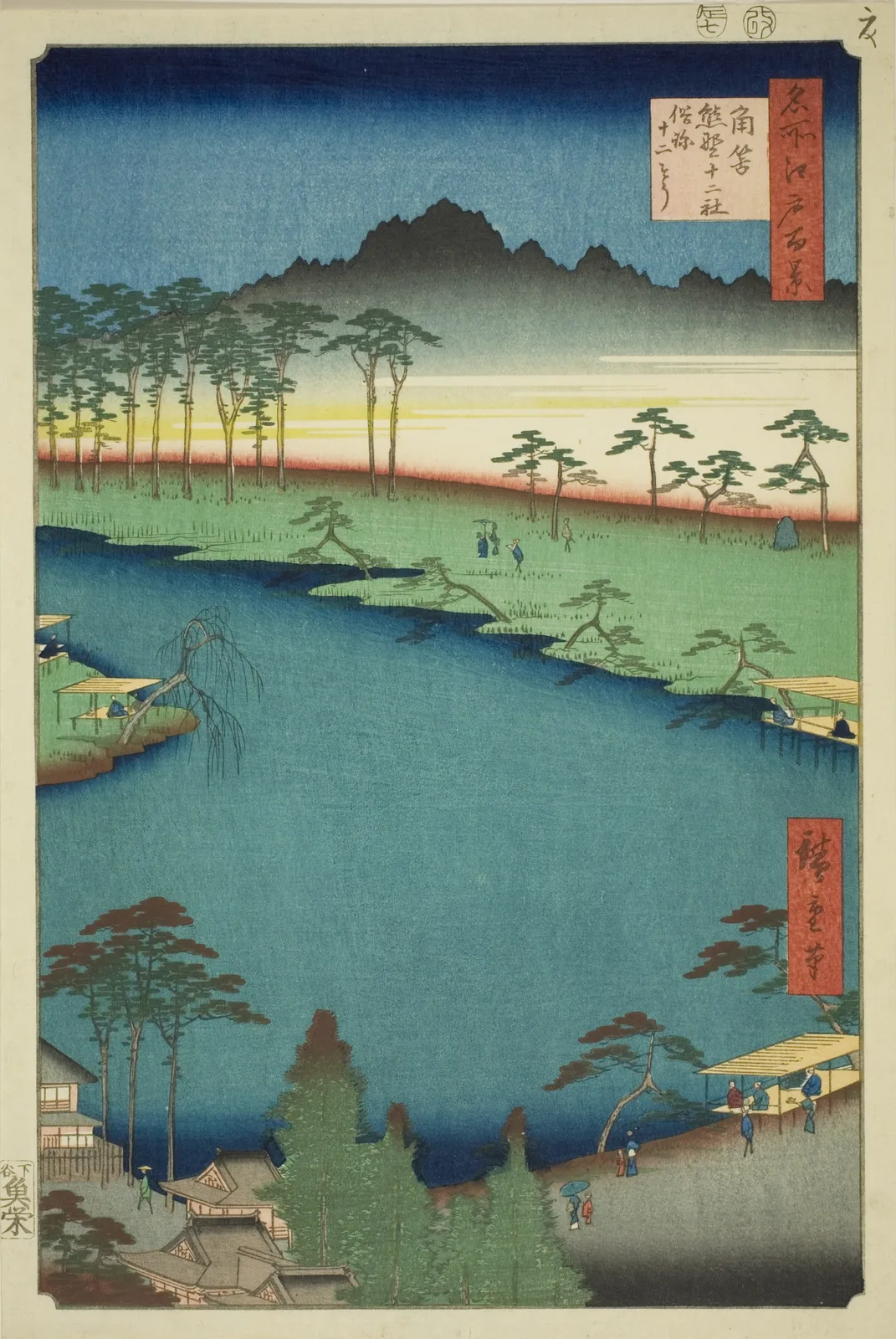
One Hundred Famous Views of Edo ・ 50
Kumano Junisha Shrine in Tsunohazu, Popularly Known as Juniso
名所江戸百景 角筈熊野十二社俗称十二そう
A view looking down from a height on the Juniso pond, which lay at the gate of Kumano Shrine in what is now Nishi-Shinjuku. Teahouses line the pond's edge, and beyond a band of sunset color a dark range of distant mountains stretches across. It is a peaceful evening scene of a leisure spot in Edo's western suburbs.
- Artist
- Utagawa Hiroshige
- Date
- July 1856 (Ansei 3)
- Medium / format
- Woodblock print (ukiyo-e)
- Series
- One Hundred Famous Views of Edo 119 prints
- Place depicted
- Juniso(Tokyo)
About this work
In the lower left foreground the roof of Kumano Shrine and a grove of cedars peek into view, while on the bank at lower right reed-screened teahouses stand in a row with customers cooling off. In the middle is a large pond; across it a bank with pine trees continues, and people walk with parasols. Beyond lie open fields and distant mountains. Small figures stroll along the pond's edge.
The pond is painted a deep blue-green, and the sky shifts from indigo at the top to a red band of sunset. Layering the black mountains, the red band, and the green fields horizontally, and framing the scene with trees and teahouses in the foreground, conveys the height from which the pond is viewed.
The name Juniso comes from the shrine's enshrinement of the twelve Kumano deities (Junisho Gongen), and the area was a leisure spot on the western fringe of Edo. The pond also had a waterfall, and with teahouses serving meals lined along it, it is said to have drawn many visitors in summer to cool off.
This is one print from the summer section. A feature of the series is that it also includes suburban sights far from the center of Edo, and the distant mountains are thought to be those of Chichibu and Tanzawa to the west. In the stillness of dusk, it shows the pleasures of Edo residents who went out to the suburbs for a day's outing.
The place today
Kumano Shrine still stands today on the west side of the Nishi-Shinjuku skyscraper district, next to Shinjuku Central Park. The Juniso pond was filled in in 1968 because of the development of the new city center and water pollution, and the site became roads and buildings. The old place name survives in the name of Juniso-dori. The shrine grounds are a green refuge in the middle of the city.
Where can I see it?
Exhibitions change over time. Check each museum's exhibition information before you visit.
Museums that hold this work
- Tokyo National MuseumMuseum's page for this work (opens in a new tab)
Taito City, Tokyo Accession no. A-12499-383
- National Diet LibraryMuseum's page for this work (opens in a new tab)
Chiyoda City, Tokyo Accession no. 寄別1-8-2-1イ
- National Diet LibraryMuseum's page for this work (opens in a new tab)
Chiyoda City, Tokyo Accession no. 寄別1-8-2-1
Museums abroad
- Art Institute of ChicagoMuseum's page for this work (opens in a new tab)
Chicago Accession no. 1939.1414
Frequently asked questions
- Who painted One Hundred Famous Views of Edo: Kumano Junisha Shrine in Tsunohazu, Popularly Known as Juniso, and when?
- One Hundred Famous Views of Edo: Kumano Junisha Shrine in Tsunohazu, Popularly Known as Juniso is by Utagawa Hiroshige, made in July 1856 (Ansei 3). Medium: Woodblock print (ukiyo-e).
- What place does One Hundred Famous Views of Edo: Kumano Junisha Shrine in Tsunohazu, Popularly Known as Juniso show?
- It shows Juniso (Tokyo).
- Where can I see One Hundred Famous Views of Edo: Kumano Junisha Shrine in Tsunohazu, Popularly Known as Juniso?
- It is held by Tokyo National Museum, National Diet Library. Exhibitions change, so check each museum's information before you visit.
Sources and references
- Art Institute of Chicago: Kumano Junisha Shrine in Tsunohazu, Popularly Known as Juniso (Tsunohazu Kumano Junisha, zokusho Juniso), from the series "One Hundred Famous Views of Edo (Meisho Edo hyakkei)" (opens in a new tab) (checked 2026-10-19)
- ColBase(東京国立博物館): 名所江戸百景 角筈熊野十二社俗称十二そう (opens in a new tab) (checked 2026-10-19)
- Wikipedia: One Hundred Famous Views of Edo (opens in a new tab) (checked 2026-10-19)
You may also like
More from Tokyo
Discover more of the same region on our sister sites.