One Hundred Famous Views of Edo ・ 78
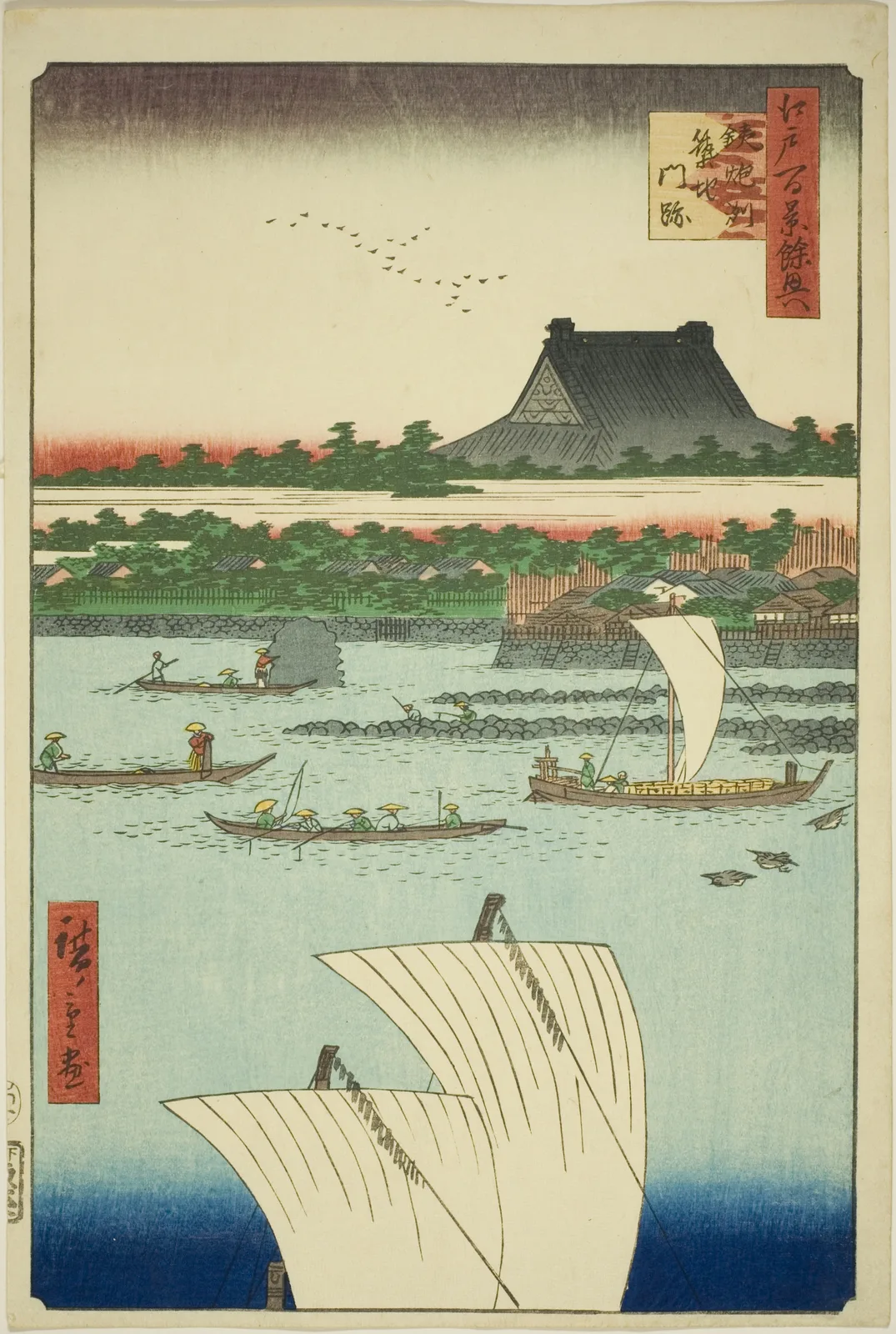
Teppozu and Tsukiji Honganji Temple
江戸百景餘興 鉄炮洲築地門跡
A view of the great roof of Tsukiji Honganji Temple from offshore at Teppozu. The tips of white sails loom large in the foreground, small fishing boats and sailing ships go back and forth on the sea, and a flock of wild geese crosses the evening sky.
- Artist
- Utagawa Hiroshige
- Date
- July 1858 (Ansei 5)
- Medium / format
- Woodblock print (ukiyo-e)
- Series
- One Hundred Famous Views of Edo 119 prints
About this work
At the bottom of the picture the tips of the white sails of two ships are drawn large. In the sea beyond float fishermen's boats hauling nets and ships under sail, and a row of stakes, apparently laid out for seaweed cultivation, can also be seen. Above the green woods and townscape on the far shore rises the great tiled roof of the Honganji main hall.
The combination of pale blue sea, white sails, and the great gray roof conveys a quiet autumn dusk. Placing only the tips of the sails large at the bottom and drawing the distant temple small conveys the breadth of the sea.
Tsukiji Honganji is a branch temple of Nishi Honganji, which lost its temple grounds near Asakusa in the Great Fire of Meireki and moved to Tsukiji, land reclaimed from the sea. Called a "monzeki," its great roof was a landmark of Edo seen from the sea. Even after the earthquake, the temple's great roof seen from the sea would have given a sense of the unchanged Edo.
Hiroshige depicts the sea at Teppozu from inside the harbor in the previous print and from offshore in this one. The bold composition showing only the tips of sails large shows well the series' characteristic of putting an object in front to reveal what lies beyond.
The place today
The present main hall of Tsukiji Honganji, built in 1934 to a design by Ito Chuta, is an ancient Indian-style stone building designated an Important Cultural Property of Japan. The surrounding sea has been reclaimed, and the area is now a district of outer-market shops and tall buildings.
Where can I see it?
Exhibitions change over time. Check each museum's exhibition information before you visit.
Museums that hold this work
- Tokyo National MuseumMuseum's page for this work (opens in a new tab)
Taito City, Tokyo Accession no. A-12499-397
- National Diet LibraryMuseum's page for this work (opens in a new tab)
Chiyoda City, Tokyo Accession no. 寄別1-8-2-1イ
Another impression is held under Yoribetsu 1-8-2-1 (https://dl.ndl.go.jp/pid/1312314)
Museums abroad
- Art Institute of ChicagoMuseum's page for this work (opens in a new tab)
Chicago Accession no. 1925.3739
- Brooklyn MuseumMuseum's page for this work (opens in a new tab)
New York Accession no. 30.1478.78
Frequently asked questions
- Who painted One Hundred Famous Views of Edo: Teppozu and Tsukiji Honganji Temple, and when?
- One Hundred Famous Views of Edo: Teppozu and Tsukiji Honganji Temple is by Utagawa Hiroshige, made in July 1858 (Ansei 5). Medium: Woodblock print (ukiyo-e).
- What place does One Hundred Famous Views of Edo: Teppozu and Tsukiji Honganji Temple show?
- It shows Teppozu, Tsukiji Hongwanji Temple (Tokyo).
- Where can I see One Hundred Famous Views of Edo: Teppozu and Tsukiji Honganji Temple?
- It is held by Tokyo National Museum, National Diet Library. Exhibitions change, so check each museum's information before you visit.
Sources and references
- Art Institute of Chicago: Teppozu and Tsukiji Honganji Temple (Teppozu Tsukiji Monzeki) (opens in a new tab) (checked 2026-10-19)
- Brooklyn Museum: Teppozu and Tsukiji Honganji Temple, No. 78 from One Hundred Famous Views of Edo (opens in a new tab) (checked 2026-10-19)
- ColBase(東京国立博物館): 江戸百景餘興 鉄炮洲築地門跡 (opens in a new tab) (checked 2026-10-19)
- 国立国会図書館デジタルコレクション: 江戸百景余興 鉄炮洲築地門跡 (opens in a new tab) (checked 2026-10-19)
- nippon.com: 『鉄砲洲築地門跡』浮世写真家 喜千也の「名所江戸百景」第72回 (opens in a new tab) (checked 2026-10-19)
You may also like
More from Tokyo
Discover more of the same region on our sister sites.