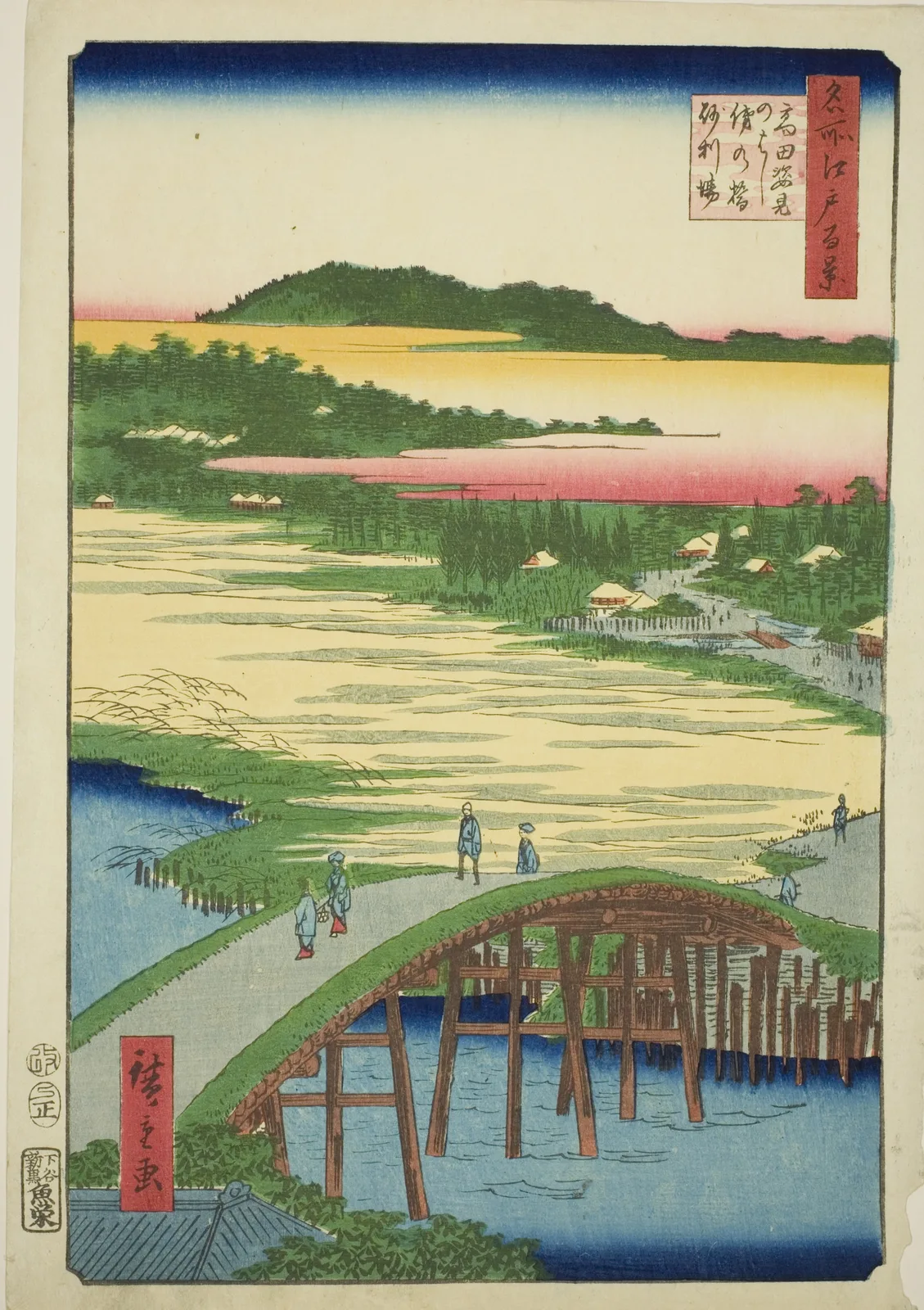
One Hundred Famous Views of Edo ・ 116
Sugatami Bridge, Omokage Bridge and the Gravel Pit at Takata
名所江戸百景 高田姿見のはし俤の橋砂利場
Omokage Bridge over the Kanda River and the village of rice fields and gravel pits beyond. The wooden bridge in the foreground and the distant gently rolling hills are beautifully gathered in vivid, bright colors.
- Artist
- Utagawa Hiroshige
- Date
- January 1857 (Ansei 4)
- Medium / format
- Woodblock print (ukiyo-e)
- Series
- One Hundred Famous Views of Edo 119 prints
- Place depicted
- Omokage Bridge(Tokyo)
About this work
At lower right a wooden arched bridge over the Kanda River is drawn, with people walking on it and along the bank path. This bridge is said to be Omokage Bridge. At left are the river and embankment, in the middle ground wide rice fields spread out, and at the foot of the hills in the back are houses and trees. Green hills lie across the top of the picture, and the sky is tinted rose and yellow.
The yellowish rice fields, the deep indigo of the river, the green of the hills, and the rose of the sky resonate vividly. The foreground bridge is drawn large, and the fields spread toward the distant hills. The people are small, and the breadth of the landscape is the protagonist.
Omokage Bridge ("Bridge of Reflections") spans the Kanda River, and its relationship to the Sugatami Bridge ("Mirror Bridge") named alongside it in the title is not clear. The gravel pit is said to be the name of a village where river gravel was gathered, and a Hikawa Shrine is thought to have stood at the foot of the hills in the back. It was a suburb of peaceful countryside.
Although it belongs to the winter section, it is known for the vividness of its colors. The shogun Tokugawa Iesada is said to have crossed this bridge in the month of the censor's seal, and some see the print's publication as related to that. The yellow and rose coloring the sky and fields are thought to express the light of a clear winter dusk.
The place today
Omokage Bridge still spans the Kanda River on the border of Shinjuku and Toshima Wards, and the Toden Arakawa Line runs right beside it with an "Omokage-bashi" stop. The riverbank is lined with cherry trees, and crowds come for blossom viewing in spring. The scenery of fields and gravel pits has turned into a residential area. Only the name of the bridge remains.
Where can I see it?
Exhibitions change over time. Check each museum's exhibition information before you visit.
Museums that hold this work
- Tokyo National MuseumMuseum's page for this work (opens in a new tab)
Taito City, Tokyo Accession no. A-12499-435
- National Diet LibraryMuseum's page for this work (opens in a new tab)
Chiyoda City, Tokyo Accession no. 寄別1-8-2-1イ
Museums abroad
- Art Institute of ChicagoMuseum's page for this work (opens in a new tab)
Chicago Accession no. 1939.1496
Frequently asked questions
- Who painted One Hundred Famous Views of Edo: Sugatami Bridge, Omokage Bridge and the Gravel Pit at Takata, and when?
- One Hundred Famous Views of Edo: Sugatami Bridge, Omokage Bridge and the Gravel Pit at Takata is by Utagawa Hiroshige, made in January 1857 (Ansei 4). Medium: Woodblock print (ukiyo-e).
- What place does One Hundred Famous Views of Edo: Sugatami Bridge, Omokage Bridge and the Gravel Pit at Takata show?
- It shows Omokage Bridge (Tokyo).
- Where can I see One Hundred Famous Views of Edo: Sugatami Bridge, Omokage Bridge and the Gravel Pit at Takata?
- It is held by Tokyo National Museum, National Diet Library. Exhibitions change, so check each museum's information before you visit.
Sources and references
- Art Institute of Chicago: Sugatami Bridge, Omokage Bridge and the Gravel Pit at Takata (Takata Sugataminohashi Omokagenohashi jariba), from the series "One Hundred Famous Views of Edo (Meisho Edo hyakkei)" (opens in a new tab) (checked 2026-10-19)
- ColBase(東京国立博物館): 名所江戸百景 高田姿見のはし俤の橋砂利場 (opens in a new tab) (checked 2026-10-19)
- 国立国会図書館デジタルコレクション: 名所江戸百景 高田姿見のはし俤の橋砂利場 (opens in a new tab) (checked 2026-10-19)
- Wikipedia: One Hundred Famous Views of Edo (opens in a new tab) (checked 2026-10-19)
You may also like
More from Tokyo
Discover more of the same region on our sister sites.