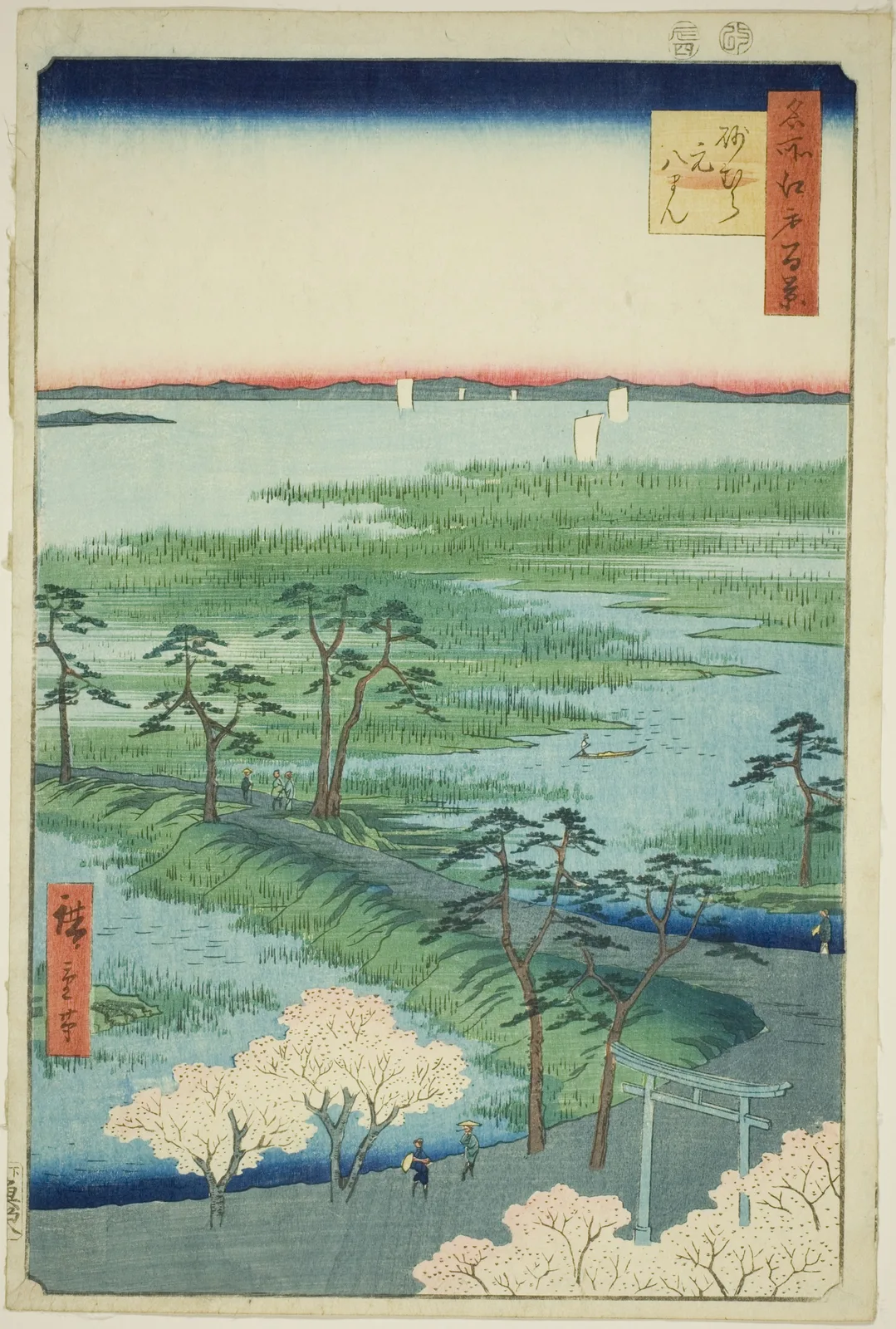
One Hundred Famous Views of Edo ・ 29
Moto-Hachiman Shrine, Sunamura
名所江戸百景 砂むら元八まん
This print shows the approach to Moto-Hachiman Shrine in Sunamura, on Edo's eastern edge, with a reed plain and Edo Bay spreading beyond. Past cherries blooming beside the torii and a row of pines, an open view of seaside marshland continues without end.
- Artist
- Utagawa Hiroshige
- Date
- April 1856 (Ansei 3)
- Medium / format
- Woodblock print (ukiyo-e)
- Series
- One Hundred Famous Views of Edo 119 prints
- Place depicted
- Sunamura(Tokyo)
About this work
A stone torii stands at lower right, with white cherries blooming around it. From the torii an embankment road lined with pines extends toward the back, where worshippers walk. Beyond is a marsh thick with reeds, small boats move along the waterways, white sails float on the distant Edo Bay, and low mountains on the far shore are hazy.
Green reed beds and the blue of water occupy most of the picture, and the white of the cherries in the foreground, the indigo of the sky and the red band of the horizon tighten the whole. From the elevated viewpoint, the winding embankment and waterways lead the eye toward the back. Keeping the line between sea and sky low emphasizes the breadth of the marsh.
Moto-Hachiman takes its name from the tradition that Tomioka Hachimangu in Fukagawa originally stood on this site, and it corresponds to today's Tomigaoka Hachimangu. Sunamura was a village of new fields reclaimed from the seashore, and people are said to have come from the town of Edo to enjoy the cherries in the precincts and the sea view.
This is one of the Spring section's prints of the seashore at the edge of town. The composition looking down over a wide marsh also serves as a record of the waterside scenery that spread across the east of Edo.
The place today
Tomigaoka Hachimangu still stands in Minami-Sunamachi 7-chome, Koto Ward, and its precincts retain a lava Fuji mound built in the late Edo period. The surrounding marshes were filled in and became a district of housing and factories, and the sea is now far away, but the shrine's woods convey the old atmosphere.
Where can I see it?
Exhibitions change over time. Check each museum's exhibition information before you visit.
Museums that hold this work
- Tokyo National MuseumMuseum's page for this work (opens in a new tab)
Taito City, Tokyo Accession no. A-12499-347
- National Diet LibraryMuseum's page for this work (opens in a new tab)
Chiyoda City, Tokyo Accession no. 寄別1-8-2-1イ
Museums abroad
- Art Institute of ChicagoMuseum's page for this work (opens in a new tab)
Chicago Accession no. 1925.3748
Frequently asked questions
- Who painted One Hundred Famous Views of Edo: Moto-Hachiman Shrine, Sunamura, and when?
- One Hundred Famous Views of Edo: Moto-Hachiman Shrine, Sunamura is by Utagawa Hiroshige, made in April 1856 (Ansei 3). Medium: Woodblock print (ukiyo-e).
- What place does One Hundred Famous Views of Edo: Moto-Hachiman Shrine, Sunamura show?
- It shows Sunamura (Tokyo).
- Where can I see One Hundred Famous Views of Edo: Moto-Hachiman Shrine, Sunamura?
- It is held by Tokyo National Museum, National Diet Library. Exhibitions change, so check each museum's information before you visit.
Sources and references
- Art Institute of Chicago: Moto-Hachiman Shrine, Sunamura (Sunamura Moto-Hachiman), from the series "One Hundred Famous Views of Edo (Meisho Edo hyakkei)" (opens in a new tab) (checked 2026-10-19)
- ColBase(東京国立博物館): 名所江戸百景 砂むら元八まん (opens in a new tab) (checked 2026-10-19)
- 国立国会図書館デジタルコレクション: 名所江戸百景 砂むら元八まん (opens in a new tab) (checked 2026-10-19)
You may also like
More from Tokyo
Discover more of the same region on our sister sites.