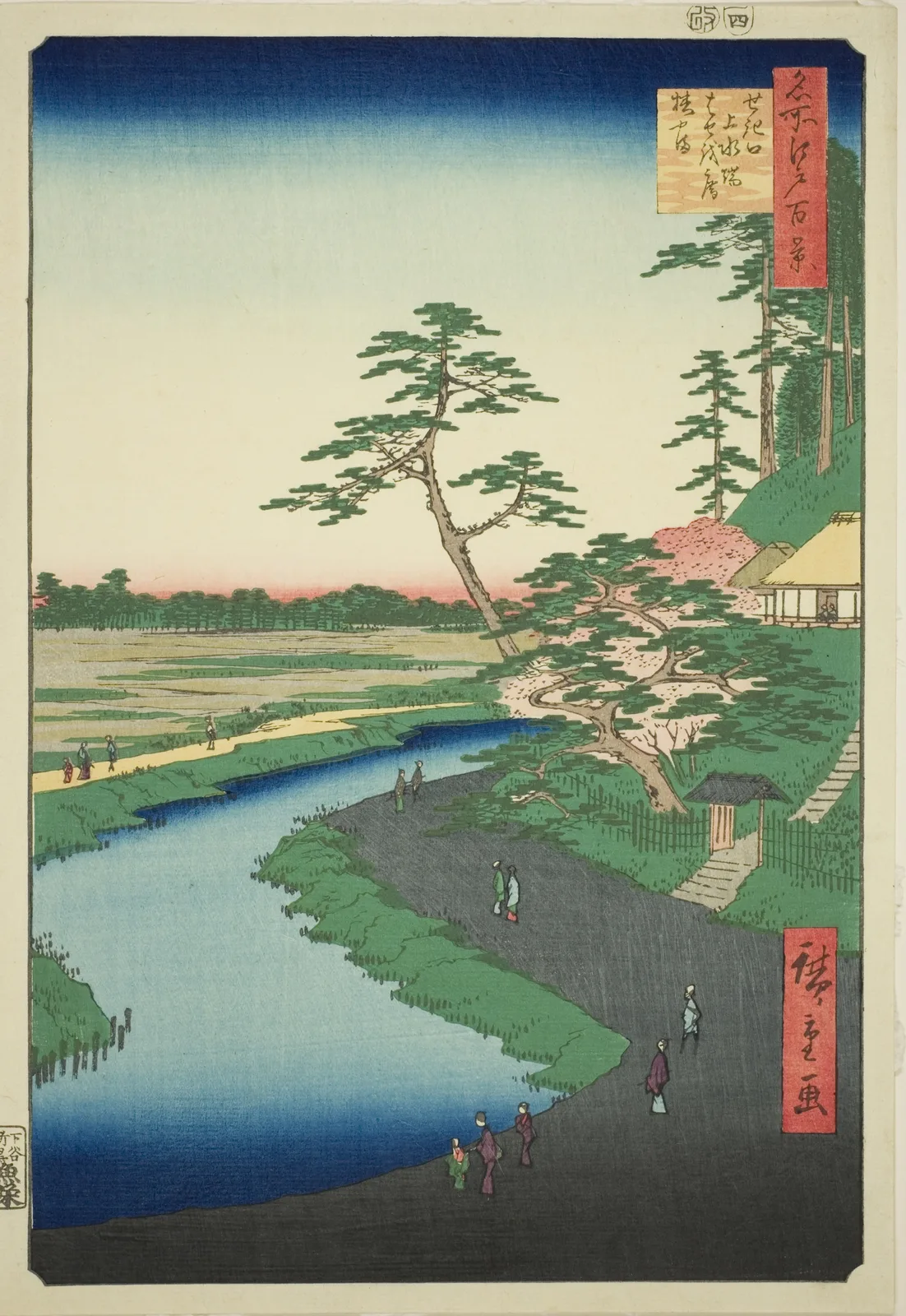
One Hundred Famous Views of Edo ・ 40
Basho's Hut on Camellia Hill Beside the Aqueduct at Sekiguchi
名所江戸百景 せき口上水端はせを庵椿やま
This print views the hermitage associated with Basho and Camellia Hill beside the Kanda Aqueduct at Sekiguchi from a path along the water. The gently curving flow of the aqueduct, a small hill with spring flowers and the hermitage on it convey the quiet atmosphere of the suburbs.
- Artist
- Utagawa Hiroshige
- Date
- April 1857 (Ansei 4)
- Medium / format
- Woodblock print (ukiyo-e)
- Series
- One Hundred Famous Views of Edo 119 prints
- Place depicted
- Sekiguchi(Tokyo)
About this work
From the lower left of the picture to the back, the blue Kanda Aqueduct flows in a gentle curve. People walk along the gray road on the right bank, and on a small hill beyond it pines and cherries grow thick around a thatched hermitage. At the foot of the hill a small gate and stone steps can be seen, and fields spread on the far bank at left, with woods continuing in the distance.
The deep blue of the river leads the eye from front to back, and the green of the hill, the pale crimson of the cherries and the gradation from indigo to red in the sky create the soft air of a spring evening. A large pine leaning diagonally gives movement to the picture. The small figures walking along the river convey the leisure of the promenade.
Sekiguchi was where the Ogarai weir, the intake of the Kanda Aqueduct, stood, and from here drinking water was sent to the town of Edo. Matsuo Basho is said to have been involved in the aqueduct works in his youth, and the hermitage set up by his disciples because of that connection is regarded as the Sekiguchi Basho Hermitage. The neighboring hill was called Camellia Hill because of its many camellias.
This print belongs to the Spring section. It depicts the hermitage connected with a haiku poet together with a riverside walking path, introducing an elegant suburban famous place favored by the people of Edo.
The place today
The hermitage and garden of the Sekiguchi Basho Hermitage remain in Sekiguchi 2-chome, Bunkyo Ward. The neighboring Camellia Hill is now the garden of Hotel Chinzanso Tokyo, and the flow of the Kanda Aqueduct continues as the Kanda River. The riverside has been developed as Edogawa Park, with rows of cherries blooming in spring.
Where can I see it?
Exhibitions change over time. Check each museum's exhibition information before you visit.
Museums that hold this work
- Tokyo National MuseumMuseum's page for this work (opens in a new tab)
Taito City, Tokyo Accession no. A-12499-358
- National Diet LibraryMuseum's page for this work (opens in a new tab)
Chiyoda City, Tokyo Accession no. 寄別1-8-2-1イ
Museums abroad
- Art Institute of ChicagoMuseum's page for this work (opens in a new tab)
Chicago Accession no. 1939.1413
Frequently asked questions
- Who painted One Hundred Famous Views of Edo: Basho's Hut on Camellia Hill Beside the Aqueduct at Sekiguchi, and when?
- One Hundred Famous Views of Edo: Basho's Hut on Camellia Hill Beside the Aqueduct at Sekiguchi is by Utagawa Hiroshige, made in April 1857 (Ansei 4). Medium: Woodblock print (ukiyo-e).
- What place does One Hundred Famous Views of Edo: Basho's Hut on Camellia Hill Beside the Aqueduct at Sekiguchi show?
- It shows Sekiguchi (Tokyo).
- Where can I see One Hundred Famous Views of Edo: Basho's Hut on Camellia Hill Beside the Aqueduct at Sekiguchi?
- It is held by Tokyo National Museum, National Diet Library. Exhibitions change, so check each museum's information before you visit.
Sources and references
- Art Institute of Chicago: Basho's Hut on Camellia Hill Beside the Aquaduct at Sekiguchi (Sekiguchi josui-bata Bashoan Tsubakiyama), from the series "One Hundred Famous Views of Edo (Meisho Edo hyakkei)" (opens in a new tab) (checked 2026-10-19)
- ColBase(東京国立博物館): 名所江戸百景 せき口上水端はせを庵椿やま (opens in a new tab) (checked 2026-10-19)
- 国立国会図書館デジタルコレクション: 名所江戸百景 せき口上水端はせを庵椿やま (opens in a new tab) (checked 2026-10-19)
You may also like
More from Tokyo
Discover more of the same region on our sister sites.