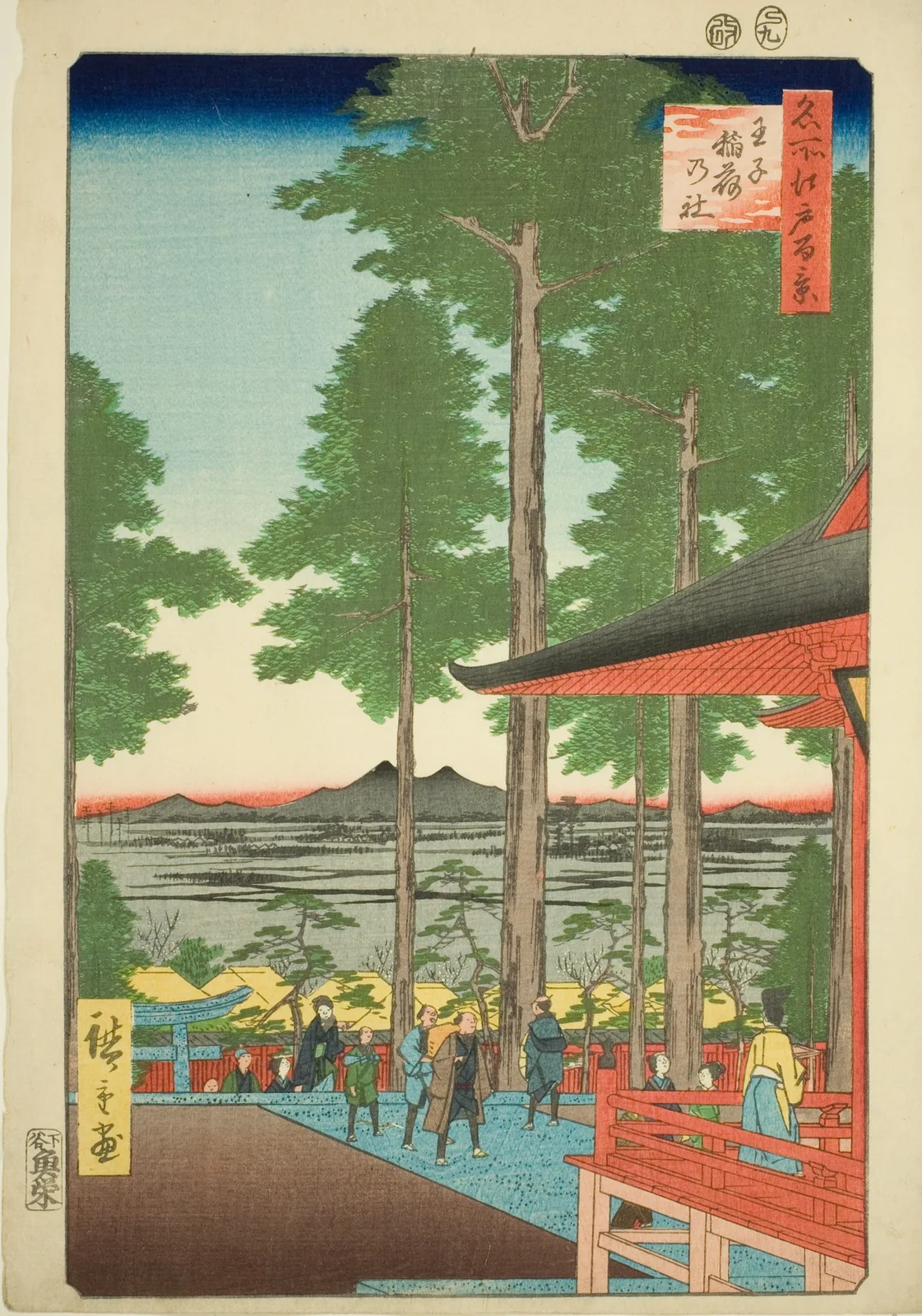
One Hundred Famous Views of Edo ・ 18
Oji Inari Shrine
名所江戸百景 王子稲荷の社
This print looks from beside the buildings of Oji Inari Shrine, through a cedar grove, at the northern plain and Mount Tsukuba. Worshippers climb the stone steps, and the vermilion shrine building presses in on the right of the picture. Tall cedar trunks divide the picture vertically.
- Artist
- Utagawa Hiroshige
- Date
- September 1857 (Ansei 4)
- Medium / format
- Woodblock print (ukiyo-e)
- Series
- One Hundred Famous Views of Edo 119 prints
- Place depicted
- Oji Inari Shrine(Tokyo)
- Seen in the distance
- Mount Tsukuba
About this work
At right the vermilion shrine building and the railing of its corridor jut out, and worshippers walk across the grounds in the foreground. In the middle many large cedars rise tall, and below them a torii and the roof of a teahouse peek through. A plain spreads in the distance, and Mount Tsukuba with its two peaks can be seen.
The composition repeats the vertical lines of the cedar trunks and lets the distant view show between them. The vermilion of the shrine, the deep green of the cedars and the red horizon of sunset combine solemnity and brightness in the grounds.
Oji Inari was a shrine regarded as the head of all Inari shrines in the Kanto region, and was known for a legend that on New Year's Eve foxes from all over Kanto gathered there and lit fox fires. Hiroshige also depicted this legend in the Winter section's Ceremonial Robes Tree at Oji, Foxfires on New Year's Eve.
This is the eighteenth print of the Spring section. Like the preceding view north from Asukayama, it repeats a view of Mount Tsukuba from the heights of Oji, showing the famous places around Oji in succession. The censor's seal dates it to September 1857 (Ansei 4). The composition that overlaps cedar trunks in front of the picture is shared with the Kanda Myojin print and gives an impression of the height of the trees in the grounds. The figures of worshippers suggest that Oji was an easy excursion destination for the people of Edo.
The place today
Oji Inari Shrine still stands in Kishi-cho, Kita Ward, and is known for its kite fair on the day of the Horse in February. In keeping with the fox-fire legend, locals hold the Oji Fox Procession on New Year's Eve, walking in fox masks. A place called the fox's burrow also remains deep in the grounds.
Where can I see it?
Exhibitions change over time. Check each museum's exhibition information before you visit.
Museums that hold this work
- Tokyo National MuseumMuseum's page for this work (opens in a new tab)
Taito City, Tokyo Accession no. A-12499-336
- National Diet LibraryMuseum's page for this work (opens in a new tab)
Chiyoda City, Tokyo Accession no. 寄別1-8-2-1イ
Another impression is also held under Yoribetsu 1-8-2-1 (pid 1312254)
Museums abroad
- Art Institute of ChicagoMuseum's page for this work (opens in a new tab)
Chicago Accession no. 1939.1497
Frequently asked questions
- Who painted One Hundred Famous Views of Edo: Oji Inari Shrine, and when?
- One Hundred Famous Views of Edo: Oji Inari Shrine is by Utagawa Hiroshige, made in September 1857 (Ansei 4). Medium: Woodblock print (ukiyo-e).
- What place does One Hundred Famous Views of Edo: Oji Inari Shrine show?
- It shows Oji Inari Shrine (Tokyo).
- Where can I see One Hundred Famous Views of Edo: Oji Inari Shrine?
- It is held by Tokyo National Museum, National Diet Library. Exhibitions change, so check each museum's information before you visit.
Sources and references
- Art Institute of Chicago: Oji Inari Shrine (Oji Inari no yashiro), from the series "One Hundred Famous Views of Edo (Meisho Edo hyakkei)" (opens in a new tab) (checked 2026-10-19)
- ColBase(東京国立博物館): 名所江戸百景 王子稲荷の社 (opens in a new tab) (checked 2026-10-19)
- 国立国会図書館デジタルコレクション: 名所江戸百景 王子稲荷の社 (opens in a new tab) (checked 2026-10-19)
You may also like
More from Tokyo
Discover more of the same region on our sister sites.