One Hundred Famous Views of Edo ・ 74
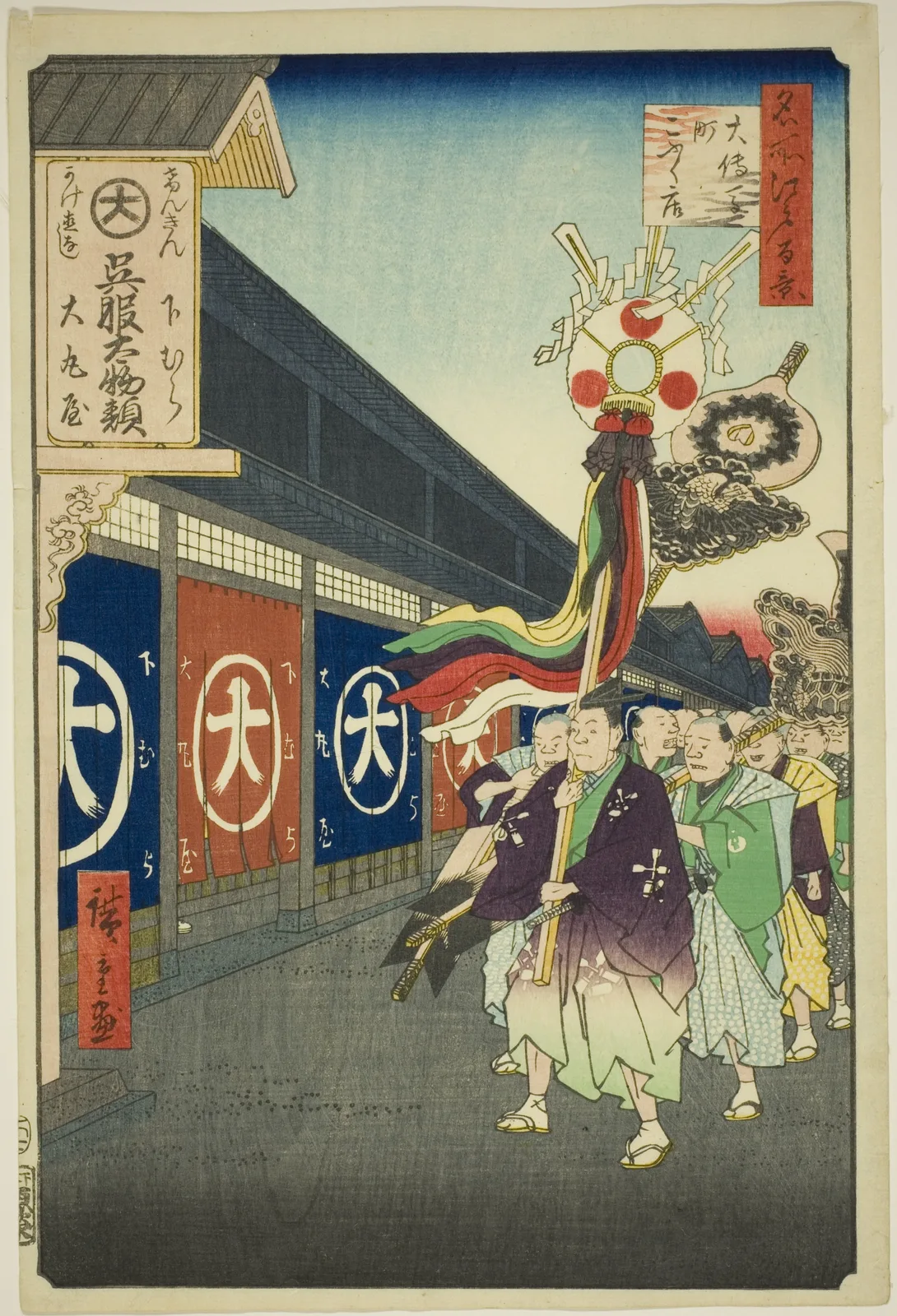
Silk-goods Lane, Odenma-cho
名所江戸百景 大伝馬町こふく店
A procession carrying celebratory decorations passes in front of the large dry-goods store Daimaruya in Odenma-cho. Navy and red noren curtains dyed with the character "Dai" line the shop, and men in matching haori coats walk along looking festive.
- Artist
- Utagawa Hiroshige
- Date
- July 1858 (Ansei 5)
- Medium / format
- Woodblock print (ukiyo-e)
- Series
- One Hundred Famous Views of Edo 119 prints
- Place depicted
- Odenmacho(Tokyo)
About this work
On the left, the long shopfront of Daimaruya extends into the distance. The signboard under the eaves reads "silk and cotton goods," and the navy and red noren are dyed with a large "Dai" inside a circle. In the middle of the street, men carrying decorations with fans and ritual paper wands held high advance, and a similar party follows behind.
The strong navy and vermilion of the noren and the purple and green of the men's haori stand out vividly against the gray ground and pale sky. The lines of the store's roof converge into the distance, emphasizing the length of the street and the size of the shop.
Odenma-cho was a district where wholesalers of cotton and silk goods gathered, and Daimaruya was its leading firm. The procession is said to celebrate the raising of the ridgepole of the shop rebuilt after the great Ansei earthquake, and the men are thought to be firefighter chiefs carrying congratulatory gifts. It conveys the recovery of Edo.
In a series centered on famous sights, this lively scene of a celebratory party moving in front of a large store is a rare picture of a townspeople's event. The device of showing the noren emblem large is thought also to have carried the meaning of advertising the shop.
The place today
Odenma-cho is now Nihonbashi-Odenmacho in Chuo Ward, and traces of its history as a textile wholesale district remain. Daimaru closed its Tokyo store at the end of the Meiji era but returned after the war by opening a store at the Yaesu exit of Tokyo Station. Buildings line the street, and nothing of the large Edo-period shopfronts survives.
Where can I see it?
Exhibitions change over time. Check each museum's exhibition information before you visit.
Museums that hold this work
- Tokyo National MuseumMuseum's page for this work (opens in a new tab)
Taito City, Tokyo Accession no. A-12499-393
- National Diet LibraryMuseum's page for this work (opens in a new tab)
Chiyoda City, Tokyo Accession no. 寄別1-8-2-1イ
Another impression is held under Yoribetsu 1-8-2-1 (https://dl.ndl.go.jp/pid/1312310)
Museums abroad
- Art Institute of ChicagoMuseum's page for this work (opens in a new tab)
Chicago Accession no. 1925.3730
- Brooklyn MuseumMuseum's page for this work (opens in a new tab)
New York Accession no. 30.1478.74
Frequently asked questions
- Who painted One Hundred Famous Views of Edo: Silk-goods Lane, Odenma-cho, and when?
- One Hundred Famous Views of Edo: Silk-goods Lane, Odenma-cho is by Utagawa Hiroshige, made in July 1858 (Ansei 5). Medium: Woodblock print (ukiyo-e).
- What place does One Hundred Famous Views of Edo: Silk-goods Lane, Odenma-cho show?
- It shows Odenmacho (Tokyo).
- Where can I see One Hundred Famous Views of Edo: Silk-goods Lane, Odenma-cho?
- It is held by Tokyo National Museum, National Diet Library. Exhibitions change, so check each museum's information before you visit.
Sources and references
- Art Institute of Chicago: Silk-goods Lane, Odenma-cho (Odenma-cho gofukudana) (opens in a new tab) (checked 2026-10-19)
- Brooklyn Museum: Silk-Goods Lane, Odenma-cho, No. 74 from One Hundred Famous Views of Edo (opens in a new tab) (checked 2026-10-19)
- ColBase(東京国立博物館): 名所江戸百景 大伝馬町こふく店 (opens in a new tab) (checked 2026-10-19)
- 国立国会図書館デジタルコレクション: 名所江戸百景 大伝馬町こふく店 (opens in a new tab) (checked 2026-10-19)
You may also like
More from Tokyo
Discover more of the same region on our sister sites.