One Hundred Famous Views of Edo ・ 43
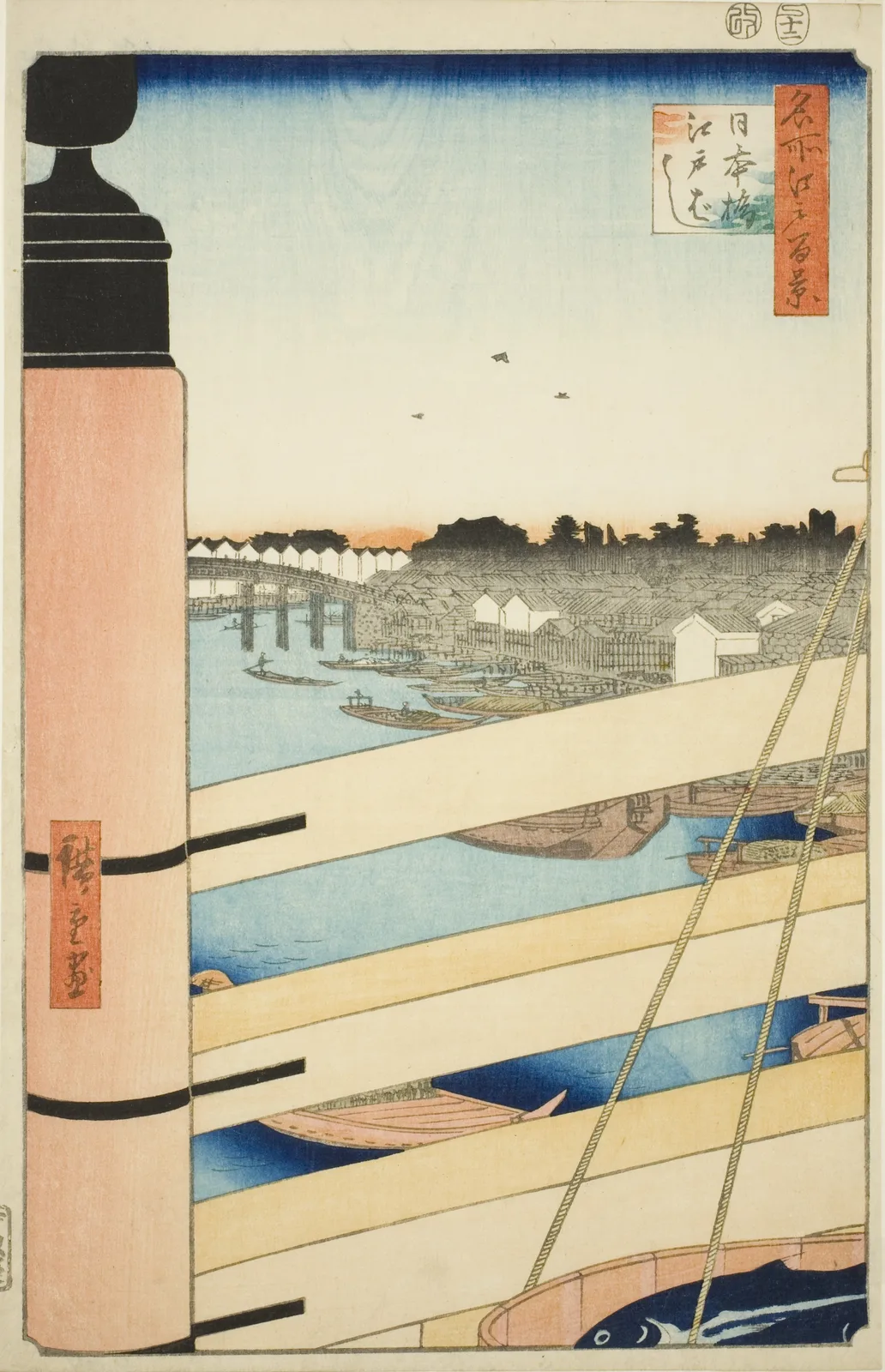
Nihon Bridge and Edo Bridge
名所江戸百景 日本橋江戸ばし
This print views the Nihonbashi River and Edobashi downstream through the railing and giboshi finials of Nihonbashi. A bonito tub carried on a pole passes in the foreground, and white-walled storehouses along the river and boats coming and going convey the summer vitality of Edo's commercial center.
- Artist
- Utagawa Hiroshige
- Date
- December 1857 (Ansei 4)
- Medium / format
- Woodblock print (ukiyo-e)
- Series
- One Hundred Famous Views of Edo 119 prints
- Place depicted
- Nihonbashi(Tokyo)
About this work
At front left a main post of Nihonbashi topped with a giboshi finial stands large, and a plain-wood railing runs diagonally across the bottom of the picture. At lower right a tub holding bonito and the rope of the carrying pole peek in. Between the railing posts the Nihonbashi River can be seen with cargo boats lined up, and farther back Edobashi and a bank lined with white-walled storehouses continue.
Placing the main post and railing extremely large in the foreground and letting the scenery show through the gaps is the composition. The pale crimson of the post, the plain wood of the railing and the blue of the river contrast vividly, and the sky is gradated deep indigo at the top and pale white below.
Nihonbashi was the starting point of the five great highways, and at the north end of the bridge stood the fish market, where large quantities of fish were landed every morning. The first bonito of the season, which appeared in early summer, was a first-of-the-season delicacy that Edoites competed to buy at high prices, and the bonito in the tub is thought to indicate that season.
This is the first print of the Summer section. Showing Nihonbashi not by the famous place itself but by part of the bridge and goods for sale is one of the typical examples of the series' bold close-up compositions. Small birds flying in the sky add the brightness of a morning at the riverbank.
The place today
The stone bridge built in 1911 is still in use as Nihonbashi and is designated an Important Cultural Property. An expressway covers it directly overhead, though work to move it underground is under way. Edobashi also still spans the river on Showa-dori, and a monument stands at the site of the fish market.
Where can I see it?
Exhibitions change over time. Check each museum's exhibition information before you visit.
Museums that hold this work
- Tokyo National MuseumMuseum's page for this work (opens in a new tab)
Taito City, Tokyo Accession no. A-12499-361
- National Diet LibraryMuseum's page for this work (opens in a new tab)
Chiyoda City, Tokyo Accession no. 寄別1-8-2-1イ
Museums abroad
- Art Institute of ChicagoMuseum's page for this work (opens in a new tab)
Chicago Accession no. 1965.1038
Frequently asked questions
- Who painted One Hundred Famous Views of Edo: Nihon Bridge and Edo Bridge, and when?
- One Hundred Famous Views of Edo: Nihon Bridge and Edo Bridge is by Utagawa Hiroshige, made in December 1857 (Ansei 4). Medium: Woodblock print (ukiyo-e).
- What place does One Hundred Famous Views of Edo: Nihon Bridge and Edo Bridge show?
- It shows Nihonbashi (Tokyo).
- Where can I see One Hundred Famous Views of Edo: Nihon Bridge and Edo Bridge?
- It is held by Tokyo National Museum, National Diet Library. Exhibitions change, so check each museum's information before you visit.
Sources and references
- Art Institute of Chicago: Nihon Bridge and Edo Bridge (Nihonbashi, Edobashi), from the series "One Hundred Famous Views of Edo (Meisho Edo hyakkei)" (opens in a new tab) (checked 2026-10-19)
- ColBase(東京国立博物館): 名所江戸百景 日本橋江戸ばし (opens in a new tab) (checked 2026-10-19)
- 国立国会図書館デジタルコレクション: 名所江戸百景 日本橋江戸ばし (opens in a new tab) (checked 2026-10-19)
You may also like
More from Tokyo
Discover more of the same region on our sister sites.