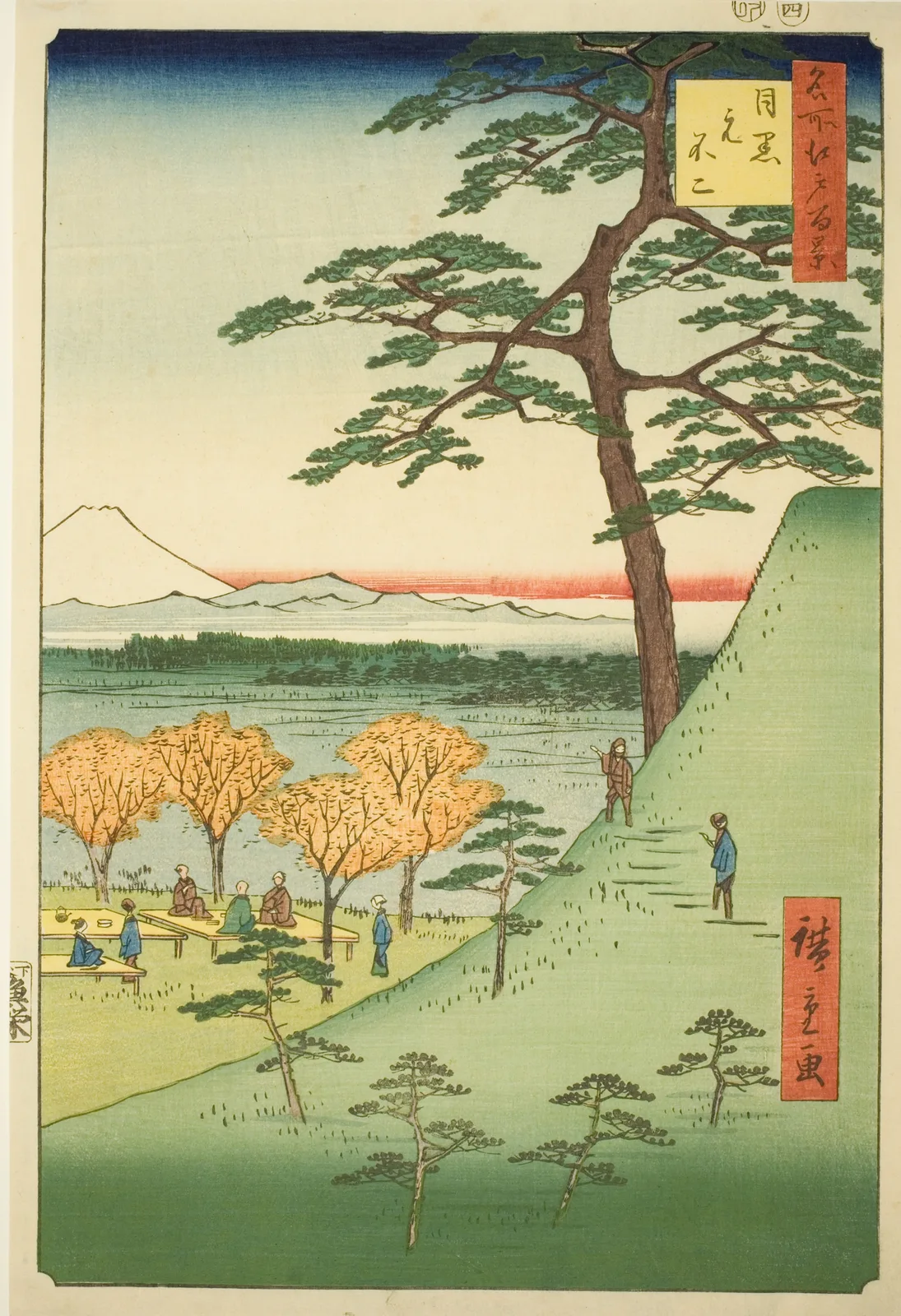
One Hundred Famous Views of Edo ・ 25
Original Fuji, Meguro
名所江戸百景 目黒元不二
This print shows Moto-Fuji, the Fuji mound built by the Fuji confraternity of Meguro village, with its green flank taking up much of the picture. Beyond people enjoying the view on and at the foot of the mound, the real Mount Fuji floats white, inviting a comparison of the two Fujis.
- Artist
- Utagawa Hiroshige
- Date
- April 1857 (Ansei 4)
- Medium / format
- Woodblock print (ukiyo-e)
- Series
- One Hundred Famous Views of Edo 119 prints
- Place depicted
- Meguro(Tokyo)
- Seen in the distance
- Mount Fuji
About this work
The green slope pressing in from the right is the Moto-Fuji mound, and people climb it among young pines. On the flat ground at left, benches stand in a row under trees turning color, where worshippers sit down. Beyond lie the fields and woods of Meguro, and in the distance snow-capped Mount Fuji rises.
The ridgeline of the mound cutting diagonally across the picture and a large pine rising straight upward form the framework of the composition. Green gradation expresses the roundness of the mound, and the red band on the horizon and the white of Fuji convey clear air. The placement of the tiny figures shows the height of the mound well.
Moto-Fuji was a mound about 12 meters high built in 1812 (Bunka 9) by members of the Fuji confraternity of Meguro village, and a Sengen shrine is said to have been enshrined at its top. It was believed that climbing a mound brought the same blessings as a pilgrimage to Fuji, and such Fuji mounds were built in various parts of Edo. After a new Fuji mound was built nearby, this one came to be called Moto-Fuji, the Original Fuji.
Although it belongs to the Spring section, the trees in the foreground appear tinted yellow and orange, an unusual coloring for a spring print. The series also includes New Fuji, Meguro, depicting the new Fuji mound in the same Meguro, so the two mounds are thought to have been meant to be compared.
The place today
The shrine buildings on the Moto-Fuji mound were removed in 1878 (Meiji 11), and today only an explanatory sign marking the site stands at the top of Mekirizaka in Kami-Meguro 1-chome, Meguro Ward. The stone monuments from the mound are said to have been moved to Hikawa Shrine in Ohashi, and the surroundings are a quiet residential area close to Daikanyama.
Where can I see it?
Exhibitions change over time. Check each museum's exhibition information before you visit.
Museums that hold this work
- Tokyo National MuseumMuseum's page for this work (opens in a new tab)
Taito City, Tokyo Accession no. A-12499-343
- National Diet LibraryMuseum's page for this work (opens in a new tab)
Chiyoda City, Tokyo Accession no. 寄別1-8-2-1イ
Museums abroad
- Art Institute of ChicagoMuseum's page for this work (opens in a new tab)
Chicago Accession no. 1939.1403
Frequently asked questions
- Who painted One Hundred Famous Views of Edo: Original Fuji, Meguro, and when?
- One Hundred Famous Views of Edo: Original Fuji, Meguro is by Utagawa Hiroshige, made in April 1857 (Ansei 4). Medium: Woodblock print (ukiyo-e).
- What place does One Hundred Famous Views of Edo: Original Fuji, Meguro show?
- It shows Meguro (Tokyo).
- Where can I see One Hundred Famous Views of Edo: Original Fuji, Meguro?
- It is held by Tokyo National Museum, National Diet Library. Exhibitions change, so check each museum's information before you visit.
Sources and references
- Art Institute of Chicago: Original Fuji, Meguro (Meguro Moto-Fuji), from the series "One Hundred Famous Views of Edo (Meisho Edo hyakkei)" (opens in a new tab) (checked 2026-10-19)
- ColBase(東京国立博物館): 名所江戸百景 目黒元不二 (opens in a new tab) (checked 2026-10-19)
- 国立国会図書館デジタルコレクション: 名所江戸百景 目黒元不二 (opens in a new tab) (checked 2026-10-19)
You may also like
More from Tokyo
Discover more of the same region on our sister sites.