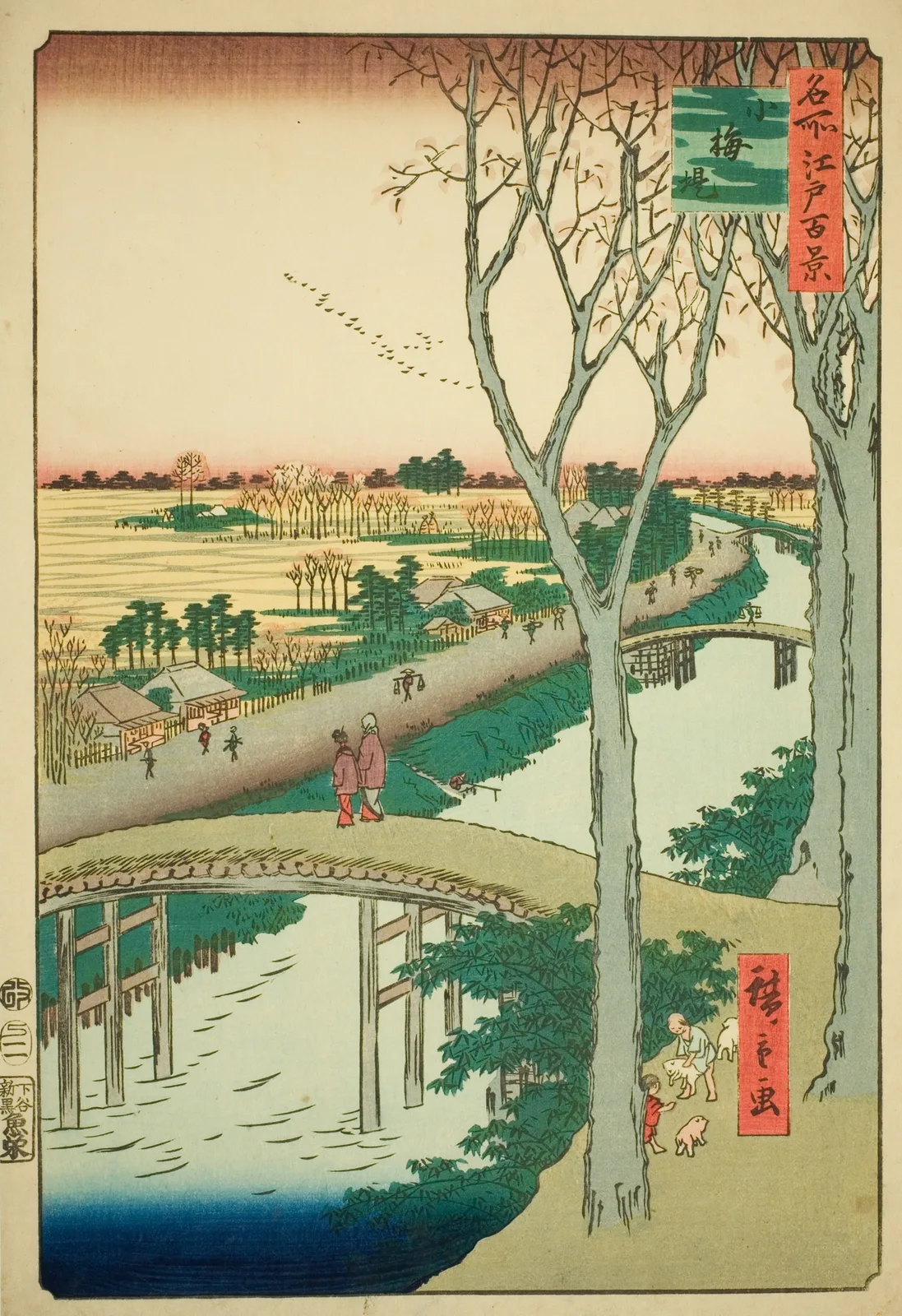
One Hundred Famous Views of Edo ・ 104
Koume Embankment
名所江戸百景 小梅堤
An irrigation channel in Koume Village in Mukojima and the embankment path beside it, seen through winter-bare trees. The winding channel leading into the distance and the peaceful village houses are gathered in gentle colors.
- Artist
- Utagawa Hiroshige
- Date
- February 1857 (Ansei 4)
- Medium / format
- Woodblock print (ukiyo-e)
- Series
- One Hundred Famous Views of Edo 119 prints
- Place depicted
- Koume(Tokyo)
About this work
Two slender bare trees stand in the foreground, and beneath them a waterway flows, curving into the distance. On the embankment path at right are people walking together, a child, and a dog, and a wooden bridge spans the foreground. Beyond the channel, fields, farmhouses, and trees spread out, and a line of geese crosses the sky.
The gray of the bare trees, the pale blue of the channel, and the young-grass green of the embankment are in gentle harmony. A bridge is placed in both the foreground and the background, and the curve of the channel leads the eye into the distance.
Koume Village was a farming village that spread across the area of today's Mukojima and Oshiage, east of the Sumida River, and was a suburb that Edo residents visited to enjoy the charm of the countryside. The channel is the Yotsugi-dori Irrigation Canal (Hikifune River), and the name Hikifune is said to have come from boats being towed by ropes to carry people.
Although it belongs to the winter section, its soft colors evoke the quiet of the suburbs as they await spring. The same canal is also depicted in the spring print "Towboats along the Yotsugidori Canal." The breadth of this series is shown by its choice of an everyday suburban path where Edo people enjoyed strolling rather than a showy famous site.
The place today
The Hikifune River was filled in by the mid-Showa period and is now a road called Hikifune-kawa-dori. The name Koume has also disappeared from the town names, but it survives in the names of elementary schools and other places near Tokyo Skytree in Sumida Ward. This is the area at the foot of Tokyo Skytree.
Where can I see it?
Exhibitions change over time. Check each museum's exhibition information before you visit.
Museums that hold this work
- Tokyo National MuseumMuseum's page for this work (opens in a new tab)
Taito City, Tokyo Accession no. A-12499-423
- National Diet LibraryMuseum's page for this work (opens in a new tab)
Chiyoda City, Tokyo Accession no. 寄別1-8-2-1イ
Museums abroad
- Art Institute of ChicagoMuseum's page for this work (opens in a new tab)
Chicago Accession no. 1939.1493
Frequently asked questions
- Who painted One Hundred Famous Views of Edo: Koume Embankment, and when?
- One Hundred Famous Views of Edo: Koume Embankment is by Utagawa Hiroshige, made in February 1857 (Ansei 4). Medium: Woodblock print (ukiyo-e).
- What place does One Hundred Famous Views of Edo: Koume Embankment show?
- It shows Koume (Tokyo).
- Where can I see One Hundred Famous Views of Edo: Koume Embankment?
- It is held by Tokyo National Museum, National Diet Library. Exhibitions change, so check each museum's information before you visit.
Sources and references
- Art Institute of Chicago: Koume Embankment (Koumezutsumi), from the series "One Hundred Famous Views of Edo (Meisho Edo hyakkei)" (opens in a new tab) (checked 2026-10-19)
- ColBase(東京国立博物館): 名所江戸百景 小梅堤 (opens in a new tab) (checked 2026-10-19)
- 国立国会図書館デジタルコレクション: 名所江戸百景 小梅堤 (opens in a new tab) (checked 2026-10-19)
- Wikipedia: One Hundred Famous Views of Edo (opens in a new tab) (checked 2026-10-19)
You may also like
More from Tokyo
Discover more of the same region on our sister sites.