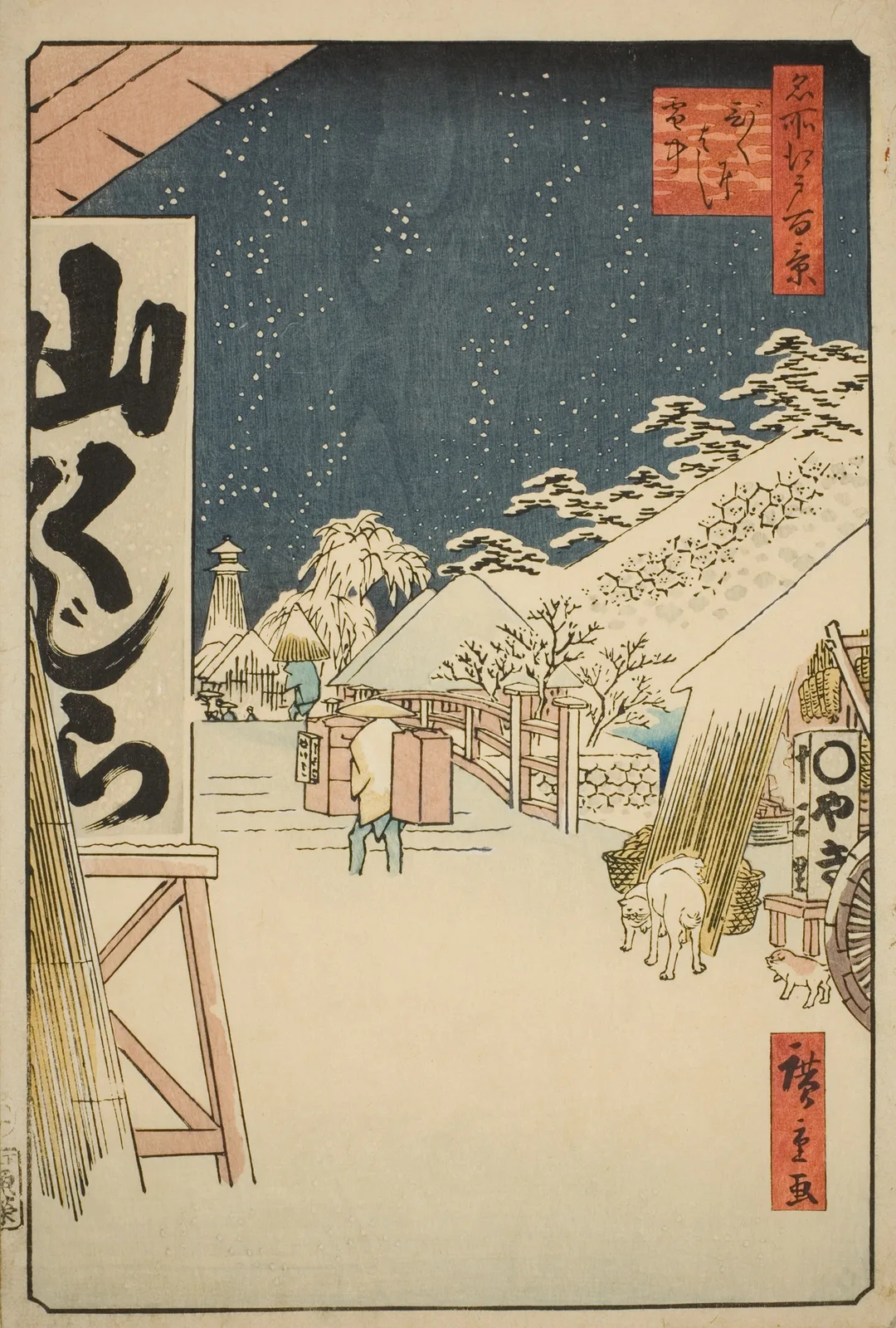
One Hundred Famous Views of Edo ・ 114
Bikuni Bridge in Snow
名所江戸百景 びくにはし雪中
The foot of Bikuni Bridge in snow, seen past a large "Yamakujira" signboard. The snow-covered stone embankment and bridge, a man walking with a load, and the sign of a roast-sweet-potato shop vividly convey the daily life of the winter town.
- Artist
- Utagawa Hiroshige
- Date
- October 1858 (Ansei 5)
- Medium / format
- Woodblock print (ukiyo-e)
- Series
- One Hundred Famous Views of Edo 119 prints
- Place depicted
- Kyobashi(Tokyo)
About this work
At lower left stands a signboard with "Yamakujira" written large, and at lower right are the signboard of a roast-sweet-potato shop reading "maru-yaki" and a snow-covered roof. Between them a man carrying a load walks the snowy road, and in the distance are Bikuni Bridge and the snow-laden stone walls and trees along the moat. Large flakes of snow fall from a navy sky.
The contrast between white snow and deep navy sky is strong, and the black characters on the signboards lend the picture strength. Enclosing both sides with the foreground signboard and roof, the composition looks through the gap to the bridge and embankment beyond.
Bikuni Bridge was a bridge that spanned the area where the outer moat and the Kyobashi River joined. "Yamakujira" ("mountain whale") means wild boar meat and was the signboard of a shop serving it as medicinal eating in Edo, where eating the meat of beasts was officially avoided. Roast sweet potatoes were also a favorite winter treat of the common people. In its device of letting signboards alone speak of the town's food, one can see the fine attention paid to the lives of Edo people.
Its censor's seal gives October 1858 (Ansei 5), making it a print issued after the death of the first Hiroshige. From the composition with its wide-open foreground and the way the snow is drawn, a theory that the second Hiroshige's hand is involved is strongly held, though the holding museums attribute it to the first.
The place today
The outer moat and the Kyobashi River were filled in after the war, and the site of Bikuni Bridge is in the area of today's Ginza 1-chome and Kyobashi in Chuo Ward, with an expressway running above it. No trace of the bridge remains, but the Kyobashi bridge pillars survive nearby, and the name Kyobashi is carried on in the district and station names.
Where can I see it?
Exhibitions change over time. Check each museum's exhibition information before you visit.
Museums that hold this work
- Tokyo National MuseumMuseum's page for this work (opens in a new tab)
Taito City, Tokyo Accession no. A-12499-433
- National Diet LibraryMuseum's page for this work (opens in a new tab)
Chiyoda City, Tokyo Accession no. 寄別1-8-2-1イ
Museums abroad
- Art Institute of ChicagoMuseum's page for this work (opens in a new tab)
Chicago Accession no. 1925.3760
Frequently asked questions
- Who painted One Hundred Famous Views of Edo: Bikuni Bridge in Snow, and when?
- One Hundred Famous Views of Edo: Bikuni Bridge in Snow is by Utagawa Hiroshige, made in October 1858 (Ansei 5). Medium: Woodblock print (ukiyo-e).
- What place does One Hundred Famous Views of Edo: Bikuni Bridge in Snow show?
- It shows Kyobashi (Tokyo).
- Where can I see One Hundred Famous Views of Edo: Bikuni Bridge in Snow?
- It is held by Tokyo National Museum, National Diet Library. Exhibitions change, so check each museum's information before you visit.
Sources and references
- Art Institute of Chicago: Bikuni Bridge in Snow (Bikunibashi setchu), from the series "One Hundred Famous Views of Edo (Meisho Edo hyakkei)" (opens in a new tab) (checked 2026-10-19)
- ColBase(東京国立博物館): 名所江戸百景 びくにはし雪中 (opens in a new tab) (checked 2026-10-19)
- 国立国会図書館デジタルコレクション: 名所江戸百景 びくにはし雪中 (opens in a new tab) (checked 2026-10-19)
- Wikipedia: One Hundred Famous Views of Edo (opens in a new tab) (checked 2026-10-19)
You may also like
More from Tokyo
Discover more of the same region on our sister sites.