One Hundred Famous Views of Edo ・ 31
The Entwined Camphor Trees at Azuma Shrine
名所江戸百景 吾嬬の森連理の梓
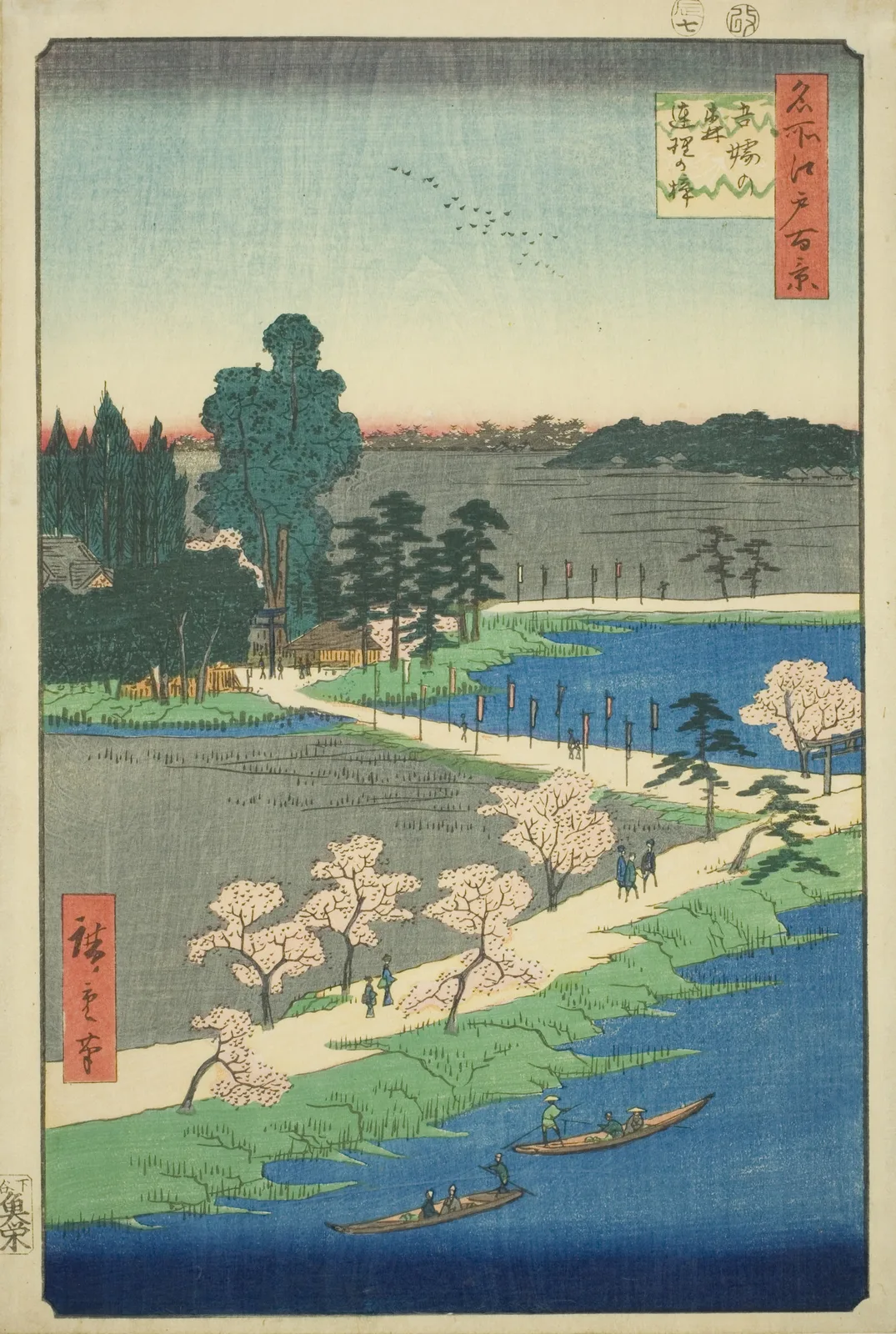
This print views from afar Azuma Gongen shrine in the grove called Azuma no Mori, east of Mukojima, and its sacred entwined tree. A cherry-lined embankment and waterway, and an approach lined with banners, lead to a grove rising in a mound among the fields, a pastoral spring scene.
- Artist
- Utagawa Hiroshige
- Date
- July 1856 (Ansei 3)
- Medium / format
- Woodblock print (ukiyo-e)
- Series
- One Hundred Famous Views of Edo 119 prints
- Place depicted
- Azuma Shrine(Tokyo)
About this work
Two boats move along the waterway in the foreground, and cherries bloom on the embankment bank where people walk. The embankment road bends at the back and becomes an approach lined with red banners leading to the grove at left. Rising especially tall in the grove is the entwined tree, with the roof of a shrine visible beneath it. Geese fly in a line across the sky.
The blue waterway and the white embankment road lead the eye back through the picture in diagonal bends. The gray-green of the fields, the pale crimson of the cherries and the deep green of the grove form layers, and the red band at the horizon conveys distance. The line of geese shows the breadth of the sky and adds the calm air of a spring dusk.
Azuma no Mori is today's Azuma Shrine, said to enshrine Princess Ototachibana, who threw herself into the sea during the eastern campaign of Yamato Takeru. In the precincts stood a camphor tree with two trunks drawing together from a single root, which drew worship as a lucky tree for marital harmony. The title writes it as azusa, but it is said to have actually been a camphor tree.
This print belongs to the Spring section. Placing the sacred tree of a famous place as the protagonist but small in the distance, with the pilgrimage route in front, is a composition often seen in prints of suburban famous places.
The place today
Azuma Shrine still stands in Tachibana 1-chome, Sumida Ward. The entwined camphor has withered, and only its roots and part of the trunk are said to remain in the precincts. The surrounding fields and waterways have turned into a district of housing and factories, and the shrine's small grove keeps a trace of the former Azuma no Mori.
Where can I see it?
Exhibitions change over time. Check each museum's exhibition information before you visit.
Museums that hold this work
- Tokyo National MuseumMuseum's page for this work (opens in a new tab)
Taito City, Tokyo Accession no. A-12499-349
- National Diet LibraryMuseum's page for this work (opens in a new tab)
Chiyoda City, Tokyo Accession no. 寄別1-8-2-1イ
Museums abroad
- Art Institute of ChicagoMuseum's page for this work (opens in a new tab)
Chicago Accession no. 1925.3755
Frequently asked questions
- Who painted One Hundred Famous Views of Edo: The Entwined Camphor Trees at Azuma Shrine, and when?
- One Hundred Famous Views of Edo: The Entwined Camphor Trees at Azuma Shrine is by Utagawa Hiroshige, made in July 1856 (Ansei 3). Medium: Woodblock print (ukiyo-e).
- What place does One Hundred Famous Views of Edo: The Entwined Camphor Trees at Azuma Shrine show?
- It shows Azuma Shrine (Tokyo).
- Where can I see One Hundred Famous Views of Edo: The Entwined Camphor Trees at Azuma Shrine?
- It is held by Tokyo National Museum, National Diet Library. Exhibitions change, so check each museum's information before you visit.
Sources and references
- Art Institute of Chicago: The Entwined Camphor Trees at Azuma Shrine (Azuma no mori Renri no azusa), from the series "One Hundred Famous Views of Edo (Meisho Edo hyakkei)" (opens in a new tab) (checked 2026-10-19)
- ColBase(東京国立博物館): 名所江戸百景 吾嬬の森連理の梓 (opens in a new tab) (checked 2026-10-19)
- 国立国会図書館デジタルコレクション: 名所江戸百景 吾嬬の森連理の梓 (opens in a new tab) (checked 2026-10-19)
You may also like
More from Tokyo
Discover more of the same region on our sister sites.