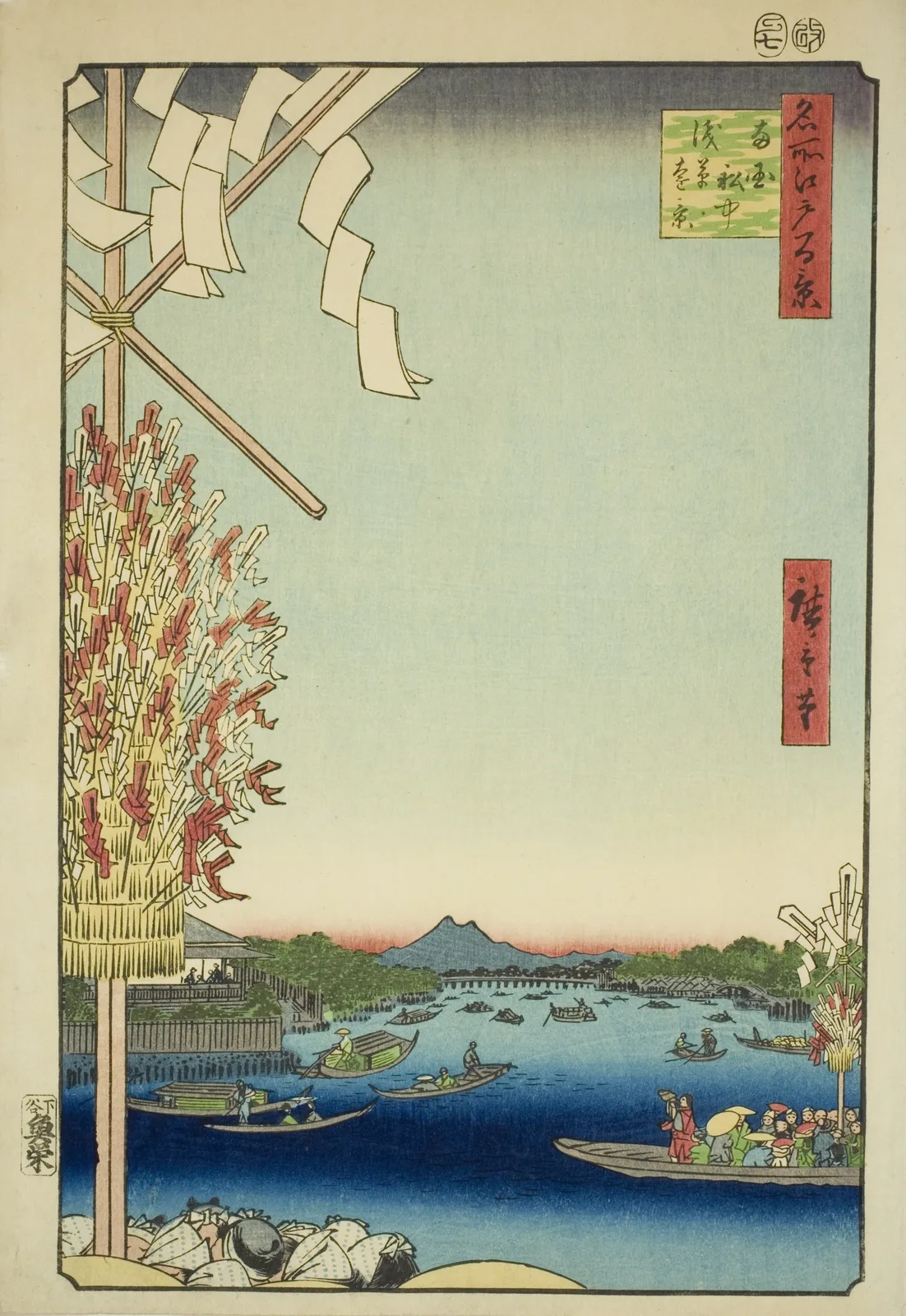
One Hundred Famous Views of Edo ・ 60
Asakusa River, Great Riverbank, Miyato River
名所江戸百景 浅草川大川端宮戸川
Pilgrims setting out for Oyama purify themselves in the Sumida River in this picture. In the foreground stands a large votive bonten, and beyond the river Azuma Bridge and Mount Tsukuba can be seen. It conveys the faith and travel pleasures of Edo commoners.
- Artist
- Utagawa Hiroshige
- Date
- July 1857 (Ansei 4)
- Medium / format
- Woodblock print (ukiyo-e)
- Series
- One Hundred Famous Views of Edo 119 prints
- Place depicted
- Sumida River(Tokyo)
- Seen in the distance
- Mount Tsukuba
About this work
At the left of the picture, a bonten made of bundled red and white paper and a pole hung with paper streamers project large from the top. Hats are lined up at the water's edge in front, and at lower right floats a boat carrying people shouldering wooden votive swords. Small boats pass on the river, and in the distance Azuma Bridge appears with the twin-peaked Mount Tsukuba rising beyond. People rest on the second floor of a teahouse on the bank.
The red and white of the bonten, the deep blue of the river, and the pale sky are vividly contrasted. By leaving the upper half of the picture wide open and cutting off the bonten in the foreground at the edge of the frame, the artist emphasizes the broad river and the distant mountain.
The Oyama pilgrimage was a journey to Oyama in Sagami, which Edo craftsmen made in summer in organized confraternities. Before departure they are said to have purified themselves in the Sumida River and set out carrying votive wooden swords. Asakusa River, Okawabata, and Miyato River are all names for the Sumida River. A trip with fellow members of the confraternity was both a religious act and an enjoyable outing.
This print belongs to the summer section, and its censor's seal dates it to the seventh month of Ansei 4 (1857). The composition of placing festival or pilgrimage figures large in the foreground and setting the famous scenery behind is used repeatedly in the series.
The place today
Both banks of the Sumida River now have the Sumida River Terrace promenade, from which one can see Azuma Bridge from Asakusa and Tokyo Skytree. The Oyama pilgrimage continues today, and Oyama Afuri Shrine in Isehara, Kanagawa Prefecture, receives many worshippers at the summer mountain opening. Summer festivals are still held along the river.
Where can I see it?
Exhibitions change over time. Check each museum's exhibition information before you visit.
Museums that hold this work
- Tokyo National MuseumMuseum's page for this work (opens in a new tab)
Taito City, Tokyo Accession no. A-12499-372
- National Diet LibraryMuseum's page for this work (opens in a new tab)
Chiyoda City, Tokyo Accession no. 寄別1-8-2-1イ
- National Diet LibraryMuseum's page for this work (opens in a new tab)
Chiyoda City, Tokyo Accession no. 寄別1-8-2-1
Museums abroad
- Art Institute of ChicagoMuseum's page for this work (opens in a new tab)
Chicago Accession no. 1939.1419
Frequently asked questions
- Who painted One Hundred Famous Views of Edo: Asakusa River, Great Riverbank, Miyato River, and when?
- One Hundred Famous Views of Edo: Asakusa River, Great Riverbank, Miyato River is by Utagawa Hiroshige, made in July 1857 (Ansei 4). Medium: Woodblock print (ukiyo-e).
- What place does One Hundred Famous Views of Edo: Asakusa River, Great Riverbank, Miyato River show?
- It shows Sumida River (Tokyo).
- Where can I see One Hundred Famous Views of Edo: Asakusa River, Great Riverbank, Miyato River?
- It is held by Tokyo National Museum, National Diet Library. Exhibitions change, so check each museum's information before you visit.
Sources and references
- Art Institute of Chicago: Asakusa River, Great Riverbank, Miyato River (Asakusagawa Okawabata Miyatogawa), from the series "One Hundred Famous Views of Edo (Meisho Edo hyakkei)" (opens in a new tab) (checked 2026-10-19)
- ColBase(東京国立博物館): 名所江戸百景 浅草川大川端宮戸川 (opens in a new tab) (checked 2026-10-19)
- Wikipedia: One Hundred Famous Views of Edo (opens in a new tab) (checked 2026-10-19)
You may also like
More from Tokyo
Discover more of the same region on our sister sites.