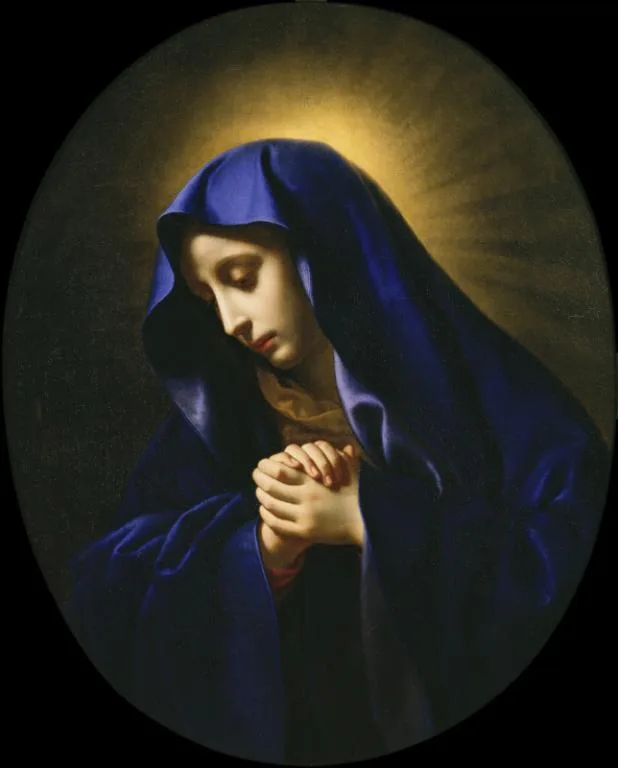
Mater dolorosa
悲しみの聖母
A painting of the Virgin by the seventeenth-century Florentine painter Carlo Dolci, with a pale halo set against a dark background. Its highlights are the deep blue mantle made with lapis lazuli and the beautiful yet sorrowful expression of the Virgin with her hands clasped.
- Artist
- Carlo Dolci
- Date
- c. 1655
- Medium / format
- Oil
About this work
Against a dark background, the Virgin's face and clasped hands emerge, and a pale ring of light (a halo) is painted behind her head. She lowers her eyes and prays quietly, as if holding back her grief. The deep blue of the mantle that wraps her body comes from paint made of lapis lazuli, a blue mineral, and sets off the whiteness of her skin.
Dolci painted this work around 1655, when he was about thirty-nine. According to Filippo Baldinucci, who wrote the painter's first detailed biography, Dolci was devout from childhood and belonged to a confraternity of Saint Benedict throughout his life. The pose with clasped hands goes back to Titian's depictions of the Virgin, and it is thought to draw also on a type of Virgin image favored in sixteenth- and seventeenth-century Spain.
For a long time the model was said to be his wife Teresa, whom he married in 1654, but doubts remain when the painting is compared with an autograph drawing of her. On the back of the canvas is written a Latin phrase meaning "Queen of Martyrs, pray for us." After being passed down in families including an English ducal house, it was purchased by the National Museum of Western Art in 1999.
Where can I see it?
Exhibitions change over time. Check each museum's exhibition information before you visit.
Museums that hold this work
- The National Museum of Western Art, TokyoMuseum's page for this work (opens in a new tab)
Taito City, Tokyo Accession no. P.1998-0002
Frequently asked questions
- Who painted Mater dolorosa, and when?
- Mater dolorosa is by Carlo Dolci, made in c. 1655. Medium: Oil.
- Where can I see Mater dolorosa?
- It is held by The National Museum of Western Art, Tokyo. Exhibitions change, so check each museum's information before you visit.
Sources and references
- 国立美術館所蔵作品総合目録検索システム ドルチ、カルロ《悲しみの聖母》 (opens in a new tab) (checked 2026-10-18)
- 国立西洋美術館 所蔵作品 悲しみの聖母 (opens in a new tab) (checked 2026-10-18)
More from Tokyo
Discover more of the same region on our sister sites.