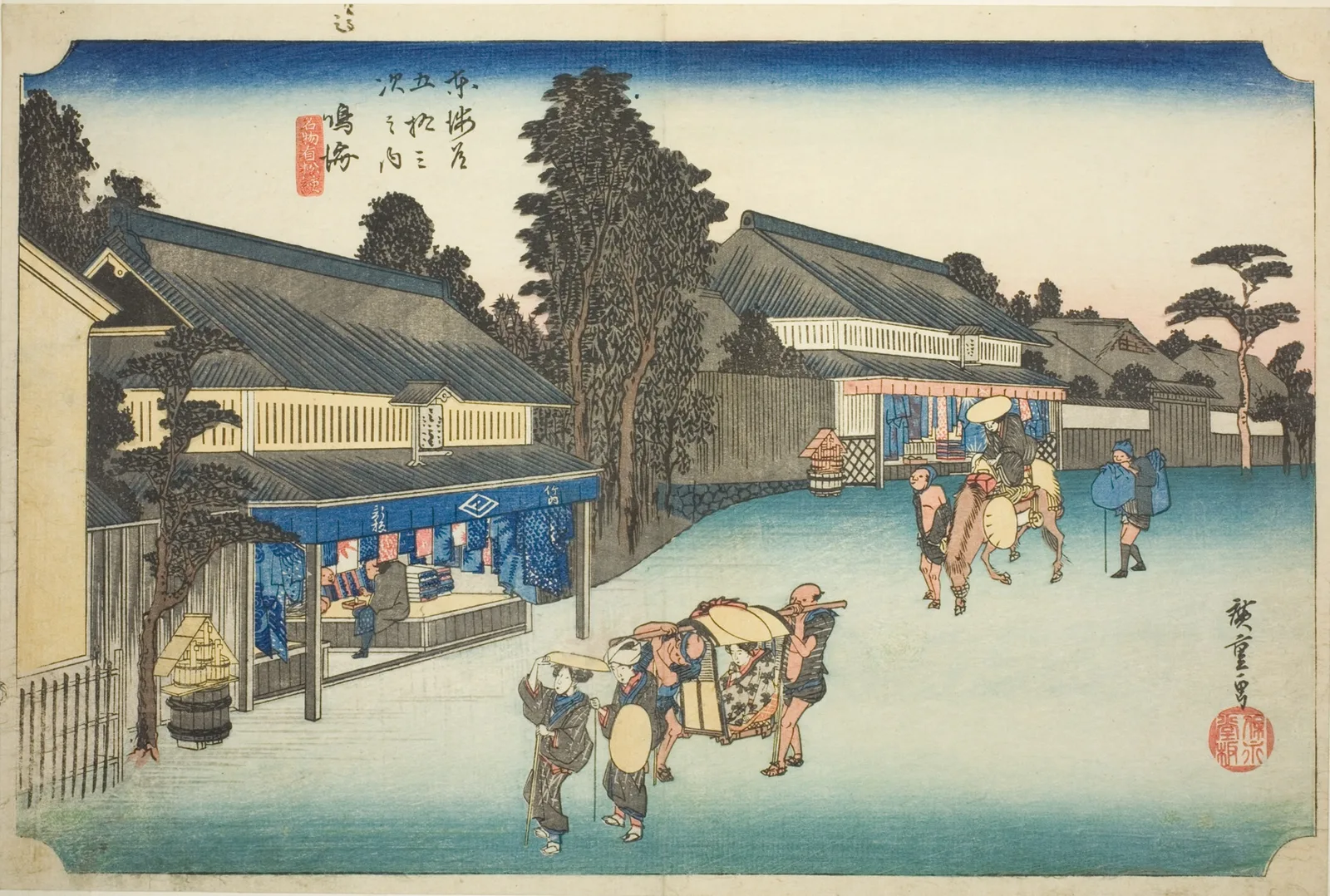
The Fifty-three Stations of the Tokaido (Hoeido edition) ・ 41
Famous Arimatsu Tie-dyed Fabrics at Narumi
東海道五拾三次之内 鳴海 名物有松絞
Travelers in palanquins and on horseback pass along a highway lined with shops selling Arimatsu shibori. The two-story shopfronts, with colorful shibori cloth hanging from the eaves, convey the prosperity of a village that flourished on tie-dyeing.
- Artist
- Utagawa Hiroshige
- Date
- c. 1833-34 (Tenpo 4-5)
- Medium / format
- Woodblock print (ukiyo-e)
- Series
- The Fifty-three Stations of the Tokaido (Hoeido edition) 55 prints
- Place depicted
- Narumi-juku(Aichi)
About this work
On the left of the street is a shop with colorful cloths hanging from its eaves. Further back another shop can be seen displaying cloth in the same way. Both sell Arimatsu shibori (tie-dyed cloth dyed in patterns by binding it), and have handsome two-story frontages. The shop roofs are large, and the white-walled second floors have lattice windows in a row. The shops facing the street are opened wide in front to display their goods.
In the shop in the foreground, a seated customer is deep in conversation with the shopkeeper. The Tokyo Fuji Art Museum points out that the noren curtain bears a pattern combining the characters of Hiroshige's Hiro. On the street are a palanquin, a woman traveler in a hat, and a traveler on horseback, who go on without a glance at the shops.
Arimatsu is a town between Narumi-juku and Chiryu-juku, opened in 1608 (Keicho 13) by the Owari domain. Shibori dyeing was devised as a souvenir for travelers going back and forth on the Tokaido and became a specialty. The title says Narumi, but what is drawn is the townscape of Arimatsu, the place of production of the specialty. Beyond, the road continues with houses and trees.
The place today
Along the Tokaido in Arimatsu, the residences of shibori merchants and townhouses continue for about 800 m. It was selected as a Nationally Important Preservation District for Groups of Traditional Buildings in 2016 (Heisei 28) and was also certified as a Japan Heritage site in 2019 (Reiwa 1). Houses with mushikomado windows and udatsu fire walls line the street.
Where can I see it?
Exhibitions change over time. Check each museum's exhibition information before you visit.
Museums that hold this work
- Tokyo National MuseumMuseum's page for this work (opens in a new tab)
Taito City, Tokyo Accession no. A-12499-46
Museums that hold this series (please check the museum's website for whether it holds this print)
- Shizuoka City Tokaido Hiroshige Museum of Art
Shimizu Ward, Shizuoka
All prints of the Hoeido edition were shown in the museum's collection exhibition Fifty-three Stations of the Tokaido (2024-25)
Museums abroad
- Art Institute of ChicagoMuseum's page for this work (opens in a new tab)
Chicago Accession no. 1925.3547
Frequently asked questions
- Who painted The Fifty-three Stations of the Tokaido: Famous Arimatsu Tie-dyed Fabrics at Narumi, and when?
- The Fifty-three Stations of the Tokaido: Famous Arimatsu Tie-dyed Fabrics at Narumi is by Utagawa Hiroshige, made in c. 1833-34 (Tenpo 4-5). Medium: Woodblock print (ukiyo-e).
- What place does The Fifty-three Stations of the Tokaido: Famous Arimatsu Tie-dyed Fabrics at Narumi show?
- It shows Narumi-juku (Aichi).
- Where can I see The Fifty-three Stations of the Tokaido: Famous Arimatsu Tie-dyed Fabrics at Narumi?
- It is held by Tokyo National Museum, Tokyo Fuji Art Museum, National Diet Library. Exhibitions change, so check each museum's information before you visit.
Sources and references
- Art Institute of Chicago: Narumi: Famous Tie-dyed Fabrics of Arimatsu (Narumi, meibutsu Arimatsu shibori) (opens in a new tab) (checked 2026-10-18)
- ColBase(東京国立博物館): A-12499-46 (opens in a new tab) (checked 2026-10-18)
- 東京富士美術館 収蔵品: 東海道五拾三次之内 鳴海 名物有松絞 (opens in a new tab) (checked 2026-10-18)
- 国立国会図書館デジタルコレクション: 東海道五拾三次 鳴海・〔名物有松絞〕 (opens in a new tab) (checked 2026-10-18)
You may also like
More from Aichi
Discover more of the same region on our sister sites.
Matsuri Biyori
Festivals in Aichi
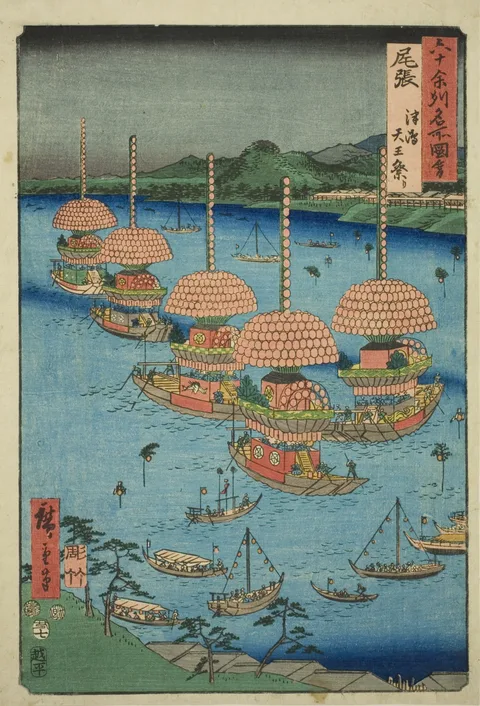
- Owari Tsushima Tenno Festival Danjiri-bune Boat Event
- Chiryu Dashi Bunraku and Karakuri
- Inuyama Festival Yama Float Event
- Kamezaki Shiohi Festival Float Event